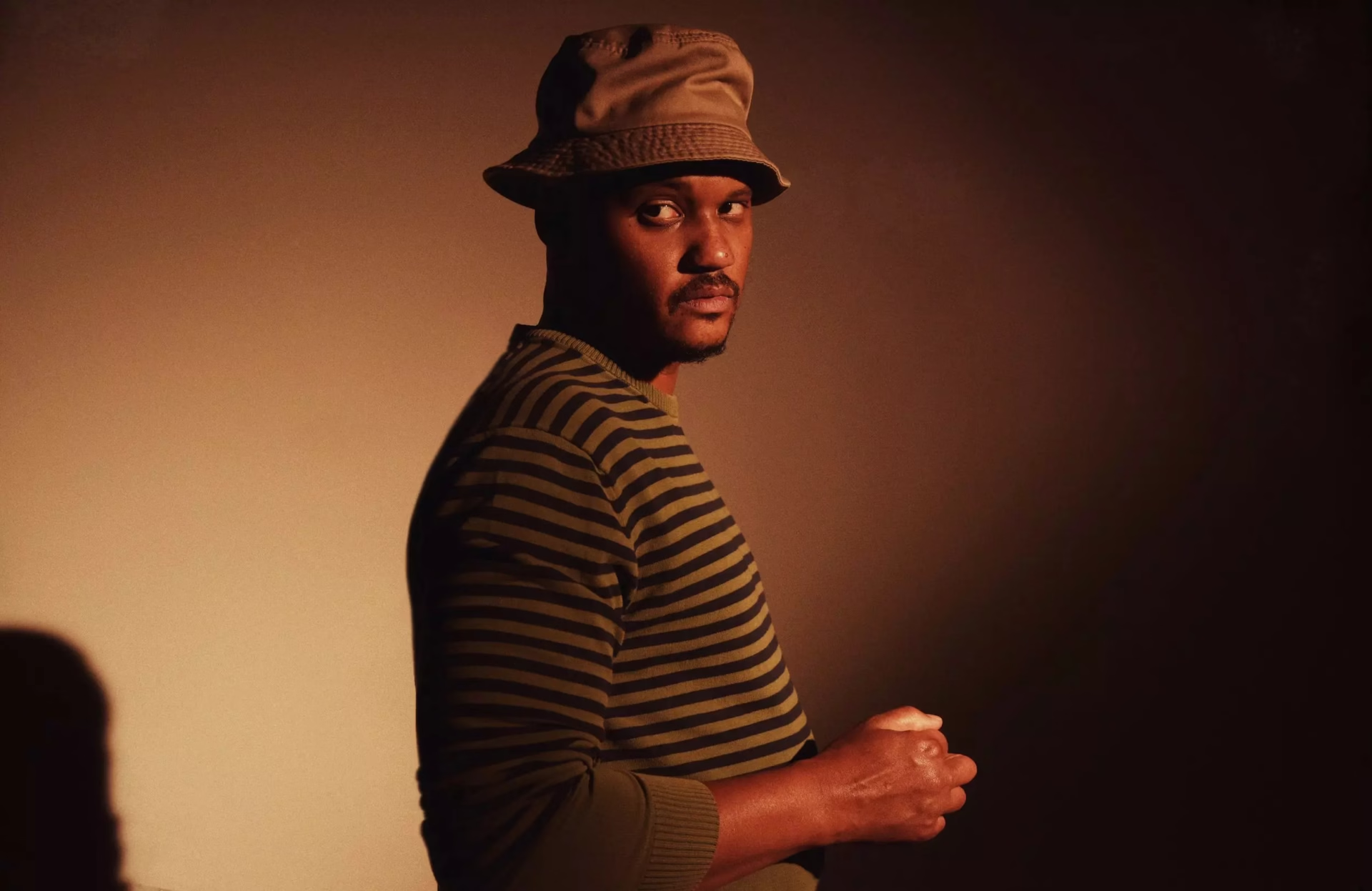
Being a musician is a bit like being a meteorologist: It's hard to predict the exact moment a creative expression will arrive, just like it’s hard to predict how much rain will come. When it does, though, it’s incredibly important to be prepared. R&B raconteur Son Little (real name Aaron Livingston) kept his songs on a hard drive, but just as the weather can change without notice, so can one's luck. Last summer as he was preparing to leave Philadelphia to finish writing his new album in Northern California wine country, the hard drive died. He lost everything. He had no back-up.
Naturally, Livingston was devastated. "I kind of thought I'll plug it back in tomorrow and it will work, but it didn’t," he recently told the Recording Academy. "I was depressed for about a week or so and then I just started facing the reality that I’m gonna have to cook up some new ideas because the show must go on," he added. So as the summer faded over Petaluma, Calif., Livington spent eight days penning a bunch of new tunes. He then took them to Paris and recorded at Studio Ferber —opened in 1973 just inside the Eastern Périphérique—with renowned French producer Renaud Letang (Manu Chao, Charlotte Gainsbourg, Feist).
While his first two albums, Son Little (2015) and New Magic (2017), were rooted in the blues and have a neat rock 'n roll swagger, aloha is soaked in smokey, mid-'60s soul. After producing his first two records himself and, in 2017, winning the Best American Roots Performance GRAMMY for producing Mavis Staples' "See That My Grave Is Kept Clean," this time with Letang behind the board Livingston was able to capture the duality of letting go of old feelings and embracing new ones. Losing his original demos, writing in solitude in California and living the French lifestyle for a few weeks all helped give aloha the smooth, laid-back vibe he had hoped for.
Livingston recently spoke to the Recording Academy about recording in Paris, writing music in the brittle Northern California woods, and testing his mettle with Philadelphia's legendary Roots crew. Our conversation has been condensed for clarity.
<style>.embed-container { position: relative; padding-bottom: 56.25%; height: 0; overflow: hidden; max-width: 100%; } .embed-container iframe, .embed-container object, .embed-container embed { position: absolute; top: 0; left: 0; width: 100%; height: 100%; }</style><div class='embed-container'><iframe src='https://www.youtube.com/embed/xLo0a_mKmx4' frameborder='0' allowfullscreen></iframe></div>
During your time at Studio Ferber in Paris, were you able to form a daily routine?
You know what, I had a blessing in disguise. When I first got there—on either the first or second day—I crashed out in an Uber and I left my phone in there. So I ended up riding the Metro instead of getting Ubers and I guess I did get into a routine, riding the Metro with the local folks every morning and blending in as much as I could. And their method of working is different to what I’m used to — [in the U.S.] folks tend to grind out these marathon sessions, whereas [in France] they’re really measured about how they do things. It’s like you get your lunch and go to your nine-to-five. We'd show up in the morning, have coffee, work until lunch, sit down and have a nice lunch together, then work until the evening and go home.
Places like Studio Ferber tend to have a lot of old instruments lying around. Were there any that you became particularly infatuated with?
It’s funny, a lot of studios you go to have 50 different vintage guitars and you can get lost among all the choices—you play the part on a '64 Strat and then you decide that maybe you should try it using the '67 ES-335 [Gibson guitar]. I went to play bass and Renaud said, "I think you’re going to love this bass." And he brings out this thing that probably weighs as much as I do. I forget the model, I think it was a '75 or '76 Gibson recording bass, but I had never seen one before. This thing was the heaviest guitar I have ever touched. It has this unusual sweeping EQ, almost like a phase inversion switch, that you would never see on most guitars. So I played this bass on pretty much every song and there was kind of this beauty, or simplicity, to that. I think we were probably two weeks in before I asked, "Is there another bass here?" I guess we could have found one, but we didn't need it. Over 25 years [Renaud] has come to feel that this is the best bass, so why not trust the guy that has been working there for two decades?
Up until this album you've produced all your own music. You've even won a GRAMMY for a song you produced for Mavis Staples. What did you gain by handing that responsibility to someone else?
I guess going in I had some concern that maybe there would be some trouble, but the positive aspect of having someone else in the control room objectively evaluating my performance was invaluable to me. One thing Renaud really excels at is getting a sense of an artist's intent. I think he really understood and appreciated what I was trying to do, what I wanted to get out of the music, and how I wanted it to sound, so he became like a watchdog for anything that I might do that he felt was working against my own wishes. It’s surprising how often you stray or get knocked off your square by overthinking or being overly critical of your own performance. I guess the demon that every performer deals with is doubt, that desire to be perfect, and sometimes that gets in the way of your real goal, which is to make something great. Having a second brain that was less critical than my own and even more focussed on the end goal was really just a beautiful experience.
<style>.embed-container { position: relative; padding-bottom: 56.25%; height: 0; overflow: hidden; max-width: 100%; } .embed-container iframe, .embed-container object, .embed-container embed { position: absolute; top: 0; left: 0; width: 100%; height: 100%; }</style><div class='embed-container'><iframe src='https://www.youtube.com/embed/jaZcnBog0Zs' frameborder='0' allowfullscreen></iframe></div>
You wrote the songs for aloha in a house and an adjacent barn in Petaluma, Calif. Can you describe that setting?
Well you know, it's very brown. Everything is sort of golden brown up there and unfortunately these past two summers it’s been very rough, the whole place is like kindling. At that time it felt like it was the last bit of summer—summer was kind of fading—and it’s a beautiful time to be in Sonoma County [wine country]. It’s not far from San Francisco, but that area is very open, it’s very rural. A lot of people thrive on the action of a city for their writing, but I've learned over the years that my creative process is really enhanced by solitude and silence. I only got about eight days this time—my hope is to always have more—but it was enough time to quiet my mind and fill the space with ideas.
The pace of this record is a little more laid back than your last two—it has more silence and you optimize that space beautifully. How much of that comes from the topics you sing about, and how much comes from external factors, such as writing the album in solitude in the summertime and having someone else produce it?
It's hard to say what’s more influential. I hear the environment in there, but I don't know if that's the dominant factor. I do think that a song like "suffer" was really waiting to emerge for me, and I think the same could be said for a lot of these songs—"About Her. Again" comes to mind. Both in the immediate aftermath of losing the drive and making the trip up to the country, it really opened up the space for me to have a more contemplative mood that made everything come together and make sense to me. Like I said, the stuff I was working on previously really didn’t have that mood at all. In hindsight, it’s hard for me to even imagine those songs being aloha. It’s hard for me to picture what that would have been like, it just wasn’t the right moment for it. I miss some of that stuff I did, but in a way I'm glad I lost it.
This album is about letting go of old feelings and learning to embrace new ones. Can you give any examples of where those two things intersect?
There's a couple of cases where, because of my negligence, I had to do things a little quicker than I had originally planned, and it led me to re-evalute some older pieces that had been hanging around for a while. Some of these songs I had written over the years—"mahalia" is one, and "hey rose" is almost a mish-mash of different poems I had written that came back to life and resonated differently.
<style>.embed-container { position: relative; padding-bottom: 56.25%; height: 0; overflow: hidden; max-width: 100%; } .embed-container iframe, .embed-container object, .embed-container embed { position: absolute; top: 0; left: 0; width: 100%; height: 100%; }</style><div class='embed-container'><iframe src='https://www.youtube.com/embed/Mpcl0_4cPns' frameborder='0' allowfullscreen></iframe></div>
Early in your career, you had the opportunity to work with the legendary Philadelphia rap group The Roots. What did you gain from that experience?
It’s a really tight community and they're really supportive people [who] are really positive and are champions of the arts, and of each other. But at the same time, it’s fiercely competitive and there’s a real culture of excellence. I remember my first experiences playing around those people—I would get up on the mic, grab a bass, a guitar or even drums here and there—and while [they] were supportive, you had to be able to do your thing, because while you were on bass there were six world-class bass players standing right there. So if you jumped up there you had to really come with it and give it everything you had, and [be prepared to] fall on your face sometimes.
I think that's maybe the most valuable lesson that you can learn, that you can crash and burn and still get up and get back to it—it’s all about what you have in your heart. I guess more than anything else, if you’re in a place where half the room is these incredibly gifted artists and you want to differentiate yourself from them, you kind of have to realize that whatever you’ve got, it’s uniquely yours. And if you do that to the best of your ability, then you’ve really got something. I think [playing with The Roots] really taught me to be the best version of myself and not worry about what everyone else is doing. My experiences there were really good because they rewarded me for being myself—there were no rewards for just blending in—and that’s among the most valuable lessons you can learn as an artist.
On 'Things Fall Apart,' The Roots Deepened Hip-Hop
