
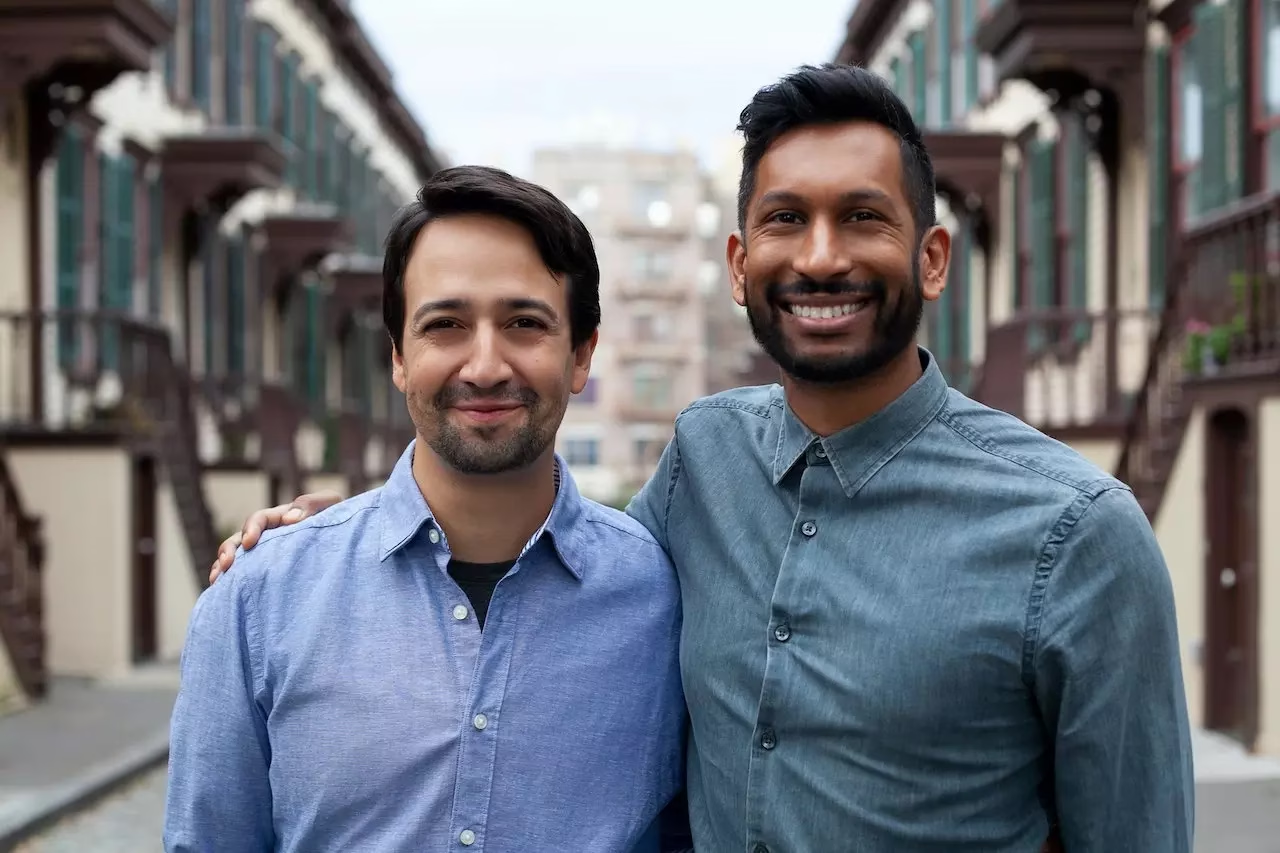
Most people know "Song Exploder" as the popular podcast giving die-hard music fans a deep, inside look into the sonic mechanics behind their favorite tracks. A whole new class of music-heads now knows "Song Exploder" as the new Netflix series bringing the creativity behind music to the digital screen.
Originally launched as a podcast in 2014, "Song Exploder" dissects classic and current fan-favorite songs, with guest artists breaking down each individual track and element in detail to paint an intimate audio portrait of their art. The podcast, which has accumulated more than 60 million streams and downloads over the years and has hosted guests like U2, Selena Gomez, Björk, Fleetwood Mac, Solange and many others, now breathes new life as a Netflix docuseries.
Introduced on the streaming platform at the beginning of October, "Song Exploder" adds an even deeper layer of storytelling and personal insight to the songs being deconstructed beat by beat. The show's inaugural four-episode run features Alicia Keys ("3 Hour Drive"), Lin-Manuel Miranda ("Wait For It" from "Hamilton"), R.E.M. ("Losing My Religion") and Ty Dolla $ign ("LA"). (Last week [Oct. 15], Netflix unveiled its next slate of guests for the show's second season, set to debut Dec. 15: Dua Lipa, The Killers, Nine Inch Nails and Natalia Lafourcade.
Whether in visual or podcast format, the core of "Song Exploder" remains the same: "an intimate portrait of an artist telling the story of how their artistic mind worked through creating one of their songs," host and creator Hrishikesh Hirway tells GRAMMY.com.
GRAMMY.com chatted with Hrishikesh Hirway about the human connection behind his new "Song Exploder" Netflix series and how he hopes the show will inspire others to create their own art.
<style>.embed-container { position: relative; padding-bottom: 56.25%; height: 0; overflow: hidden; max-width: 100%; } .embed-container iframe, .embed-container object, .embed-container embed { position: absolute; top: 0; left: 0; width: 100%; height: 100%; }</style><div class='embed-container'><iframe src='https://www.youtube.com/embed//rjIooIOtg4I' frameborder='0' allowfullscreen></iframe></div>
You have an endless supply of songs from which to choose for any given "Song Exploder" episode, podcast and show. What needs to stand out in a song in order for you to develop it for "Song Exploder"?
The first step in the process is really identifying the artists before even getting to the song, because, frankly, I don't know necessarily which songs might have the best stories. The most famous songs don't necessarily have the most interesting stories, and the people who know that better than anyone are the people who made the songs.
But what I can try and determine is which artists seem really interesting and thoughtful, good storytellers, and who are also beloved by a lot of people. That's kind of where I start. And once I can get an artist onboard to talk about a song in this way, then I start the process of trying to narrow down which song it's going to be with them.
I feel like I don't know what the story [of the song] is all the time. There are a lot of songs that haven't necessarily been delved into, and frankly, I'm always interested in something like that ... where the backstory [of a song] hasn't been canonized and "Song Exploder" can be a place to tell it for the first time. So I really am relying on input from the artists ... The question that I ask them, frankly, is: Which of your songs do you feel the most emotional attachment to?
Ultimately, the most interesting stories, I think, when it comes to making songs or really making any kind of art, are about people and their feelings and the things that inspire them to make something at all. Even though the show is about music, it's also a portrait of each of these artists. In order to tell you something insightful, especially for it to be something that could be interesting to people who aren't people who make music themselves and also aren't necessarily even familiar with the artist or the song, it has to be something that connects to something in the human experience that feels significant.
I always try to make "Song Exploder" a show that reflected a broad range of genres and artists and backgrounds. So there's kind of almost a guarantee that you couldn't just get people hooked on the show based on who the artists were and what the songs were; I want everybody to watch every episode and listen to every episode of the podcast because I think that it's a worthwhile conversation to have. I think the creative process is something that's really fascinating in and of itself. It's an example of how people react to their own experience, to actually decide to make something based on their ideas, what they lived through, what they love ... The thing that I'm actually most interested in is that kind of emotional experience: the emotional attachment to the act of creating a piece of music.
Michael Stipe of R.E.M. in "Song Exploder" | Photo: Courtesy of Netflix/Netflix
There's a moment in the R.E.M. episode where frontman Michael Stipe gets almost emotional listening to his own voice on the band's classic, "Losing My Religion," and hearing the song elements broken down and presented to him in such an intimate manner, even after so many years since the song's release. How do you go about getting artists to open up to you and dive into their art so deeply?
I think one thing that helps is that I'm not really approaching [the interview process] head-on, certainly not right away. The questions don't start off front and center in like an emotionally investigative way. I think I have to earn their trust first, and part of that is from talking about the mechanics of the process first. That's the entry point in all these conversations. One of the reasons why having the [song's] stems is important, not just in terms of letting the listeners know what's going on in the song, but in terms of being able to facilitate that conversation with the artist.
Of all of the questions, the hardest one to answer is probably, "Why?" "Why did you decide to make the song this way? Why did you write this lyric? Why did you choose this chord progression?" That's the hardest [question], but it's also the one that I'm most interested in. But it's a little easier to start off with, first of all, "What?" "What are we listening to?" And then to ask them, "OK, how did you make it? And when did you make it?" All those basic factual questions are a way to just let them and me submerge ourselves into the memories of making that song.
Once they're there and able to relive some of the experience of it by hearing the actual evidence of the stuff that they did on that day—hearing their voice, hearing the instrument, hearing the actual track that they recorded around that time—it's a lot easier to ask them to then dig a few layers deeper and ask what was going on in their lives and how that might've fed into some of those creative decisions.
You're now juggling the show and the podcast. How do you decide what songs go on the podcast format and what goes in video format?
Well, the podcast is a lot of work for a podcast, but that means that I'm still able to turn around an episode in a few weeks, whereas the TV show takes a much longer time to put together. There are just so many more components to it, and it's so much more work.
Part of the pitch for doing the television show is that I was trying to ask these artists to take a leap of faith, [like,] "This is something that's going to take a while to make, so you can't tie it to your promotional calendar, necessarily. I can't guarantee that it'll come out on such and such date to coincide with your single release or something like that." It was really more like, "Would you like to participate in this thing where there'll be this really meticulously crafted mini-documentary about this work that you did, and it's sort of evergreen."
That's a different pitch than with the podcast. Although with the podcast, I say all those things, too. I say it's evergreen and it's always better when it's not necessarily tied to your release schedule and more like when people have had a chance to live with the song a little bit. But one of the advantages of the podcast is it can be a little more nimble because it's a little easier to put together.
So this is a long way of saying that a lot of times that question is answered by the artists themselves or their publicists or managers, who are looking for a very specific outcome or timing, or they have something in mind, and that could be a matter of scale. It really depends on the circumstances of the artist and what works for them.
Fans who've been following the podcast for a while will find a totally different experience when they come to the show. There are two types of storytelling when I hear "Song Exploder," the podcast, and when I watch "Song Exploder," the docuseries. The podcast is very audio-heavy: You get to really hear all of the isolated bits and pieces of the song. The show has a lot more historical and cultural context, sort of like a mini-documentary for a song, and you also hear from a lot more voices beyond just the recording artist. Beyond the visual element, what do you gain in terms of storytelling through the show?
I think one of the things that you mentioned is absolutely key to the TV show, which is that often on the podcast, it's just a single voice or maybe two voices together … But with the TV show, because the timeline was so different, there was a chance to stop and say, "OK, who do we really want? Who are all the voices that are involved in the creation of the song?" Maybe not just the artist, but also the collaborators that were essential to making the song.
Having that kind of breadth and depth, it isn't always afforded to the shorter turnaround time and the scale of the podcast. But here, to really immerse the audience and give a really full picture of what the song was, having those other voices in there was really important. For [the] Alicia Keys episode [about the song "3 Hour Drive,"] we traveled to London to film with [the song's guest vocalist and co-writer/co-producer] Sampha and the [song's] co-writer/co-producer Jimmy Napes because we knew that they were going to only expand and flesh out the story.
I think a part of it is also a matter of craft, too. When you're working in audio, you're kind of only working in one dimension, which is time. You're just relying on one sense, hearing, and you're just basing everything on how long things take; the rhythm comes from just that one sense. But with TV, you have to also give a rhythm and complexity visually, too. You can't just transliterate the podcast into a TV format, where it's just one person talking, mixed with the isolated stems, because it wouldn't work; it would get very boring very quickly. So in order to have that kind of texture and nuance, we wanted to involve all those different people and try and give a little bit bigger of a picture than maybe what comes out in the podcast.
<iframe frameborder="0" height="200" scrolling="no" src="https://play.prx.org/e?uf=http:%2F%2Ffeed.songexploder.net%2FSongExploder&ge=prx_93_5197f5e9-5802-4f6e-9c0d-a3371084b88e" width="100%"></iframe>
Do you see the podcast and the show as separate entities or related in the same family? Do you need to engage with both formats to fully appreciate or understand what "Song Exploder" is trying to do?
Oh, I don't think you have to engage with both. Of course, I would love it if people did, just because they're both things that I've put a lot of work into, and you want people to enjoy the stuff that you've worked on. This is not a great analogy, but I think it's sort of like reading a book or watching a movie that's been adapted of that book. I don't think you need to read the book to enjoy the movie, and vice versa, you don't need to have seen the movie to have full enjoyment of the book. But maybe you'll get something out of the experience of taking both in. Maybe it changes the way you feel about both.
This is, of course, a little bit different, because it's not even the same story that's being told. It's really just taking the core concept, which is an intimate portrait of an artist telling the story of how their artistic mind worked through creating one of their songs, and taking that concept and expressing it in these two different media. So it's much looser even than something like an adaptation of a book to a movie.
What artist or what song is your holy grail for the podcast or the show or both?
I don't have one holy grail—I think I probably have about a thousand. Anytime I start listening to music, I start wondering about it. That's not new since I started "Song Exploder"; it's the other way around. That's always been the way I listen to music. When I fall in love with a song, I want to hear it from the inside out. I want to hear what the individual tracks, what the individual stems sound like. I want to know what the ideas were that inspired all of these things that I'm falling in love with. "Song Exploder" was just a way of me being able to actually make that happen for myself. So anytime I'm listening to music and I hear something great, you could put it on the list.
Ty Dolla $ign in "Song Exploder" | Photo: Courtesy of Netflix/Netflix
What is your ultimate goal with "Song Exploder"?
I wish people would either watch the show or listen to the podcast and come away with a feeling that they want to make something themselves. Part of my aim with the show is to democratize the act of creation a little bit. I think it's easy to look at very successful artists or very successful songs or any kind of art in any format, where it has reached a certain level of success, and think that there's some uncrossable boundary for everyday people that keeps them from making something as great as those songs …
I think the best feeling that I always get from finishing working on an episode is something akin to that. That like, I just want to go make something, and it doesn't just have to be music. I think that anybody who is interested in making anything at all, to get something from the show, just the idea of going from nothing but an idea and following that all the way through to a finished piece of art, I hope that might be inspiring to everyone.
Glen Ballard On How His Netflix Show "The Eddy" Puts Music, Jazz And Performance First
