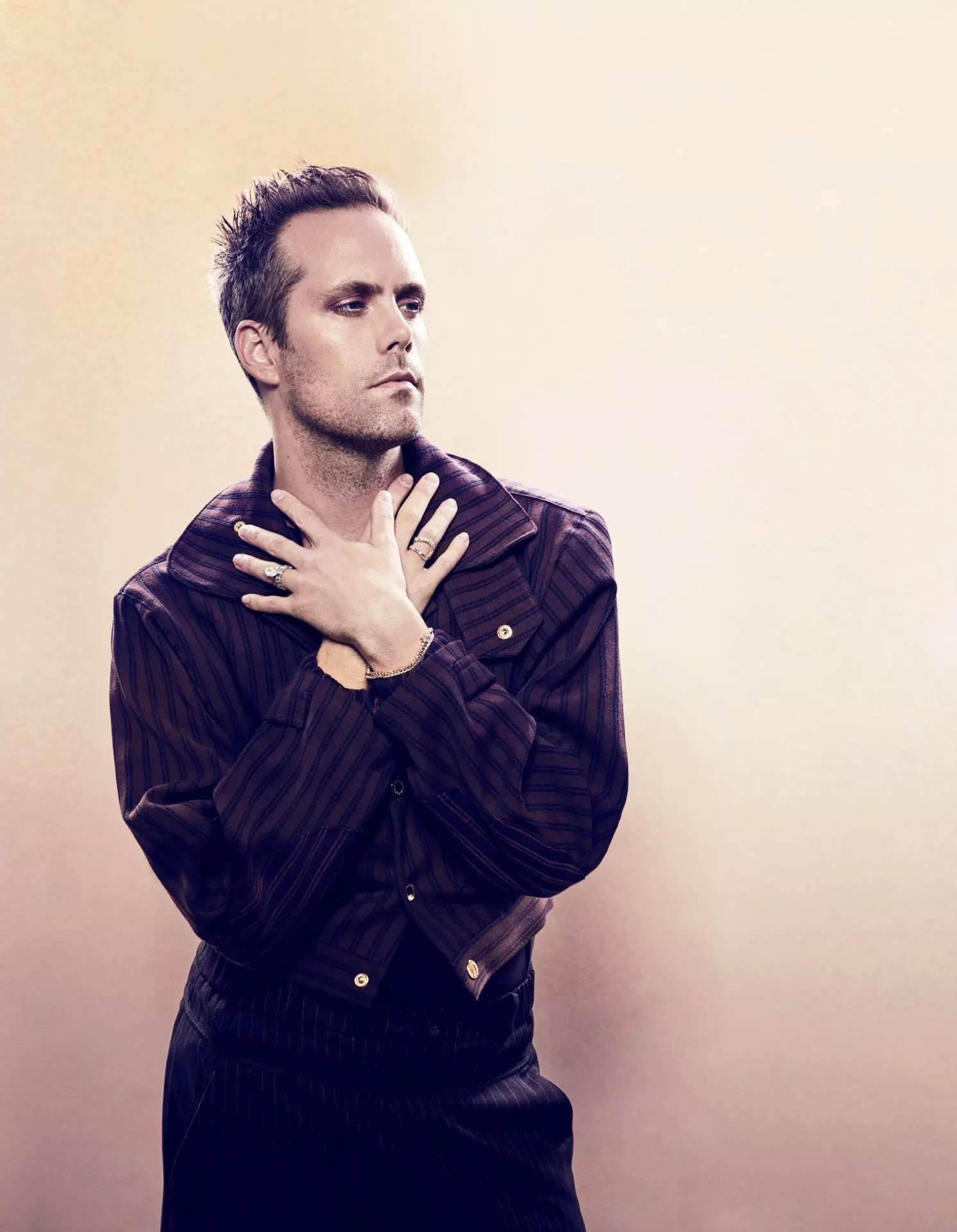
It’s late May, months deep into the country’s extended period of self isolation, but Justin Tranter—coming to me live via Zoom from their Hollywood home—says they’ve just written one of the best songs of their career. Considering that the veteran songwriter has helped pen some of the biggest hits of the past decade—including Justin Bieber’s "Sorry," Imagine Dragons' "Believer" and Selena Gomez’s 2019 chart-topper "Lose You To Love Me"—those words carry real, certifiable weight.
But it’s not hard to believe them when you look at Tranter's track record—just ask Britney Spears, Fall Out Boy, Halsey, Bebe Rexha, Nick Jonas, Cardi B, Gwen Stefani and Janelle Monáe what they think about their GRAMMY-nominated collaborator, a writer whose lyrics are not easily quantifiable beyond, simply, singular and necessary. And it’s equally easy to believe Tranter when they say they’ve actually been artistically thriving lately—"I know that saying that comes from an extreme place of privilege," they’re quick to note—as they enjoy the fruits of time, creativity and the ability to (for once) not overwork themselves.
Beyond their prestigious, prolific songwriting career, Tranter spends much of their time advocating for others. They're a vocal champion for the LGBTQIA+ community, including their continued work with singer Shea Diamond (their Emmy-contending song "I Am America" soundtracks HBO's "We're Here," which was just picked up for a second season) and their spot on the board of GLAAD. Just last year, Tranter received the ACLU of Southern California's Bill of Rights Award. "Justin Tranter has not only redefined popular music through their work with some of the biggest artists on the planet, but has redefined what it means to be an advocate through music," the organization wrote. "As an activist, I wanted the ACLU Bill of Rights Award, and as a songwriter, I want Song of the Year," Tranter says now with a grin.
<style>.embed-container { position: relative; padding-bottom: 56.25%; height: 0; overflow: hidden; max-width: 100%; } .embed-container iframe, .embed-container object, .embed-container embed { position: absolute; top: 0; left: 0; width: 100%; height: 100%; }</style><div class='embed-container'><iframe src='https://www.youtube.com/embed/dx9s0z_S_9M' frameborder='0' allowfullscreen></iframe></div>
They may not be far off. Their work with fellow songwriter Julia Michaels on Selena Gomez’s most recent album, Rare, carries on a fruitful partnership that began with 2015’s Revival. In the last year alone, Tranter has racked up credits on Dua Lipa’s exceptionally well-received sophomore album, Future Nostalgia ("Boys Will Be Boys"), Kesha’s High Road, Camila Cabello’s Romance and Lady Gaga’s long-awaited return to dance-pop, Chromatica ("911" and "Alice")—the latter of whom they’ve known as friends for decades, and even previously opened for on tour with their band Semi Precious Weapons.
Over the course of an hour, Tranter spoke with the Recording Academy about their banner year, songwriting in the time of COVID-19, the importance of intersectionality and protest in Pride’s history and future and more.
Hi Justin!
[noticing my Selena Gomez "Bad Liar" poster behind me] I've never felt more welcome in a Zoom in my life.
How has work been for you now that you’re homebound? I’m sure historically you’ve done some of it remotely anyway.
Exactly. The people that I write with a lot, we're able to figure out ways to do stuff virtually. I'm very heavily involved in the [upcoming] Bebe Rexha album, who's so amazing and such an underrated talent. She sings her ass off. She writes her ass off. And I think on this album the world is finally gonna really see the Bebe that we all know. And since me and Bebe are so close, and most of the songs are done, it’s just doing little tweaks here and there. That’s easy to do.
This week was the first week that I actually had some really successful cowrites over FaceTime. I've had to minimize the amount of people in a session, because us pop queens, we love to have five people in a room. I needed to be like, "OK, someone send us a track and then me and the other songwriter will just write to your track. I can’t have you on FaceTime while we do this, it’s too much."
The Zoom thing is great for conversations, but it has the mute feature, which is so helpful for conversations but not really helpful when you’re trying to hear music. I’m figuring it out, but it just started to click the last couple of days. My thing was: I’ll just work more than anybody, and that’s how I’ll survive in this business. I definitely just said yes to literally everything… why did I say yes to everything? [Laughs.]
<style>.embed-container { position: relative; padding-bottom: 56.25%; height: 0; overflow: hidden; max-width: 100%; } .embed-container iframe, .embed-container object, .embed-container embed { position: absolute; top: 0; left: 0; width: 100%; height: 100%; }</style><div class='embed-container'><iframe src='https://www.youtube.com/embed/-oI4_shsYnE' frameborder='0' allowfullscreen></iframe></div>
When we entered this period of social distancing a few months ago, did you already have your spring and summer mostly booked?
My schedule is always booked three months out, for the most part. Of course stuff changes because artists have to cancel, but I was pretty much booked through June when this started.
It’s a bummer, but also I try to find the positive in everything. One of the main positives for us super activist radical-type people: we all knew capitalism was a shit show, but this has really just been like… "OK… so you think this is working? Because our essential workers don’t make a living wage, so if this is capitalism’s plan, I think it’s pretty clear now this is the wrong plan."
So much of your career is focused on activism: you’re a GLAAD board member, you’re so supportive of LGBTQIA+ artists and writers and talent behind the scenes. What does Pride look like in 2020 when we can’t actually be together?
My definition of what Pride means—I can’t impose this on anybody else—is to just live your truth at all times. Celebrate your truth. But fight for those in our community that are less fortunate, that are less privileged, that are still being marginalized in many ways. Obviously, Pride started as a protest, and we always have to remember that energy.
I love that Pride has become a celebration, because a celebration of our truth is so important. But we always have to keep in mind the protest part of it. I think that we can do that virtually. It may not feel as crazy, and the celebration part might feel different, and the protest part might not have that community energy where you can literally smell the sweat and you can hear the screams. But I think we can still do that.
One of my favorite artists that I love to work with is a woman named Shea Diamond, a trans singer-songwriter who’s one of the best talents of our time. She makes all her money during Pride season. There are so many amazing people in this world for whom Pride is the time that they actually get hired and celebrated enough that someone cuts them a f**king check.
Obviously we need to be supporting black trans talent all year round. And it’s amazing that there is this season where you know you are getting f**king paid, but now that season is gone for her. A lot of our artistic community survive off of Pride season. Having in-person Pride disappear in that way is really sad, but I think in terms of the celebrations and protests, we can get the job done online.
<style>.embed-container { position: relative; padding-bottom: 56.25%; height: 0; overflow: hidden; max-width: 100%; } .embed-container iframe, .embed-container object, .embed-container embed { position: absolute; top: 0; left: 0; width: 100%; height: 100%; }</style><div class='embed-container'><iframe src='https://www.youtube.com/embed/LUbB_n89Ax8' frameborder='0' allowfullscreen></iframe></div>
You've been vocal on social media about the epidemic of anti-Black police brutality, and ensuing protests, in America. How best can we show up as allies in this moment?
The best way to always be a good ally is to listen and support. Seek out leaders of the BLM movement on social media and listen to everything they are saying and support it. Support it with your voice, with your time, and with your wallet if possible. Also look at your own life, and places where you can make change. How are you hiring at your company? How are you talking to racist family members? Are you spending money at black-owned businesses? Oh, and f**king vote.
So many members of our LGBTQIA+ community have wisely advised pivoting our Pride efforts this year to supporting the BIPOC communities in America. As someone with extensive advocacy work, in what ways would you advise people looking to help?
Since this is the GRAMMYs, let’s focus on music. Stream black LGBTQ artists. Buy their merch. Share their songs and videos on your socials. Book them and pay them for gigs even if they are virtual. Shea Diamond’s music has always been speaking about what the whole world is finally waking up to in the past few weeks and deserves a million streams a day. VINCINT’s voice, passion and musicality is at the highest level and deserves to be heard on repeat. serpentwithfeet speaks to my soul in ways I never imagined—I’m sure the music will speak to everyone’s soul if they listen.
You worked with Shea Diamond on the theme song for the new HBO show We’re Here, "I Am America." How did that opportunity come along?
The two creators of the show, Steve Warren and Johnnie Ingram, saw her perform "American Pie" and fell in love and couldn’t believe her talent, her lyricism, her voice, everything. Then, through the magic of the internet, they found out that we worked together. They were like, “Oh my god, the two of you have to write a song for this show.”
We watched the show and me and Shea were actually sitting in this very room, on that couch right there, and I was like, "It still needs to feel like this is your song." We definitely say "we’re here" like four or five different times in the song. "But to make it feel believable, it still needs to feel like your f**king song. If you, Shea Diamond, were gonna write a Pride anthem, what could you say that nobody else could say?” And she was like, "I don’t know… I am America?" I was like, "Welp! Song’s written, bitch! We can go home!"
You had another banner moment just a few months ago with Selena Gomez’s Rare, which found you reuniting with someone whose recent musical career carries so much of your DNA in it. What is it about her that makes you want to keep going back?
First and foremost, she’s a great person. She couldn’t be sweeter. She couldn’t be more honest. I love my job, and there are people that I work with who I make amazing music with, together, and Selena’s one of those people. But she’s also a real friend.
I got the call that I was gonna receive the ACLU Bill of Rights award on the way to the studio to work with her. I was telling her about it because I was excited, and she was like, "Is there anything I can do to help? Do you have someone to present you with the award yet? I would love to do that." So much of my fundraising and advocacy involves having to ask celebrities awkward questions. She’s just one of those people I don’t have to ask. She just was like, "Well I’ll be there. Fierce! What’re we wearing?"
Creatively, what me, Selena, and Julia [Michaels] have together is just so, so, so special. My first hit was Fall Out Boy’s "Centuries," but my first pop hits were all with Selena, which opened the pop doors for me. What me, Julia, and Selena did together has changed my life, time and time again. I’ve been so blessed to have so many songs connect, but only two that’ve gone No. 1 on the Billboard Hot 100, and one of those was Selena.
And she's so honest in the studio. She's like, "Here’s my whole life and here’s my whole feelings, because I trust you with them. Let’s try to make a song." It’s just too fun. She's the best.
<style>.embed-container { position: relative; padding-bottom: 56.25%; height: 0; overflow: hidden; max-width: 100%; } .embed-container iframe, .embed-container object, .embed-container embed { position: absolute; top: 0; left: 0; width: 100%; height: 100%; }</style><div class='embed-container'><iframe src='https://www.youtube.com/embed/NZKXkD6EgBk' frameborder='0' allowfullscreen></iframe></div>
A partnership like that that can be so rare in creative industries. So often those turn out to be, no malice intended, work-for-hire deals. Yours, though, feels like an equal playing field.
It’s so equal and so collaborative. Also, she’s such a great storyteller on the microphone. I think what really sets her apart is she has unbelievable taste, and she’s not afraid to make decisions. She’s like, "'Bad Liar' this is the coolest song ever, this is my single."
Everyone loved "Good For You." She was the one who was like, "This is the first single, everyone please stop talking. This is the song. Thank you!" We are living in a singles era. I think it’s starting to get a little different, because streaming’s leveled the playing field, but we’re still in a singles game. So pop stars can get really nervous about what songs should come first. Selena knows what’s cool, and she knows what she wants to do, and isn’t really worried about whether that is the biggest hit or not. What she’s worried about is: does it tell the story she wants to tell? And because she knows what story she wants to tell, she makes the decision. That is such a priceless gift in any creative industry. Working with her is a dream.
What is it about Lady Gaga, who you just worked with on Chromatica, that checks those same boxes for you?
One listen to "Bad Romance" and not a person alive can deny that Gaga is one of the best songwriters of our time, with one of the clearest perspectives of our time. She checks all the boxes—always has, always will. Having "Alice" and "911" be fan favorites is such an unbelievable, full-circle moment. Seeing the fans that used to tweet my band [Semi Precious Weapons] in 2010 be so excited that we worked on these songs together in 2020 is really special.
I'm sure you saw last month the #JusticeForGlory campaign that launched Britney Spears' most recent album—on which you cowrote several songs—to the top of the iTunes charts worldwide. What was it like seeing such a masterpiece finally be so publicly warmly regarded?
It’s a f**king trip, I tell you. I love that woman so much. I love her as a fan. I love her as a collaborator. I love her as a vocalist. I knew this was happening because the Britney fandom was letting me know. But obviously Julia [Michaels], having sung hit songs, her social media is way f**king bigger, so she was not aware. She sent me a screenshot of iTunes, and the "Slumber Party" video was either No. 1 or No. 2 and she was like, "Hey, um, what the f**k is going on with ‘Slumber Party’? I’m not complaining, but what is happening?" I was like, "Yeah there’s been this whole campaign..." [Laughs hysterically.]
<style>.embed-container { position: relative; padding-bottom: 56.25%; height: 0; overflow: hidden; max-width: 100%; } .embed-container iframe, .embed-container object, .embed-container embed { position: absolute; top: 0; left: 0; width: 100%; height: 100%; }</style><div class='embed-container'><iframe src='https://www.youtube.com/embed/2RRY3OVqtwc' frameborder='0' allowfullscreen></iframe></div>
I would kick myself if I didn’t ask you about my favorite song on Glory, "Do You Wanna Come Over?" What do you remember about recording that one with her?
Me, Julia, and Mattman & Robin are all signed with Warner Chappell for our publishing. My now business partner Katie Vinten dreamed up this whole amazing [writing] camp in Vegas, and we went. We got invited to see Britney’s show, so we all went.
The next morning, it was Julia’s birthday and she had an early flight, so we had to write quickly so she could pack and get out of there. We wrote "Do You Wanna Come Over?" after seeing her show and being so inspired by it, and what worked in the show and what it needed and what it didn’t. We called Britney’s team and had them come over immediately to listen to it, and then they played it for her and she loved it. Her next day off that she could get back to L.A., we went and recorded it.
That was the first time that we had heard her sing where we were in the room, in the studio. In the most polite way, Britney asked me and Julia to leave because we were freaking out. We were just like, "Oh my god, she sounds so good, that just comes out of her face. She doesn’t put that tone on, that’s just her tone. She just does that." We were literally losing our f**king minds. She was like, "Hey y’all, I don’t want to be rude but… I need to focus. Thank you for the support, but I can’t sing like this." I was like, "Oh, yeah, of course you can’t. No one can sing like that!" [Laughs.]
Putting aside the current pandemic, what does a dream session look like for you?
What I actually have learned from this pandemic is: I’m finding real joy in making every syllable count. As someone who’s mainly a lyricist, that’s what I wanna do now, every day. I don’t have to write every lyric! If the artist is amazing at lyrics, great, but I wanna make sure every fucking syllable counts, and not take for granted the fact that people might listen. I wanna tell that story the best way possible.
That is my new dream, to just creatively really challenge myself. I’m fortunate enough that I’ve had all the different kinds of hits somebody can have. I thought I wanted to just have hits forever and ever, but I’m learning that actually I just want to push myself as a songwriter and as a lyricist. I wanna just really figure out how I can still be excited about this. I find a lot of joy in it now. I feel like a whole new era is about to start.
Shea Diamond Sings "Don't Shoot" For Special Pride Month Edition Of Press Play
