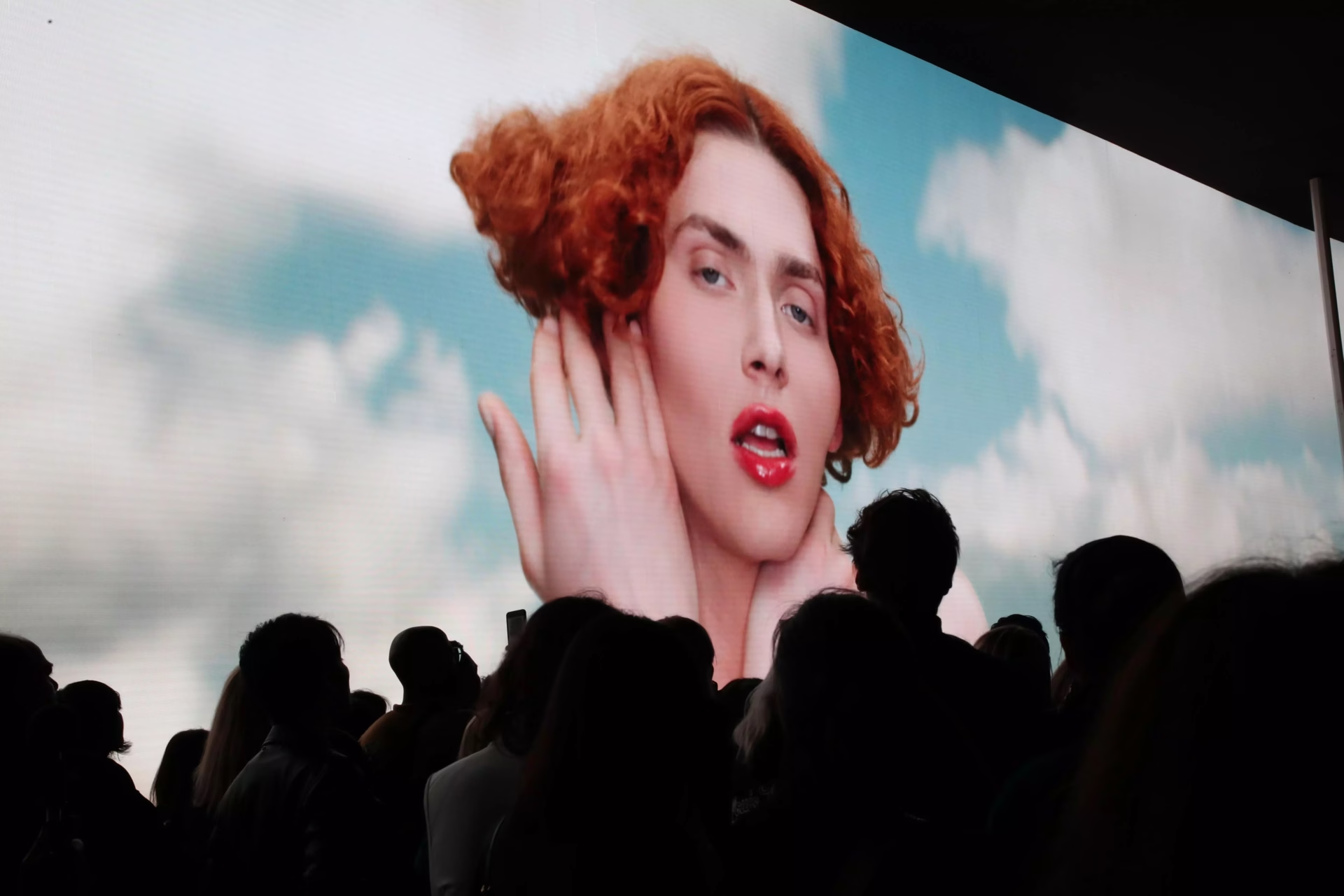
Many artists now viewed as self-evidently revolutionary were once seen as merely provocative. The Beatles once sparked parental panics and religious boycotts; now, Paul McCartney and Ringo Starr both have "Sir" before their name. Jim Morrison made Nietzchean inquiries into sex, death and the nature of prayer; today, The Doors sound comfortable and comforting. Half a century later, get a load of Sophie, a gender-norm-shattering Scottish producer with a bold expression who refused limitations—in music and in society. The artist’s uncategorizable, maximalist tracks resemble avant-garde electronica meets IMAX-scaled sound design.
<style>.embed-container { position: relative; padding-bottom: 56.25%; height: 0; overflow: hidden; max-width: 100%; } .embed-container iframe, .embed-container object, .embed-container embed { position: absolute; top: 0; left: 0; width: 100%; height: 100%; }</style><div class='embed-container'><iframe src='https://www.youtube.com/embed//es9-P1SOeHU' frameborder='0' allowfullscreen></iframe></div>
Immerse yourself in tracks like "Bipp," the alluringly fun club banger; "Ponyboy," an experimental track full of sexual inuendos; or "It's Okay to Cry," a song full of comforting vulnerability, and you'll find an artist on the bleeding edge of culture. Still, Sophie was perceptive enough to know the artist was one of many more to come.
"There's a huge amount of work to be done socially and culturally in the gap between where we are now and, I imagine, where we could be," Sophie, who was transgender and preferred not to be referenced with gendered or non-binary pronouns, told Arte Tracks in 2018. "The places that our imaginations can take us are so far away from what we're presented with a lot of the time. So, I can't get too excited about anything happening now. I'm really excited about what should be happening in the future."
Sophie tragically died on Jan. 30 after slipping and falling from the three-story balcony of an apartment where the artist stayed in Athens, Greece, while trying to take a picture of the full moon. Sophie was only 34. "She will always be here with us," the artist's label Transgressive said in a statement, calling the artist's desire for the lunar shot "true to her spirituality."
Sophie's girlfriend, Evita Manji, told Daily Mail she spoke to Sophie after the fall. "I managed to tell her I love her and to keep fighting," she said. "She's an immaterial girl now; she can be anything she wants... and she is in everything around us," Manji said in a later online tribute.
Sophie Xeon was born in Glasgow in 1986 and grew up absorbing rave tapes from the artist's father and experimenting with synthesis. In the early 2000s, the precocious musician relocated to Berlin and formed Motherland, a dance-pop collective. Motherland's Matthew Lutz-Kinoy used the artist's music at exhibitions in Europe and the New Museum in Manhattan and boosted Sophie's signal.
A decade later, Sophie began DJing and releasing music. In the early 2010s, the artist rose as part of the forward-thinking PC Music Collective production team, which operated parallel to and against the mainstream’s current.
The artist's career began in earnest with the effervescent single "Lemonade / Hard,'" keeping her identity a secret in the beginning. (She revealed her face for the first time in a music video in 2017). "I think about physics and materials [while creating]," Sophie explained to Billboard in 2014, revealing a scientific-like approach to creating music. "'Lemonade' is made out of bubbling, fizzing, popping, and 'Hard' is made from metal and latex—they are sort of sculptures in this way. I synthesize all sounds except for vocals using raw waveforms and different synthesis methods as opposed to using samples. This means considering the physical properties of materials and how those inform the acoustic properties.
"For instance—why does a bubble have an ascending pitch when popped and why does metal clang when struck, and what is this clanging sound in terms of pitch and timbre over time? How do I synthesize this?" the artist asked. "Perhaps after learning about these things, it might be possible to create entirely new materials through synthesis."
"Lemonade / Hard" ended up in a 2015 McDonald's ad and seamlessly worked in that context. Sophie had no compunction about licensing the artist's music in commerce. In the same interview, Sophie frankly called the artist's genre "advertising"—which might seem like anathema to those committed to operating in a counterculture at odds with capitalism.
"Pop should be about finding new forms for feelings and communicating them in ways which talk about the world around us right now," the artist told The New York Times in 2015. "There’s no need to view something commercial as necessarily bad. I believe you don’t need to compromise one percent on what you want to present and need to communicate to people en masse."
Almost immediately after the McDonald's ad, Sophie became part of the mainstream landscape, releasing the artist’s debut album Product in 2015. That year, the artist co-wrote and produced Madonna's infamous single "Bitch, I'm Madonna." Sophie followed that up with writing and production work for artists as divergent as the dance-popper Charli XCX (2016's Vroom Vroom) and Odd Future MC Vince Staples ("Yeah Right" and "Samo" from 2017's Big Fish Theory). Sophie also remixed Rihanna's "Nothing Is Promised," a track from Mike Will Made It's debut 2017 album Ransom 2.
"It’s impossible to summarize the journey I went on with Sophie. Even the most insignificant things felt enormous,” XCX expressed on Twitter. “All I can [say] is that I will miss her terribly—her smile, her laugh, her dancing in the studio, her gentle inquisitive voice, her cutting personality, her ability to command a room without even trying, her incredible vision and mind."
<blockquote class=“twitter-tweet”><p lang=“und” dir=“ltr”><a href=“https://t.co/cfyBmy1clO”>pic.twitter.com/cfyBmy1clO</a></p>— Charli (@charli_xcx) <a href=“https://twitter.com/charli_xcx/status/1356643095903752193?ref_src=twsrc%5Etfw”>February 2, 2021</a></blockquote> <script async src=“https://platform.twitter.com/widgets.js” charset=“utf-8”></script>
Staples also took to social media to remember the artist. "Sophie was different," he said in a Twitter tribute. "You ain't never seen somebody in the studio smoking a cigarette in a leather bubble jacket, just making beats, not saying one word. And don't let the verse be deep or heartfelt, 'cause she stopping the computer and walking outside until you get bacc [sic] on some gangsta shit."
In 2018, Sophie released the artist’s second and final studio album, Oil of Every Pearl’s Un-Insides. The album is fascinating, a tidal wave of disparate styles—glitch, techno, dream pop, ambient house, EDM, and more—coupled with a transgender and transhumanist visual aesthetic. The album was met with acclaim, earning Sophie a GRAMMY nomination for Best Dance Electronic/ Album in 2018. "This is the kind of music that, in 20 years, we may look back on as a pivotal point in changing the trajectory of the pop music sound," Exclaim! wrote in a glowing 2018 review.
Sophie left us far too soon, but for anyone wondering if the future of music will resemble this singular artist, here's a thought: Given how the Internet age has bled all genres and stylistic eras into one morass, like in Soundcloud rap—and how traditional ideas of gender are being deconstructed and reexamined daily in mainstream culture—this makes it not just conceivable but likely.
There may have only been one Sophie, but if you’re looking for a bellwether of what a pop musician might look and sound like in the 22nd, 23rd, and 24th centuries, look no further.
LaShawn Daniels, GRAMMY-Winning Songwriter & Producer, Dies At 41