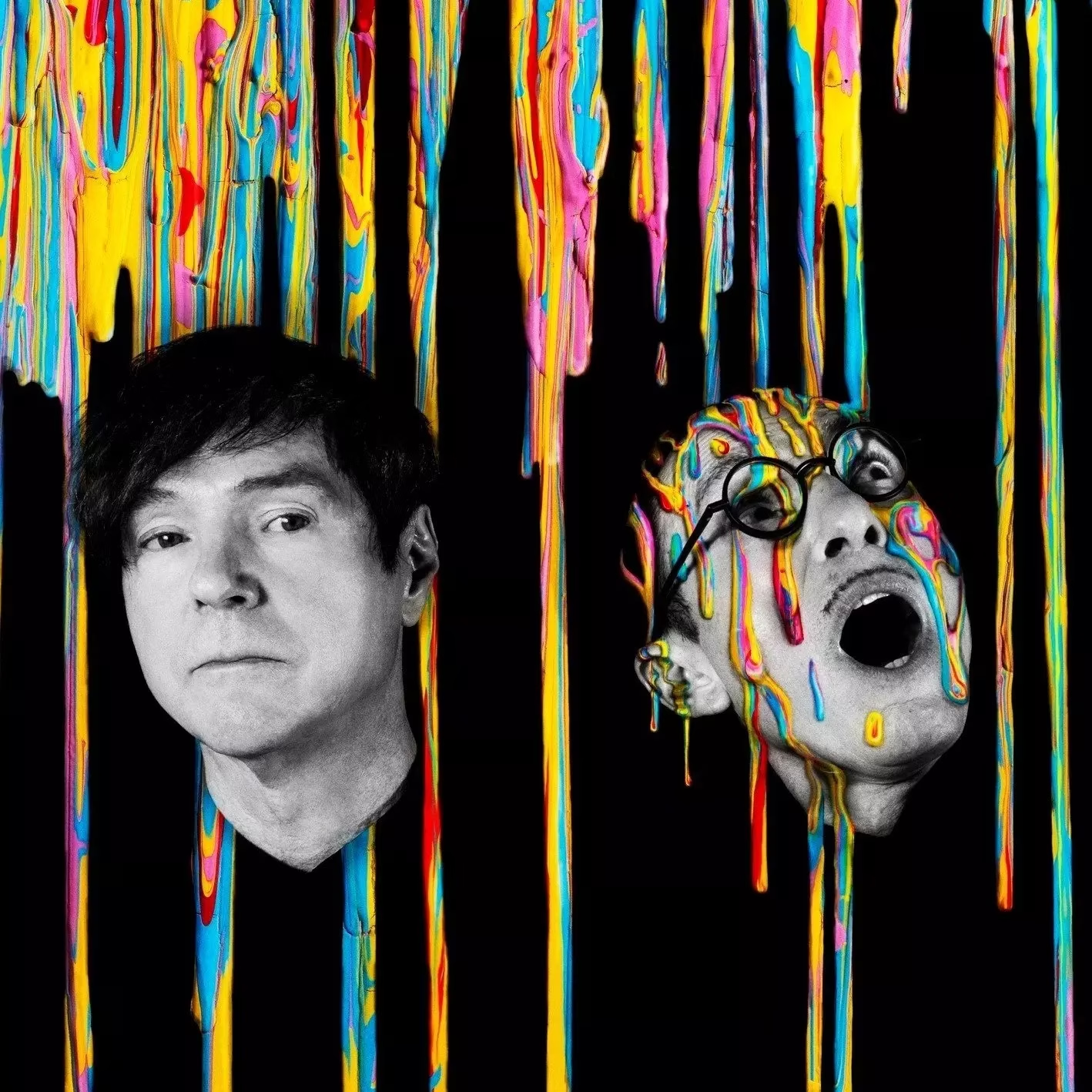
Even the best rock bands follow a sad life cycle seemingly embedded in their DNA: As retirement age approaches, the desire to innovate—and be brazenly weird—often flickers and fades, like a lightbulb on its last legs. But Sparks are not a normal rock band—if they can even be described as "rock," or even a "band."
Since the group's formation in 1967, brothers Ron (keyboards) and Russell Mael (vocals) have followed a non-linear evolution through intricate glam-rock (1974's Kimono My House), electronic disco (1979's No. 1 in Heaven), power pop (1982's Angst in My Pants), house music (1994's Gratuitous Sax & Senseless Violins), Neo-classical (2002's Lil' Beethoven), operatic radio musical (2009's The Seduction of Ingmar Bergman) and indie-rock (2015's FFS, a collaboration with Franz Ferdinand). Russell is 71. Ron is 74. Sparks have no business being this interesting for this long.
And somehow the duo are deep into one of their most productive years of the last five decades. They just released their 24th LP, a batch of radiant art-pop called A Steady Drip, Drip, Drip; and Annette, an upcoming musical film they wrote and composed, recently wrapped post-production. (The movie was originally scheduled to premiere at the 2020 Cannes Festival—then the entertainment industry collapsed amid the COVID-19 pandemic.) Meanwhile, filmmaker Edgar Wright is currently finalizing the first authorized documentary about the band.
Russell spoke with GRAMMY.com about Sparks' sustained productivity amid lockdown, their slate of new projects and how to write a cinematic song about a lawnmower.
<style>.embed-container { position: relative; padding-bottom: 56.25%; height: 0; overflow: hidden; max-width: 100%; } .embed-container iframe, .embed-container object, .embed-container embed { position: absolute; top: 0; left: 0; width: 100%; height: 100%; }</style><div class='embed-container'><iframe src='https://www.youtube.com/embed/i0PWkOO8CVQ' frameborder='0' allowfullscreen></iframe></div>
This is a frightening time, and the music industry is in a tailspin. But you have several projects in the pipeline, so at least you're staying productive.
That's the main thing: staying productive. That's the one thing we're able to do. Ron is in his place, which is a 10-minute drive from me, and we're trying to keep our self-isolation between us in this immediate period. It hampers some of the workflow we're used to—we're constantly working, and we have a studio in my place. That's been limited during this period, but we're still being really active. We're doing a couple of videos now that we're able to do on our own. We're gonna be having a couple of isolation "live" performance videos that we're able to do with our band. Most of them are in L.A., but a couple are in other states. And Ron is always constantly writing. In a certain way, we're kind of lucky that we have a job that we can continue to do in a slightly altered capacity.
Do you imagine if this continues throughout the year and into next year that you might continue to write songs remotely, swapping files through email?
That's kind of how we're working now, so it's already started. We're working on a video for one of the songs from the album, so it forces you to be creative in different ways than you were before. We're each shooting ourselves for this video, and I'm compiling everything and editing at my place. We've already started that process you mentioned—you're forced to figure out new ways to cope with all this, being a musician. The other thing is what it all means for touring because we have a tour booked for all of Europe, and we're gonna be doing some dates in the States for October. But it's very, very, very questionable whether things are going to, on a live concert front, be able to happen that early. Everyone's making contingency plans if things have to get postponed.
The pandemic has also, sadly, affected your rollout for the Annette musical.
The good news is that it was all shot—the shooting ended at the end of last year. The final editing of it is able to be done remotely, and our musical polish that we've done for the project has been completed. It just remains to be seen what form the distribution of movies will take in the upcoming period too. The film was scheduled to be launched at the Cannes Film Festival this year, so that was a major disappointment for us. We were going to go with Adam Driver and Marion Cotillard, the two stars of the film, and the director, Leos Carax. It was going to be a big launch for it, but now Cannes has scrapped any idea of doing a traditional film festival, and they may be doing some kind of limited, online version. But we don't really want to launch the film under those circumstances, and I think the producers of the film agree, so everybody's gonna have to go step by step and see how everything progresses. It could also be launched at Toronto and the Venice Film Festival, but those are in September, so no one knows now if that's too soon. It's starts settling in, "God, is that too early?" The film is with Amazon in America, so everybody's having to do a waiting game. It's hard to even plan. The good news is that the film is done, and it's a pretty amazing project. We're just so fortunate that it turned out the way it did. It's something we've worked out for eight years now, and it finally got made.
Obviously film projects can take years to produce, but Annette had an especially long development period. Were you actively involved in trying to get it made this whole time, or did you just kind of move on from it and hope it might work out?
We initially did this project and thought it was going to be Sparks' next album—a narrative album, which was really intriguing to us. We touched on doing another narrative project, like [the 2009 radio musical] The Seduction of Ingmar Bergman, which was commissioned by the Swedish National Radio. That inspired us. We wrote this story, Annette, eight years ago. We went to the Cannes Film Festival and were introduced to Leos, who had used one of Sparks' songs in his [2012] movie, Holy Motors. When we got back to L.A., we said, "We should send this to Leos," not even considering that it was going to be in the form of a movie. We did, and he really flipped out over it and said, "I think this is something I'd really like to direct. It's amazing." Over the eight-year period, we worked with Leos, he'd come to L.A. often, and we'd go to Paris and meet him. It was refining what we had done initially to become a movie as opposed to an album, but he was also really instrumental in putting together the financing side of it with various producers and distributors around the world. It took a long time to do that.
When did Adam Driver come onboard, and how did that change the trajectory of the project?
About four years ago or slightly longer now, it was proposed to Adam Driver to play the lead character. We were so happily surprised that he loved the project and wanted to do it. He'd also been a fan of Leos' films as well, and he was intrigued to do a musical. It's a really non-traditional musical—it's about 95 percent sung or delivered in a musical fashion, so it was a really challenging role for him and for Marion. We were fortunate they came onboard and that Adam's passion for the project was so strong that it withstood him going on to other projects, like [2015's Star Wars: The Force Awakens]. He's been in a million movies since that time, so we're wondering, "Is he going to retain his interest for this project of ours?" And he did. He really threw his whole soul into this role. It's tricky acting in a great way but also conveying all your lines in a sung way. It's not traditional, like Broadway in the pejorative sense, like Annie. It's a lot edgier. We were so happy, and we'd love to work with him again. We've already talked about trying to work on something with him again, another musical project.
Was he a Sparks fan when he signed on for the role?
I think he became more versed in Sparks after the fact. We never really had that specific discussion, but my understanding is that he was introduced to us via this. I think he had a lot of friends that were fans of Sparks, so maybe he did his research and now he knows who we are in a cool way. In a certain way, it's even more satisfying that he responded just to the music he heard and the story, rather than it being attached to who we were or our history.
Did you immediately click on this non-traditional approach to a musical? Is that something he'd been wanting to do?
We did discuss, stylistically, how we imagined the singing. He was totally on the same wavelength as us: being more naturalistic singing. At a certain point in the movie, you kind of forget that the characters are all singing. You suspend any disbelief that it's artificial—you get sucked into the whole style of how they're transmitting the dialogue. He hadn't done a musical at all. In Marriage Story, he does one Stephen Sondheim song. But this is a completely different thing. This is a whole other area. [Laughs.]
<style>.embed-container { position: relative; padding-bottom: 56.25%; height: 0; overflow: hidden; max-width: 100%; } .embed-container iframe, .embed-container object, .embed-container embed { position: absolute; top: 0; left: 0; width: 100%; height: 100%; }</style><div class='embed-container'><iframe src='https://www.youtube.com/embed/lWengrlMpok' frameborder='0' allowfullscreen></iframe></div>
I assume you demoed these songs by singing them yourself. Was it hard to let go and allow someone else to take ownership of them? Did you get attached to your own performances?
Yeah, actually, if it hadn't been Adam Driver, it would have been more of an issue in that respect. It's true, we heard my voice for eight years as that character. It was all hypothetical until you actually heard what he was doing. You could say, "He's a great actor, but what will that sound like?" And it was such a relief: We couldn't have been happier with what we did. His character is very cool in this. It's a really strange thing: eight years of my voice, and sometimes even Ron playing some of the roles in the initial version we did, and then to hear him take over that character and go, "Wow, this is actually better than I thought it would be." We are very precious about what we do, and I didn't want to sit there and be a vocal coach in a taste sort of way. But he completely nailed it, and his singing technique is exactly what we hoped for. It's not a Broadway singer — it's a real guy who happens to be delivering lines in this stylized way.
Hopefully we'll see that project soon. In the meantime, let's talk about A Steady, Steady Drip, which includes some of the most vivid Sparks songs in years. "The Existential Threat" couldn't be a more timely song, given the assorted crises we're all dealing with right now, but it's also set to this bouncy melody.
When it was written, there were existential threats to everything in our world. But now it's taken on some extra resonance, sadly. This [character] in the song is just citing all the various things that are bombarding him. The song is so hyper in its nature, too, that we thought it was really fitting with the melody and the tempo and the urgency helping to emphasize that everything around us now is becoming more and more of an existential threat. There's going to be a video for it too, that we're really excited about, from a director and animator. It'll be coming out in early July. It's an English director named Cyriak—he's taken the song to another level as far as the fear and dread surrounding everybody in an animated [way].
<style>.embed-container { position: relative; padding-bottom: 56.25%; height: 0; overflow: hidden; max-width: 100%; } .embed-container iframe, .embed-container object, .embed-container embed { position: absolute; top: 0; left: 0; width: 100%; height: 100%; }</style><div class='embed-container'><iframe src='https://www.youtube.com/embed/dLxPIOxgkM0' frameborder='0' allowfullscreen></iframe></div>
"Please Don't F**k Up My World" couldn't be a more appropriate song for our times. I love how it isn't preachy or grandiose in protesting environmental destruction—it's this sort of simple, human-to-human plea: "Please, stop screwing everything up. I love my planet."
That's a really nice comment. That's so much what we wanted the song to be. Just like you said: It's a fine line between making a statement like that but not being preachy about it—to even use the colloquial expressions, like, "Come on, don't f**k up my world." What you said is so spot-on—I'll mention it to Ron because he'd really appreciate it. Sometimes things get misinterpreted, like you're jumping on the ecological bandwagon. We kind of don't see it that way. There's a general statement to it. We didn't want it to be this heavy-handed thing: "Oh, isn't everything so screwed up?" That's what Ron's really conscious of too with the lyrics: He spends a lot of time and care with them, to do something that isn't preachy but just talking like a human being—"Please don't mess things up." There are obviously environmental specifics within the song, but you can also take it as a relationship song in a certain way—somebody telling his partner, "Please don't f**k up my world with our relationship. Thing are not going well. Can we work for that to not be the case?"
"Lawnmower" is another essential track on this album, a very quintessential Sparks song. I love the idea of writing a grand tribute to to this trivial element of everyday American life. You can picture the green grass and picket fences like out of a 1950s sitcom. The Beach Boys wrote about surf boards, but Sparks can find a cinematic angle into a lawnmower.
Your observations have cut right to the heart. We think of it too as an iconic American image. We know that lawnmowers exist around the world, but the image of an American out on their lawn, with their potbelly in their wife-beater shirt, mowing the lawn is such an iconic, suburban thing. This guy in the song is taking so much pride in his lawn, and specifically his lawnmower, that it's almost going to be a deal-breaker in his relationship with his partner, his woman. Like you said, [the amount of] detail elevates it into something bigger than would normally be justified—speaking in such glowing terms about what this object means to this guy in the song. Even The Beach Boys reference you mentioned is very fitting as well.
<style>.embed-container { position: relative; padding-bottom: 56.25%; height: 0; overflow: hidden; max-width: 100%; } .embed-container iframe, .embed-container object, .embed-container embed { position: absolute; top: 0; left: 0; width: 100%; height: 100%; }</style><div class='embed-container'><iframe src='https://www.youtube.com/embed/tPSFpaCQEvA' frameborder='0' allowfullscreen></iframe></div>
Your songwriting collaboration with Ron has really evolved a lot over the years. In the beginning, you both wrote a lot—and often together—but Ron sort of took over as the primary writer for a long time. And then you returned to full co-writing for the bulk of the last few decades. Does that just come down to inspiration—who's feeling they have more material to contribute at a particular time?
He's doing the bulk of the songwriting now, and it varies as to what form that takes. Sometimes he'll have a really fully fleshed-out song that he'll bring over to my place in the studio. Then another way is that we'll start working here just in the studio, having no idea of what we're doing, and Ron will just start playing. My role in recent years has been engineering the albums, doing the recording with him playing. [Sometimes we don't have] any kind of goal in mind about what the specific song will be because there's nothing there. Maybe Ron will take away the track from that day and see if he can come up with some melody line on top of that. Or maybe there's a lyric idea, or a title, that gets imposed on that piece of music that hasn't been fully developed. Those are the basic ways that things get written.
Ron said you've been approached before about doing a Sparks documentary but weren't interested. Did those filmmakers just not have the right approach? Did they not seem like authentic fans?
It was a combination of things. When Edgar approached us after one of our shows in L.A. to propose this idea of doing a documentary on Sparks, [he had this] passion and enthusiasm for the band. It was like, "Wow, he's really well-versed in Sparks, and he's effervescent in his love for the band." There was that on one level, but even that's not enough if you're not also convinced the director is able to convey the spirit of Sparks visually and make it into a movie. In the past, we hadn't been convinced that some directors, even though they liked Sparks, were actually on the same wavelength as us—that the ultimate film would be a visual equivalent of what Sparks is musically, in the same spirit and tone. We were also concerned because people don't know much about us personally, and obviously you have to open up and give some of that information. But you [want it to] be done in a way that isn't exposing every little wart on you, that it would be done in a way that still guarded some of the mystique and mystery. Edgar was on the same wavelength. He said, "I promise you—if anything, you'll have more mystique after this film is out." At some point you just have to throw yourself into it.
Were you fans of his previous films?
That was a major, major thing. Anybody whose done The World's End and Hot Fuzz and Shaun of the Dead and Scott Pilgrim vs. the World and Baby Driver has a pop sensibility, and he usually incorporates some musical elements. He's so animated in his excitement when you're with him. He's so upbeat: "We're gonna do this, and it's gonna be amazing!" We thought, "We can't go wrong." He's finished a three-hour version fo the film, but he's trying to edit it down somewhat for other venues that need a shorter version. He said the film needs to be three hours to even begin to touch on the whole story of Sparks. He's done an amazing job. He followed us all around the world to Japan and Mexico City and London and L.A., just filming concerts and around the cities in various [situations] that have been close to us personally. And he's unearthed tons of archival stuff from all around the world, like TV performances from early on in our career. He also managed to gather together an amazing amount of musicians, actors, and authors to speak about their passion for Sparks. There will be some surprises of people you wouldn't necessarily expect to like Sparks—like, "Wow, that band likes Sparks? I never would have thought that in a million years." That was what Ron and I said when these people were enlisted by Edgar to take part. It was a nice outpouring of people in the documentary. We won't divulge the names, but I think people will be happily surprised to hear what they have to say.
For a band that has built such a compelling mystique, you're also very active on social media—that's a delicate balance to maintain: being accessible to fans and not stuffy but also filtering out the parts of your personal lives that aren't relevant to the artist-listener relationship.
That's really important, and what you said is really accurate. Our music speaks better for us than us speaking about us, and that's always first and foremost with us—we'd rather have people, if we had a choice, listen to our music and from that gather what you want about how we are personally. We're accessible in a certain way, but we do it on our own terms where we don't give away too much of who we are. I think the people who are really into Sparks also like not knowing every little bit of minutiae. You know more about us if you know we did a song called "Lawnmower"—that says a lot about our sensibility.
You've been maintaining that fan connection by posting these silly Facebook videos: you stretching at home, Ron showing off his collection of hand sanitizer. In one clip, a commenter wrote that your face mask has the Korean word for "laughing" on it. Is that accurate?
Yeah, it is! I think it's literally "ha ha ha," the characters repeated.
I don't know if this is a stretch, but I find that idea sort of inspiring: Despite how awful things are, maybe we should put on a mask of playfulness and laugh through the surreality of this insane time.
I think that's accurate. I knew what the mask meant because I bought it in Korea around Christmastime. When I started to do the video, I didn't have the connection in mind, but I think it's really apt. In a general way, we're hoping those videos make people happier or interested to see how we're coping with this whole situation—but we also want to do things that are not heavy-handed and pompous in what they're conveying. Now the whole idea of a self-isolation video is becoming a cliche. It's amazing how fast something becomes a cliche. So you have to fight to do something within that genre that's fresh. Now it's like, "How many ways can I film my little living room? You only have so many angles." We also want to something in the spirit of what Sparks is.
This is totally unrelated, but what do you remember about appearing in an episode of Gilmore Girls? How did those two worlds converge?
We were approached by writer-director Amy Sherman-Palladino and her husband, [executive producer] Dan Palladino. They'd used a few Sparks songs—oddly, to our mind, but happily—in a few episodes. We thought, "That's an interesting show, but we wonder what the connection is?" But nothing was pursued. Then one day we were asked to if we wanted to take part in an episode, and we did a stripped-down version of that song "Perfume" in some town square. We were really excited to do that. It was really interesting that they were even fans of Sparks. I'm telling you now, but the Palladinos are two of the spokespeople for Sparks in the documentary. That kind of makes the story full-circle.
<style>.embed-container { position: relative; padding-bottom: 56.25%; height: 0; overflow: hidden; max-width: 100%; } .embed-container iframe, .embed-container object, .embed-container embed { position: absolute; top: 0; left: 0; width: 100%; height: 100%; }</style><div class='embed-container'><iframe src='https://www.youtube.com/embed/9yyW-IDgWss' frameborder='0' allowfullscreen></iframe></div>
That just goes to show there are a lot of people out there with surprising taste. Were the Palladinos big fans of any particular Sparks era?
I think at the time they might have really been into the '80s stuff, the Angst in My Pants period. I think that was their initial entry point, and they now obviously fully-versed Sparks people. I believe the songs they used were part of the '80s period.
The benefit of being a band with a huge, varied catalog is that fans can worm their way into the catalog slowly—and then discover this enormous body of work.
Edgar Wright is English, but he wasn't there for the initial Kimono My House stuff. He picked up on Sparks starting with the No. 1 in Heaven album, which was huge for him growing up in England. It is funny how the entry place is always different. Now people can obviously pick up on all the eras—people will pick up on our latest stuff, and then there are a lot of young people who go back and are so shocked to [realize] it's a band with a 24-album history.
Blu & Exile Talk New Album 'Miles': "We're Hoping That This Music Heals People"