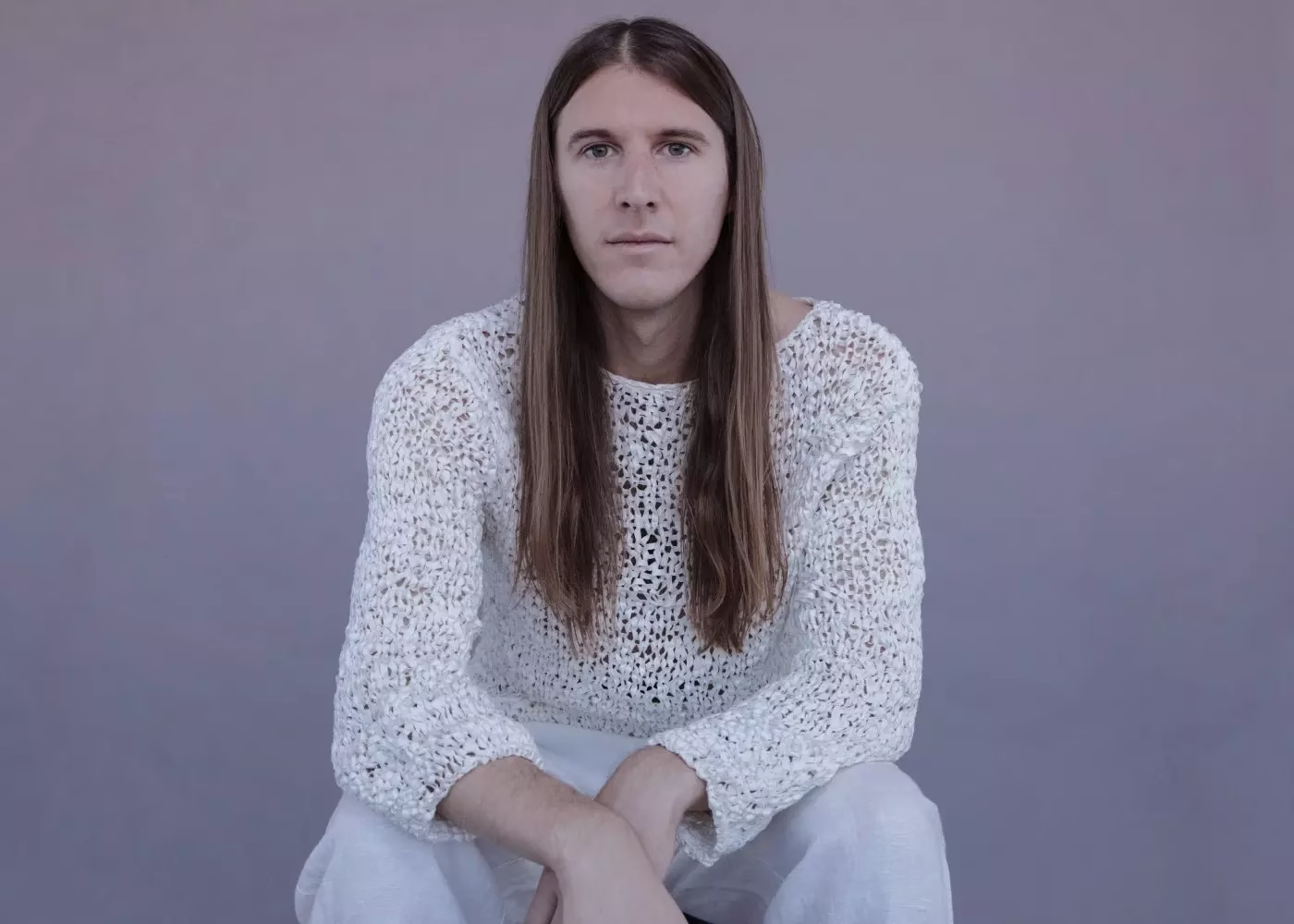
Spencer Zahn didn’t plan to release an album in the middle of a global pandemic, but if there was ever a time to shift from making eerie electronic music to something a little more soothing, such as the ambient jazz and neo-classical arrangements that comprise his latest work, Sunday Painter, now is certainly the moment for it. Unlike his two previous albums—2018’s People of the Dawn and 2019’s When We Were Brand New—which began as solitary synthesizer and upright bass experiments and developed (with the help of Darkwave's Dave Harrington) to have wavy rivers of sound, Sunday Painter, Zahn’s third album and first as a bandleader, is lined with pillowy textures and slinky grooves that drift idly by like clouds. It’s the perfect album for these tense, unfamiliar times.
Zahn is no stranger to switching gears. As a touring bassist for Kimbra, Empress Of and numerous others, he often explores different sonic landscapes and adapts quickly to new ways of playing. But aside from a project 10 years ago when he led an 11-piece band playing some of Bartók’s piano pieces, he had not attempted to lead a band of highly skilled jazz musicians playing his own music.
That all changed last summer, when he assembled some of New York City’s finest for two absorbing music-making sessions at Red Bull Studios NYC. Taking inspiration from Miles Davis’ 1969 masterpiece In A Silent Way—a record that Lester Bangs described in Rolling Stone as "part of a transcendental new music which flushes categories away"—and the solo improvisations recorded by the jazz pianist Keith Jarrett for the ECM label, Zahn and the ensemble set out to make a record that relied equally on instinct and interplay. "I thought it would be a challenge, but that it would also yield something really special," Zahn tells GRAMMY.com of why he decided to assemble a group rather than continue experimenting on his own.
You can read more of Spencer Zahn's conversation with GRAMMY.com below, where he talks about the group he assembled for Sunday Painter, shares some sage advice he received from GRAMMY-winning jazz bassist Charlie Haden, discusses growing up as a jazz-obsessed teen in southern Massachusetts and explains how a series of music videos breathed new life into his music.
<style>.embed-container { position: relative; padding-bottom: 56.25%; height: 0; overflow: hidden; max-width: 100%; } .embed-container iframe, .embed-container object, .embed-container embed { position: absolute; top: 0; left: 0; width: 100%; height: 100%; }</style><div class='embed-container'><iframe src='https://www.youtube.com/embed/x1Gcks8AmEQ' frameborder='0' allowfullscreen></iframe></div>
Can you tell me about the people that played on this album? How do you know each of them?
Dave Harrington and I have been working together for a long time. I’ve always loved what he does and he always brings so much wisdom to the music that I am making, it feels very much like a partnership between the two of us. Through Dave, I met Kenny Wollesen, who to me, is one of the great drummers in New York. He has been on so many amazing records, both in a pop context and a jazz context. Mauro Refosco is someone who is constantly changing the way I hear rhythm and melody. I think he is one of the most melodic drummers I’ve ever worked with. I first met him through the EXO-TECH project that I do with Kimbra and Sophia Brous. Andy Highmore and Jacob Bergson, I do a lot of touring and session work with those two guys. Both play Rhodes and organ on this record.
Spencer Ludwig and I met in 2015 at a strange festival gig on a ship off the coast of Bermuda. I have always been in his band, so it was cool to have him be in my band and to hear his style change to suit my aesthetic. He is such an amazing trumpet player. And Mike McGarril on soprano saxophone is someone that Spencer recommended. I don’t think he considers himself a soprano saxophone player, but he did a fantastic job. His tone, and just the way he approaches music, was really suitable. And Red Bull Studios in New York was kind of what allowed me to make this happen. Chris Tabron (chief engineer at Red Bull Studios NYC) and I have worked together on a bunch of different projects and he wanted to do a record together, so we decided to do this one there. Nate Odin recorded it and Chris mixed it, and it was such a good room to all play together in, because we didn’t use any isolation or anything like that, it was all live takes. I think Chris and Nate did a really good job of making it sound so lush.
You mentioned earlier that you were glad some of the guys were available. With you all working on so many other projects, that must have been a challenge.
Yeah, Mauro is one of the busiest guys I know. He had just finished David Byrne’s American Utopia tour and then they were about to start rehearsals for the Broadway show. I feel really lucky that I was able to get him, because he basically carved out those two days.
What was the process of playing together like? Were you specific about what you wanted each of them to play, or was it more collaborative?
There were specific things that I wanted to happen—certain melodies and form ideas—but outside of that it was pretty collaborative. I didn’t tell Kenny Wollesen much at all, and it made me a bit nervous, because I respect him so much. I didn’t want him to think that I’d just called him in to mess around. It was more that I love what he does so much that I really wanted him to do what he felt was best for the situation. And Dave is just so good at letting the space come to him. We couldn’t quite get the title track to land right and then without saying anything he just counted it off and did this really beautiful guitar intro, and then the whole band fell into place. That was the kind of thing that made this session so special to me, it was seeing how each musician made it their own.
<style>.embed-container { position: relative; padding-bottom: 56.25%; height: 0; overflow: hidden; max-width: 100%; } .embed-container iframe, .embed-container object, .embed-container embed { position: absolute; top: 0; left: 0; width: 100%; height: 100%; }</style><div class='embed-container'><iframe src='https://www.youtube.com/embed/Wnwsptrttv8' frameborder='0' allowfullscreen></iframe></div>
Do you remember what was holding that song back?
I think it was probably me, I was trying to force it into the demo version that I had come in with and the form wasn’t working. The whole song centered around the harmony and the form that I had come up with, I hadn’t really come up with a melody, and that is something that you can hear in the recording. Spencer Ludwig and Mike McGarril, they kind of alternate, taking turns at improvising melodies, and it was finding that direction that we couldn’t quite get at first.
One of the pieces that you’ve said inspired Sunday Painter is Miles Davis' In A Silent Way. When did you first encounter that record?
I first heard that album in 2006. I’d listened to Miles a lot, including his records from the early '70s—In A Silent Way came out in ‘69—but the stuff that came after it is so different. He is almost finding his footing in this new vocabulary, directing the band, probably in a similar way to he did with his quintet from ‘65 to ‘69, but there is just a totally different space and breadth in that album. Every time I listen to it I hear something new. I wanted to try and take some lessons from that and let the band have some space to just do what they would do, but then direct them at certain moments as if a conductor would, or as Miles would do on some of his albums.
The designer and visual artist Hana Tijama made three really beautiful music videos for "Roya," "The Mist" and "Key Biscayne." Has seeing your work through her eyes altered how you see each of those songs?
Absolutely, there is so much that she has brought to the music that I didn’t even know was there. They are very sculptural and abstract, but abstract in a very human way. I feel like you can see the natural elements in each one. They are not videos that are synced to the audio, necessarily, they are improvised along with the audio. She was creating everything in real time, doing full-take improvisations along with the music, and I think that is a really unique way of creating video sculpture.
It’s nice to see multiple videos created by the same person.
It really is. Hana and I were talking about the album art designer for Radiohead [Stanley Donwood], he is always at the sessions when they’re making the record, so everything goes hand-in-hand with their artwork. And although she wasn’t at the sessions, I thought that taking a nod from that and having her do all the artwork would really bring her artistic vision in alongside the music that we’d created.
Shortly after you moved to New York from Massachusetts in 2006, you had an opportunity to work as a tour manager for the legendary jazz bassist Charlie Haden. Did he give you any sage advice that really stuck with you?
One thing he told me was how to hold the string down on the fingerboard with my left hand. He said you really need to hold it down hard because you want the note to speak as clearly as possible. The way he played bass, every note was so intentional. When you listen to him with Ornette Coleman, it’s not so much a flurry of notes, but rather these really thoughtfully placed melodic ideas that help guide the band.
<style>.embed-container { position: relative; padding-bottom: 56.25%; height: 0; overflow: hidden; max-width: 100%; } .embed-container iframe, .embed-container object, .embed-container embed { position: absolute; top: 0; left: 0; width: 100%; height: 100%; }</style><div class='embed-container'><iframe src='https://www.youtube.com/embed/deNRuyA8pQQ' frameborder='0' allowfullscreen></iframe></div>
You started playing bass when you were 12 years old. Do you remember who your bass idols were back then?
I loved Herbie Hancock’s Headhunters and Thrust. That band was such a bass-led group, the way Herbie produced those records was so forward-thinking. I loved the Paul Chambers stuff with Miles Davis, and a lot of Miles’ stuff with Ron Carter. Then I started listening to newer New York bass players like Christian McBride and Chris Wood.
So even as a teenager you were listening to jazz records. Where did your interest in jazz come from?
I think it was because of my first bass teacher. He gave me Relaxin’ by the Miles Davis Quintet and I remember listening to that and thinking wow, this is really interesting music. Then he gave me more Miles Davis records, then Herbie records, and Weather Report. Then I started listening to Jaco Pastorius and everyone else that was in that band. When I was a teen I thought I had my own little private club. I was discovering all these amazing musicians, it felt like an endless ocean of possibility.
And this was before music streaming, so you would have been having to seek out those records in physical form.
I also had a bass teacher in Boston and there was a record store around the corner from his apartment. My parents would drive me up to my lesson and then after my lesson I would walk over and buy some records. I think that’s where I first got Live-Evil [by Miles Davis].
There are multiple songs on your album, notably "Key Biscayne," "Empathy Duet" and "Roya," that remind me of vaporwave music. Both your music and vaporwave evoke this feeling of moving towards a brighter future, beyond the constraints of modern capitalism. Do you see any parallels between your music and a contemporary online music genre like vaporwave?
That’s a tough question. I would like to think that my music could be enjoyed by people who don’t normally listen to instrumental music, or people who only listen to instrumental music that’s more electronic, like Jon Hopkins or Tim Hecker, but I know that this music is very different to those artists. I think there is a place where they intersect. Jazz music has always been a really modern music, it is quite forward-thinking, and it would be really cool to see new audiences being drawn to it. I’ll have to think about it a little more, because thinking about the electronic musicians that I love and what they do, and thinking how they intersect with acoustic instrumental music, there are a lot of similarities, it’s just kind of the instruments and the tonalites that they are using that are different.
'Giant Steps' At 60: Why John Coltrane's Classic Hard Bop Album Is More Than A Jazz-School Worksheet