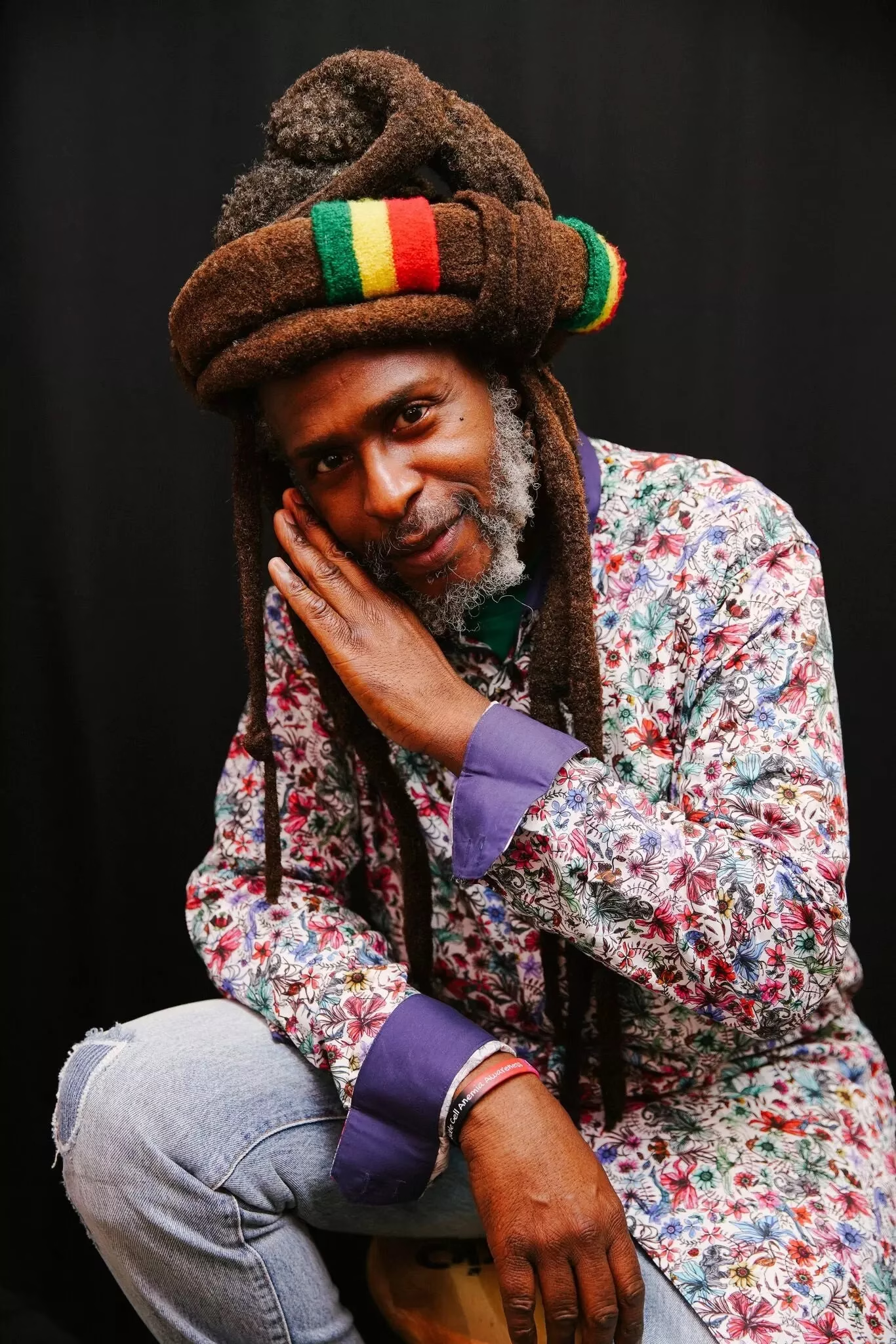
Many passionate social advocates mellow over time, but not David Hinds. Nearly 45 years into his role as leader of GRAMMY winning British reggae outfit Steel Pulse, Hinds is still working hard for change. While their message has always been a global one, Hinds has doubled down on his passion for progress to match the modern state of world and updated his method to the current creative flow of the band, keeping his nose firmly to the grindstone. The result is Mass Manipulation, Steel Pulse's infectious new album and first in 15 years.
<blockquote class="twitter-tweet"><p lang="en" dir="ltr">MASS MANIPULATION is here! <a href="https://t.co/4wxlrEbFlH">https://t.co/4wxlrEbFlH</a><a href="https://twitter.com/hashtag/steelpulse?src=hash&ref_src=twsrc%5Etfw">#steelpulse</a> <a href="https://twitter.com/hashtag/massmanipulation?src=hash&ref_src=twsrc%5Etfw">#massmanipulation</a> <a href="https://twitter.com/hashtag/newalbum?src=hash&ref_src=twsrc%5Etfw">#newalbum</a> <a href="https://twitter.com/hashtag/wisemandoctrine?src=hash&ref_src=twsrc%5Etfw">#wisemandoctrine</a> <a href="https://twitter.com/hashtag/rootfirecooperative?src=hash&ref_src=twsrc%5Etfw">#rootfirecooperative</a> <a href="https://twitter.com/hashtag/rootfire?src=hash&ref_src=twsrc%5Etfw">#rootfire</a> <a href="https://t.co/J8H7Y3LMmS">pic.twitter.com/J8H7Y3LMmS</a></p>— Steel Pulse (@steelpulse) <a href="https://twitter.com/steelpulse/status/1129238676221911041?ref_src=twsrc%5Etfw">May 17, 2019</a></blockquote> <script async src="https://platform.twitter.com/widgets.js" charset="utf-8"></script>
We spoke with Hinds while on tour to find out what he poured into the new project, where his working to make an impact on his next tour, his interest in movies and TV, what his future plans involve and more.
Why was this the right time to record and release Mass Manipulation, the band's first studio album in 15 years?
The recordings have been staggered. But because of the circumstances throughout the world for the past five, ten years, informed by activists with regards to terrorism, with regards to racism, with regards to police brutality, and regards to all these setbacks, so many countries being taken advantage of by superpowers.... All these things have always been templates years ago that made what we were doing automatically timeless. We had a year to go, and after recording several tracks, we thought to ourselves that there's still three more tracks that would have made the album right in the pocket as far as things that were happening, really on an escalated scale with things just stepped up a notch.
Although things have been happening systematically over the past years, it was stepped up a notch. As in, you can see over the past two or three years, there's been a lot of mass shootings taking place across the United States and other parts of the world. There's other protests and demonstrations going on as well. We witnessed that for the first time back in 2011, when we saw the Middle East uprising with taking over from the people that govern them, the dictators of several decades, whether it's Tunisia, whether it's Egypt, whether it's Libya, where in all these countries, all of a sudden, people are realizing that they've got a say. So "Rize" and "Stop You Coming and Come" were based on my Ethiopian experience. I was in Ethiopia for the very first time in mid-2017.
<iframe width="620" height="349" src="https://www.youtube.com/embed/kvygGZP4WgE" frameborder="0" allow="accelerometer; autoplay; encrypted-media; gyroscope; picture-in-picture" allowfullscreen></iframe>
After that experience, I was so overwhelmed, I thought it was necessary to express my views and put that song down. And then we just wanted a song also that had a solution, a conclusion to it. We didn't think the album concluded anything and we decided to do the cover version of Steve Winwood's "Higher Love." And obviously we formulated the lyrics differently and called it "Higher Love (Rasta Love)."
When it comes to Rastafarian philosophy, it is the most unifying thing for mankind when it comes to music, period, across the board. So we just thought it was necessary to record the three to four extra songs and complete the album.
Was this album intended to be so global or did it just come out that way? And why do you feel like your message is so universal?
If you go then back through Steel Pulse's albums that we've done, the messages have always been global. We've always been universal. And maybe because you're trying to differentiate between how the Jamaican acts, those that actually record and produce songs in Jamaica I mean, their lyrics are not exactly global in a sense, but a lot of it's to do with just being from Jamaica. Where Steel Pulse is coming from a British background, so it's easy for us to adjust and create songs on that merit and on that kind of platform, because we are coming from a cosmopolitan country. First of all, England as a first world country, as a Western world country was always up to speed with what other countries has been doing whether it's political, whether it's social, whether it comes to business and enterprise. So it was easy for us to keep churning out songs. That was always going to be a given from day one. I mean the very first, album, "Ku Klux Klan" was on that and you don't find that in the United Kingdom. So that tells you straight away that the band has been international or trans-Atlantic from the get-go.
Because of the weight of that message and because of Steel Pulse's legacy within reggae, the actual songwriting isn't talked about as much, but you're an extremely prolific and accomplished songwriter. After 45 years of the band, is your songwriting process the same as it was back when you were writing those early songs? How has your songwriting process changed?
I would say it varies, it ebbs and flows, but the principle has changed somewhat. Whereas in the earlier years, without a doubt there were songs that were written where the lyrics were written first, and then the music. And then there were songs where the music was written first and then I added lyrics to them, like the song "Ravers" from the True Democracy album, for example. That was an instrumental before and I added lyrics to it. And take "Sound Check" from the Handsworth Revolution album. That was actually a rhythm groove and I decided to add lyrics to it while in the studio.
This time around it's a bit of me supposing, focusing on punchlines and melodies and trying to make the lyrics as constructive as I possibly can. That can be a tendency where one can dry up when it comes to the potency and the substance that a song can have and I made sure that I wasn't drying up in that domain. That's what I'm saying. In the early years, like I said, there were a lot of times we'd base the band's lyrics on rehearsal and jamming.
But since the format isn't like that anymore, I tend to be a recluse in my home and I'll wake up in the middle of the night, maybe two, three, four, five o'clock in the morning and jot down lyrics that I found stimulate me, or that I thought provocative. And sometimes I'd purposely write without intentions of recording it, thinking if it's that strong of a song, I'll still remember it by the morning. Then I realized that was not such a good idea. Some damn good ideas I've had, and I should've held on to them so to speak. So I got the iPhone now, the iPad, and hum the melody into those machines, and you wake up the next day you capitalize on what was an idea in the middle of the night. So that's how it's been now.
Early years, a lot of the time the music was there and I added the lyrics to it. It seems to be more difficult for me sometimes. I tend to write the lyrics, having a melody in mind in the first place, and a groove in mind, and then I hear out of the tempo of delivering the songs as the words, and try to match a beat to that and then that's how it goes for me. I'm more concerned about the strength of the lyrics than melody a lot of times. In actual fact both should be supplementing themselves.
Can you tell me about this tour you're planning? As I understand, you're choosing to perform at Native American reservations and juvenile detention centers…
Well, you've heard of the term bucket list. These are the things from the beginning of the band's career, especially when we touched down in the United States (by the way about a year from now is going to be the 40th anniversary since we arrived in the U.S.) that it's always been on my mind to pursue those avenues because those have been always our major concern. We wrote songs like “Soldiers” based on how the Native Americans were decimated, and their land desecrated. Then we've always thought that there was some kind of a bond with ourselves and Native Americans with regards to the slave trade that took place in Africa, and colonialism. So there's always this thing saying, “let me hang out with these guys and see what they are about, and see how they're coping with situations.”
And then there was the other side of things as well, where for instance, I've read up on prisoners, political prisoners in different countries, and people that I've admired over the years were once political prisoners. When you think of all the African leaders for example, that took over Africa, once Africa got independence. They were all prisoners at one point, Nelson Mandela, Kwame Nkrumah, Patrice Lumumba, Jomo Kenyatta, all these guys at some point served time for their beliefs. So I've always had this thing about going inside jailhouses and seeing how people are coping with their predicament. Especially because a lot of times I don't think prisons are really addressing the situation, what really goes down within the mind of someone who's being seen as a criminal.
<blockquote class="twitter-tweet"><p lang="en" dir="ltr">New tour dates announced! Tickets on sale Friday. Tag a friend you want to bring with you and be entered to win a pair of ticket to any of the shows listed here...<a href="https://twitter.com/hashtag/steelpulse?src=hash&ref_src=twsrc%5Etfw">#steelpulse</a> <a href="https://twitter.com/hashtag/massmanipulation?src=hash&ref_src=twsrc%5Etfw">#massmanipulation</a> <a href="https://twitter.com/hashtag/newtourdates?src=hash&ref_src=twsrc%5Etfw">#newtourdates</a> <a href="https://twitter.com/hashtag/wisemandoctrine?src=hash&ref_src=twsrc%5Etfw">#wisemandoctrine</a> <a href="https://twitter.com/hashtag/rootfire?src=hash&ref_src=twsrc%5Etfw">#rootfire</a> <a href="https://twitter.com/hashtag/rootfirecooperative?src=hash&ref_src=twsrc%5Etfw">#rootfirecooperative</a> <a href="https://t.co/3U7bdohfpx">pic.twitter.com/3U7bdohfpx</a></p>— Steel Pulse (@steelpulse) <a href="https://twitter.com/steelpulse/status/1164178262773383174?ref_src=twsrc%5Etfw">August 21, 2019</a></blockquote> <script async src="https://platform.twitter.com/widgets.js" charset="utf-8"></script>
I don't think programs have been set in earnest to rehabilitate guys like this. But I've always been intrigued by trying to get into the minds of the incarcerated... And a lot of the time someone just had a bad break, a lousy break and just needed that second lease of life and needed a program to turn their life around for something positive. I mean you'd take the situation of the Central Park Five, who were five youths sent to jail for an alleged rape that took place in New York and Central Park back in 1989.
For all five guys there was not enough evidence for time in jail, but because certain factions of the police wanted to get brownie points, they were put away for a crime they didn't commit. So these kinds of things, I'm always focused in on situations where it's evident that someone didn't commit a particular crime, or if they did, what is it you can do to help their cause. I mean, obviously if they've committed murder, and the United States said it's the death penalty, you can't do anything about that, because that's the law so to speak. What I'm talking about is those where there is hope of them being rehabilitated...They come out of jail only to find themselves back in there again, because they weren't given a fair crack at the whip.
And there's a movie based on the Central Park Five, When They See Us. One of them got out of jail and God knows, he spent so many years trying to get a job, and he had that stigma hanging over his head, because they said he committed that crime he knew he didn't. After a while he had no choice but to stand on the side of the streets, selling crack like everybody else. So what I'm saying is, because he didn't do it in the first place, but got ostracized by family, got ostracized by God knows what else and he went out there trying to make a go at life. Once again, couldn't get a job. And before you know they're scraping back up again for another sentence because he didn't have that fair crack of the whip. He had to go out and try and make his ends meet. So these are the things I'm looking at, and this is why I'm taking an interest.
<iframe width="620" height="349" src="https://www.youtube.com/embed/aO7fmxoFtIw" frameborder="0" allow="accelerometer; autoplay; encrypted-media; gyroscope; picture-in-picture" allowfullscreen></iframe>
With all of these intense and heavy issues you and the band are addressing, what are some things you do to take care of yourself mentally, whether it's to relax or to make sure that you're mentally healthy?
Well, that's another good question, because right now as it stands, I'm sort of managing the band. I've done a lot of overhauls, I've changed the landscape, the backdrop of what's Steel Pulse's been about, I've changed management, changed the agency, changed certain members of the band. And it hasn't been easy, trying to do all this and still trying to create. You still try to stay focused and have the energy, the physical energy to go out there and perform, because doing this is a 24/7 kind of scenario. Once you're performing, and you've got a rest spot, you know you're not doing that, because you've got to start doing the business side of things until proper management kicks in.
So I try to make it a rule of thumb that I don't let anything stress me too much. Before, I'd be irascible, when I started out in this business, the moment something wasn't the right way, I would go apesh**. And now that's been reduced a heck of a lot, because I'm a total believer in Murphy's Law, trying to compensate and correct it, number one. Number two, I'll say, “all right, you did this much, and how much can you expect to do for the day? You're not getting any younger,” and try to just chill out a bit. So I've managed to put on a different head in how I perceive things. In my spare time, I still do a relative amount of reading in regards to what's going on in the news.
I tend to really wind down when I'm watching a couple of bad boy movies and stuff… I like watching movies in my spare time on Netflix recently, before that you see other ways of trying to access a movie. And that's how I wind down. It takes away from the reality of the world, you see how someone's living in their world in the sense of film.
Lastly, you're coming up on 45 years of Steel Pulse. What are the goals for the future of the band?
Finances being our biggest deficit, I'd like to know that there's enough money generated financially, that I can start to really be more active in other areas in regards to, for example, charity. I mean we dabbled in it, sold T-shirts or presented other avenues in generating funds for certain causes, like the earthquake that took place in Haiti, nine years ago. We did a donation for hurricane Gilbert, but that was in bloody 1988. But I'd like to know we stepped up to the plate some more in regards to certain causes, is what I'm saying. That I'd like to know. For myself personally, I'd like to know that the band's songs get featured more in movies around the world, or documentaries, and be that kind of a force when it comes to reenacting the songs that we do, with the lyrics and all that kind of stuff.
Then I'd also like to be participating in acting. When we first came to the United States, my dream was to participate in one or two movies or TV shows.
And at that time in early 80s throughout the 90s it was very difficult, because the dreadlocks were not a palatable thing in the United States and in film at that time. And then whoever became a dreadlocked individual in Hollywood had a fake Jamaican accent. They had a stereotypical kind of thing going on. I had one or two close shaves trying to get into proper selective roles. There was The Return of Superfly. That storyboard, that script was presented to me when it came out. Never happened in the end, but it was presented as an idea. And I've already managed to do acting for a brief moment in one particular film, called Rock Steady, for which, I actually wrote the title track. So that's what I'd like to know. I like to know we're a bit more active in these domains.
Peter Frampton On His Farewell Tour, Living With I.B.M. & Reclaiming 'Peter F**king Frampton'