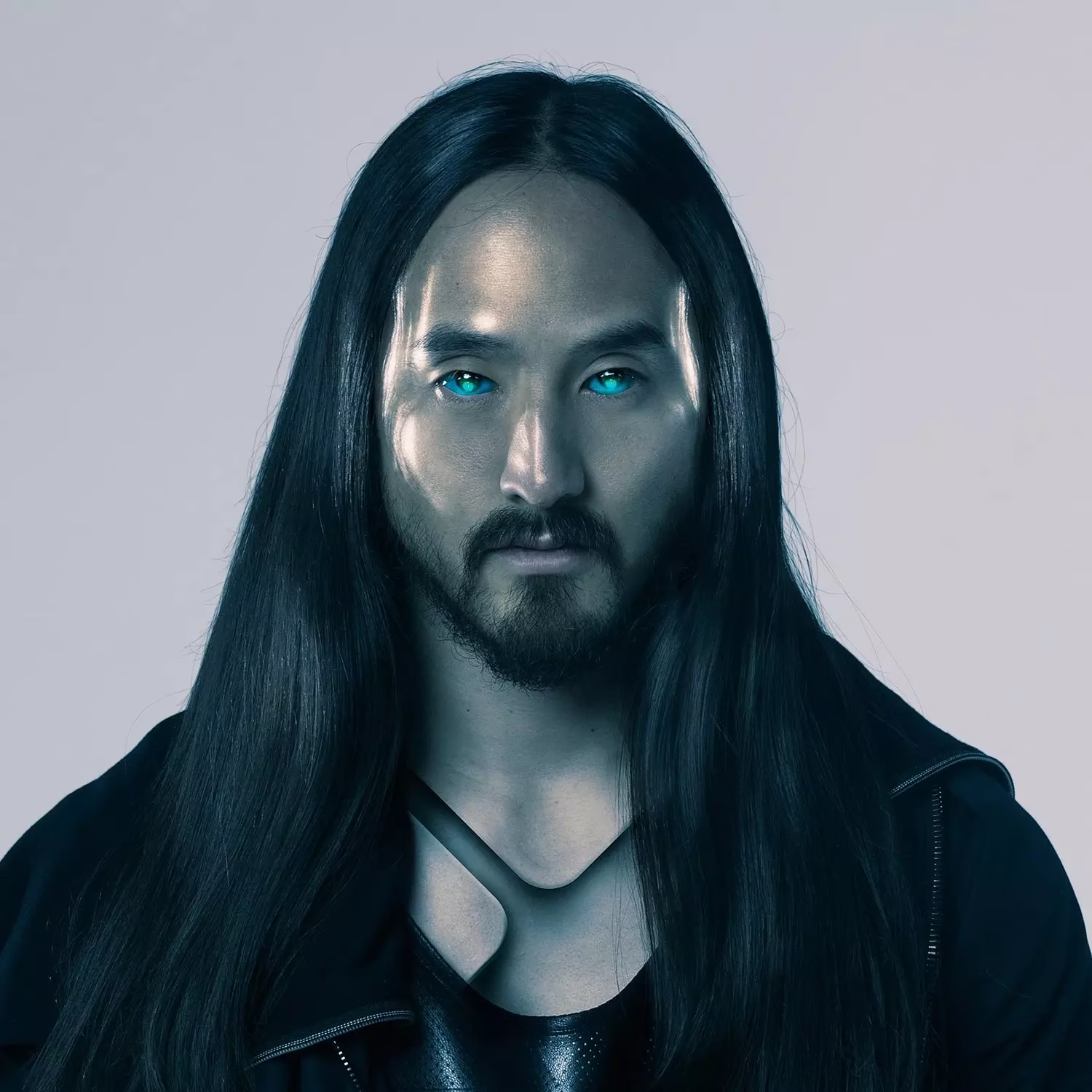
Steve Aoki's vision of the future comes from personal experience. After losing his father, Japanese-born wrestler/restaurateur Hiroaki Aoki, in 2008, the GRAMMY-nominated DJ/producer became, in his own words, obsessed with how technology and humanity would merge in the future.
"I remember after my father passed away there [were] a lot of different things I became obsessed with," says Aoki. "The ideas of living forever [and] technology fusing with our bodies where we can cure cancers — all things I wish I could've done to help my father. And I read all [these] books. And I think in the end it's because I just kind of made this connection: The neon future was really a product of trying to deal with [the] loss of my father."
Aoki took all of his studying and research and put it into his latest album Neon Future I, due Sept. 30. Featuring GRAMMY nominees Fall Out Boy and Bonnie McKee, and GRAMMY winner will.i.am, among others, the 10-track album marks Aoki's next step as an artist — a look into the man behind the fun-filled live show known to involve cake smashing and champagne spraying.
Ahead of the album's release, Aoki participated in an exclusive GRAMMY.com interview and discussed the inspiration for his latest album, how he was inspired by Skrillex's acceptance speech at the GRAMMYs in 2012 and rediscovering his love for DJing.
What is your neon future?
Something that doesn't ever stop changing, morphing and evolving. Like this process of finishing [Neon Future I] has never really stopped; it's still going, and the closure is the hardest part. Even when there's closure, there's another portal to Neon Future Part 2, which is a whole other project. With [2012's GRAMMY-nominated] Wonderland, I always consider that my training wheels into understanding how to process and write an album. It's such a different partaking than understanding how to finish writing a song — the cohesion, the overall vision and then having each song flow with each other.
Are there albums or other works of art that served as templates for creating this project?
There's no doubt the literature [I read] about the future [played] into the conceptualizing of the visual perception of what the neon future is, especially with music videos. So the music videos all being placed in the future and having elements of what I've read about, from what futurists have built their trajectories on [to] where things are going. Of course you can't have nondrama, but at the same time I'm trying to build more of this utopian sense of what I'm thinking of as the concept of what a neon future is, instead of a Terminator type.
It is funny how everyone goes for the apocalyptic vision.
Exactly. That's more exciting to watch in movies and you want to see that. But the future is not going that direction and [at] the same time with these music videos I want to create drama and I'm always battling that as we create these music videos.
What is your favorite GRAMMY moment?
My favorite GRAMMY moment was getting that call. I was in South Africa, I just landed and [got a] call from my manager saying, "Hey, you need to sit down, I need to tell you some news." I thought it was bad news, but he's like, "Yo, you just got nominated for Best [Dance/Electronica] Album." I was like, "What?" I never thought [I] was a consideration.
Do you have a favorite GRAMMY moment as a fan?
Speeches resonate more memorably. I'm sure there are more emotionally compelling speeches, but the one that hit me was watching Skrillex when he swept the [Dance/Electronic Field at the] GRAMMYs [in 2012]. He spoke from the heart and he spoke to the crowd as if he was speaking to me. He was very natural about everything and I was just so happy he did that sweep and he deserves it all. I was just excited, watching him I was inspired. I remember at the end he said something like, "Keep making music weird." It's great to see something like that happening, where I always felt like we were part of this weird subculture where the GRAMMYs wouldn't take note; [now] they are.
Do you still feel like you're part of a subculture?
When I think about the music in essence, it's just not commercial. It might have commercial elements and pop sensibilities, but [it's] not made for the radio. [It's] not made for the mainstream culture. I grew up in the most niche subculture where [there were] 1,500 kids going to a show. So for something like this I still have the same kind of context when I'm thinking about the music. And sometimes I stop and go, "Holy s***, I am working with Fall Out Boy." [And] will.i.am is kind of the definition of pop music of this decade. He's written pop records that quite possibly billions of people have heard. And you work with these people and it's so organic, and they're so human. There's that human element where it's like you're not a star, you're just my friend and we absorb this same kind of connection with this music and we want to do something with it. It's hard when you're in the present and you're doing it. Sometimes it's hard to take a step out and go, "Holy s***, you're really part of a bigger culture than you think you are." But then again, when I really break it down, dance music is still on the fringe of mainstream.
What is the next scene you see emerging?
For me there are so many exciting sounds everywhere, and as a DJ and being in Ibiza, [Spain,] [I've opened] my mind and ears to other kinds of music. Being in America and being in Europe, the way people think about digesting music is two different things. Especially on an island where it truly is the mecca of dance music; it has nothing to do with EDM. EDM has always been an American term and is a fairly new [term]. Going to what my sound is, [what's] exciting me now is I'm doing these sets and I look forward to these pre-party sets … at [Café Mambo in Ibiza where] I am exclusively playing deep house sets. … But it is not EDM, it is not banging music for the club. For that I get excited [because] I am exploring and finding out all this new music and digging into tracks I love but just [rarely] play.
Who is your dream GRAMMY collaborator?
For me to do a song with Zack de la Rocha from Rage Against The Machine would be my dream.
(Steve Baltin has written about music for Rolling Stone, Los Angeles Times, MOJO, Chicago Tribune, AOL, LA Weekly, Philadelphia Weekly, The Hollywood Reporter, and dozens more publications.)
