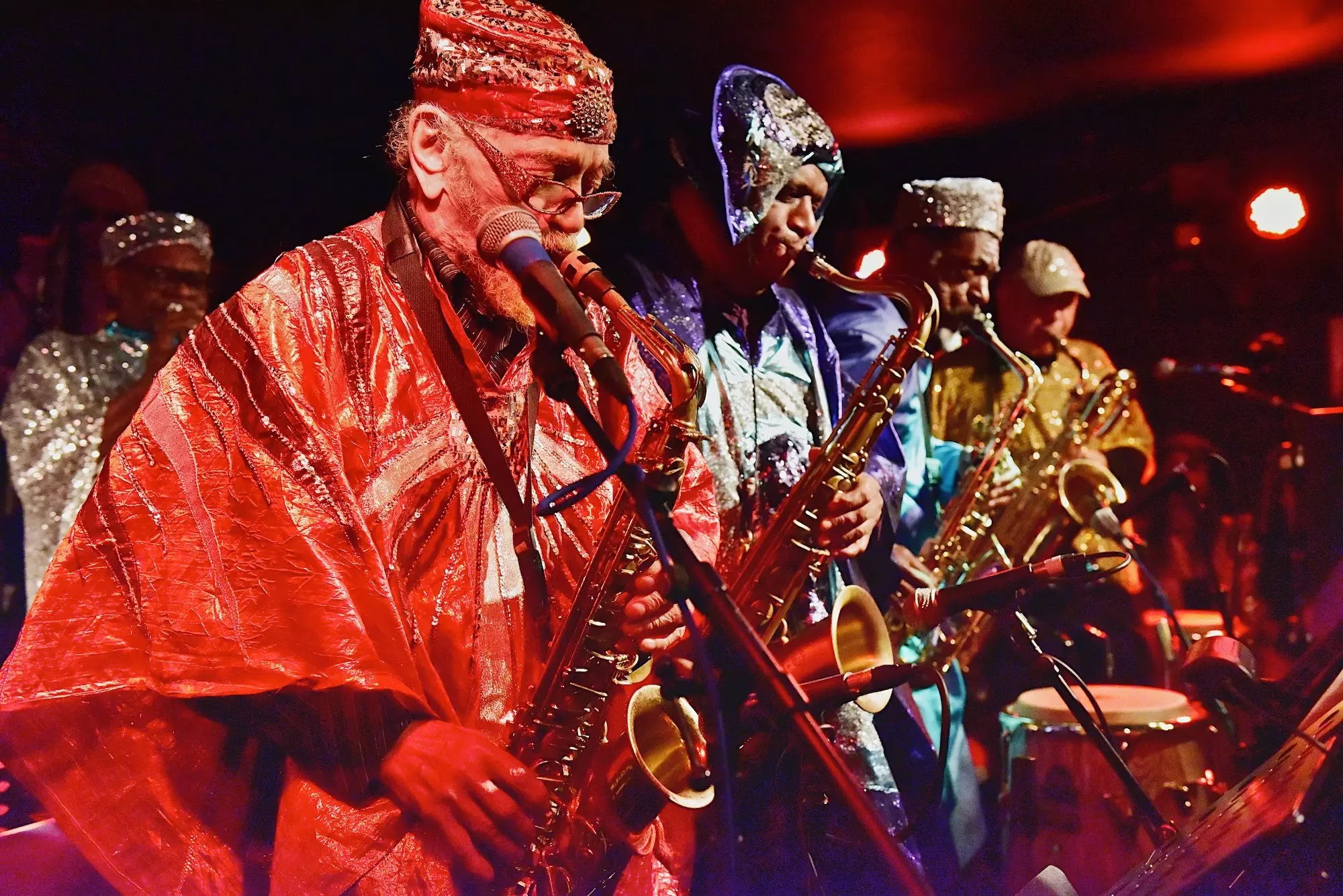
Sun Ra's music transcends genre and generation, time and space. The Alabama-born jazz legend, musical chameleon and Afrofuturist icon—who would have turned 106 in May—began performing in the swing and big band era and kept up a career for five decades, traveling the spaceways through cosmic ambient jazz, intense bursts of free jazz in the ‘60s, disco in the ‘70s and ‘80s, and various genre-agnostic experiments in the spaces in between. Sun Ra’s music was as boundless as the interstellar universe he considered himself a part of, and his sonic innovations continue to echo throughout music nearly three decades after his death.
His band, the Sun Ra Arkestra, is a significant element in keeping that music alive. They’ve continued to tour as an ensemble since the ‘90s, and on Oct. 30, will release their first new album in over two decades, Swirling. It’s as much a tribute to the legacy of Sun Ra as it is a continuation of the ideas and sounds he pioneered in his lifetime, featuring modern reinterpretations of classic Sun Ra compositions such as "Rocket No. 9" and "Angels and Demons at Play," as well as lesser-known tracks, and even the first recording of "Darkness," composed by Arkestra bandleader Marshall Allen. Though the arrival of Swirling comes during a time of fear and uncertainty, with no live music on the horizon for the foreseeable future, longtime Arkestra saxophonist Knoel Scott says that it’s even more important for them to be giving joyful, celebratory music back to the world.
"Music is a healing force," he says. "Our intention was for the music to be healing. For something to give happiness. When people live for a long time, and they’re asked what’s responsible for that, they say they laughed. So mirth and enjoyment and contentment, those things come from music."
GRAMMY.com caught up with Scott to discuss the new permutations of Sun Ra’s music on Swirling, finding hope in troubled times, and traveling in your mind through music.
<iframe style="border: 0; width: 100%; height: 120px;" src="https://bandcamp.com/EmbeddedPlayer/album=547191521/size=large/bgcol=ffffff/linkcol=0687f5/tracklist=false/artwork=small/transparent=true/" seamless><a href="https://sunrastrut.bandcamp.com/album/swirling">Swirling by Sun Ra Arkestra</a></iframe>
So, Swirling is the first new recording from the Sun Ra Arkestra in over 20 years…
The first successful attempt. We tried once or twice, but the conditions weren’t conducive.
Right. Is it a matter of logistics—having everyone be able to contribute at the same time?
Yeah, the crucial part of the band’s ritual is rehearsal. And there are some logistical difficulties. Being in New York, professional musicians, they have to work, and that work is primary, so they don’t always have time to come out. But Swirling was recorded off of a tour, so the band was pretty hot at the time. A lot of the compositions were played off of our book that we were playing off the last tour that we did. We were playing "Darkness" a lot. "Seductive Fantasy," we were playing that a lot. All the songs were part of the regular band book. That book, which Marshall arranged, I guess we were playing it for around a year. Every nine months we change it. We keep certain standards, but to keep everyone interested and keep it fresh, we bring new songs in.
Aside from most of them being part of the Arkestra's last tour, is there something that connects all of these songs?
I guess the intent. Everybody wanted to play the music well and represent Sun Ra well, and give homage to Sonny and create a product that Sonny would be proud of. So, that unified us.
Sun Ra had such a long and prolific career, and this album pulls from various moments throughout that career. Was there an effort to try to represent as broad a selection of his music as possible?
Well, his music was so varied. He played so many different styles, from R&B to so-called Afrobeat to futuristic sounds to swing to avant garde. So yes, we tried to do a variety which reflected the pantheon that Sun Ra created. So therefore, there is a lot of variety on the album. That’s how Sun Ra was, he had so much variety. We never knew what he was going to do, but all of it was within the African-American tradition.
<style>.embed-container { position: relative; padding-bottom: 56.25%; height: 0; overflow: hidden; max-width: 100%; } .embed-container iframe, .embed-container object, .embed-container embed { position: absolute; top: 0; left: 0; width: 100%; height: 100%; }</style><div class='embed-container'><iframe src='https://www.youtube.com/embed/H1ToFXHW5pg' frameborder='0' allowfullscreen></iframe></div>
Are the Arkestra's compositions all, in some way, living and evolving creations?
Yes. The nature of music is you never play it the same way twice. Something is always different. Something is always added. A new nuance created every time we play a composition. It gave us a chance to focus a little more, because the gigs are a show. The focus, to a degree, is on entertainment and presentation. But in the studio, the concentration is all on putting the visual into the music, while in a live show, the visual is there as an accent. But on the recording that all has to be in the music. So we’re trying to create a visual in the listener’s mind.
Likewise, are you always continuing to evolve as musicians?
We have to. Sun Ra says the world’s moving fast, you have to adjust yourself. And Marshall says, "It’s the spirit of the day." Tomorrow you feel a little bit different than you did today. Your interpretation of the music is going to be a little different. So it becomes a living entity, because we put our spirit into it, and it changes from day to day and moment to moment.
Sun Ra's music spans many decades and generations, and this too will likely introduce his and your music to a new generation. What is it that makes his music endure?
The fact that it was from the future. That’s why his sounds are more accessible to the audience's ear now. But in the ‘50s and ’60s, it was radical. They would just be like, "What is he doing?" He was always talking about the future and the new millennium. But the future is now, and so the time for the music is now. He designed it that way, so the millennial generation is able to relate to it, because he wrote the music for them. The music for tomorrow’s world. People have changed. People’s ears have developed. The computer age has come, and electronics are a standard part of their listening, and Sun Ra pioneered these things, so just in terms of what people listen to now, this music that people call new age and Afrobeat, techno, all these things are devices Sun Ra used in his music in the ’60s and ’70s. As soon as a new sound came out, Sun Ra was on top of it. So now, people are used to these things. Going back to Star Trek, you hear the sounds that Sun Ra was playing in the ‘60s. Those sounds are now part of the standard media presentation of music.
It’s funny you mention that—I was watching some early episodes of Star Trek and a lot of the music reminded me of Sun Ra.
Yeah. [Laughs.] The theme song is a variation on a standard called "Out of Nowhere." But especially from Slugs’ [Saloon in Manhattan], that was the type of place that the hip people went, and Sun Ra was an underground figure for years. But he was also in California for years, and there’s been a cross pollination of Sun Ra’s music into Hollywood and TV, et cetera.
<iframe style="border: 0; width: 100%; height: 120px;" src="https://bandcamp.com/EmbeddedPlayer/album=960535632/size=large/bgcol=ffffff/linkcol=0687f5/tracklist=false/artwork=small/track=3589223230/transparent=true/" seamless><a href="https://sunramusic.bandcamp.com/album/blue-delight">Blue Delight by Sun Ra & His Arkestra</a></iframe>
It’s an odd time to be releasing music right now. How do you feel about putting something out right now, especially something based so heavily on the Arkestra’s live performances, without being able to be onstage to play them?
That’s very important, because people are hungry for music. They’re not able to go out, so they’re on YouTube and Spotify, they’re listening to records. We stay at home, so music is a very important thing. I think it’s really perfect for the album to come out when people are spending more time at home and are looking for some kind of sound that will inspire them or give them hope or some kind of relief from this terrible time that we’re going through, because it’s stressful for everyone. You can’t go out, but you can put on an album and travel in your mind.
Is there a message or a feeling that you would hope listeners take away from hearing Swirling?
That there’s hope. No matter how bleak or troublesome or turbulent the times are, as long as people have love in their hearts, if they want a better world, there can be a better world. And the unification of the musicians from different areas of the United states and as far as Brazil, we all have different perspectives but come together of one accord, so the Arkestra’s contribution is a testimony that we can come of one accord. We may not always agree, but we can come together for a positive outlook and a positive goal. And that comes down to intent, for people with love in their hearts and joy in their spirits and enlightenment in their minds. Our job is to heal the planet.
Diamond Platnumz Talks Growing Up In Tanzania & Breaking Into American Popular Music
