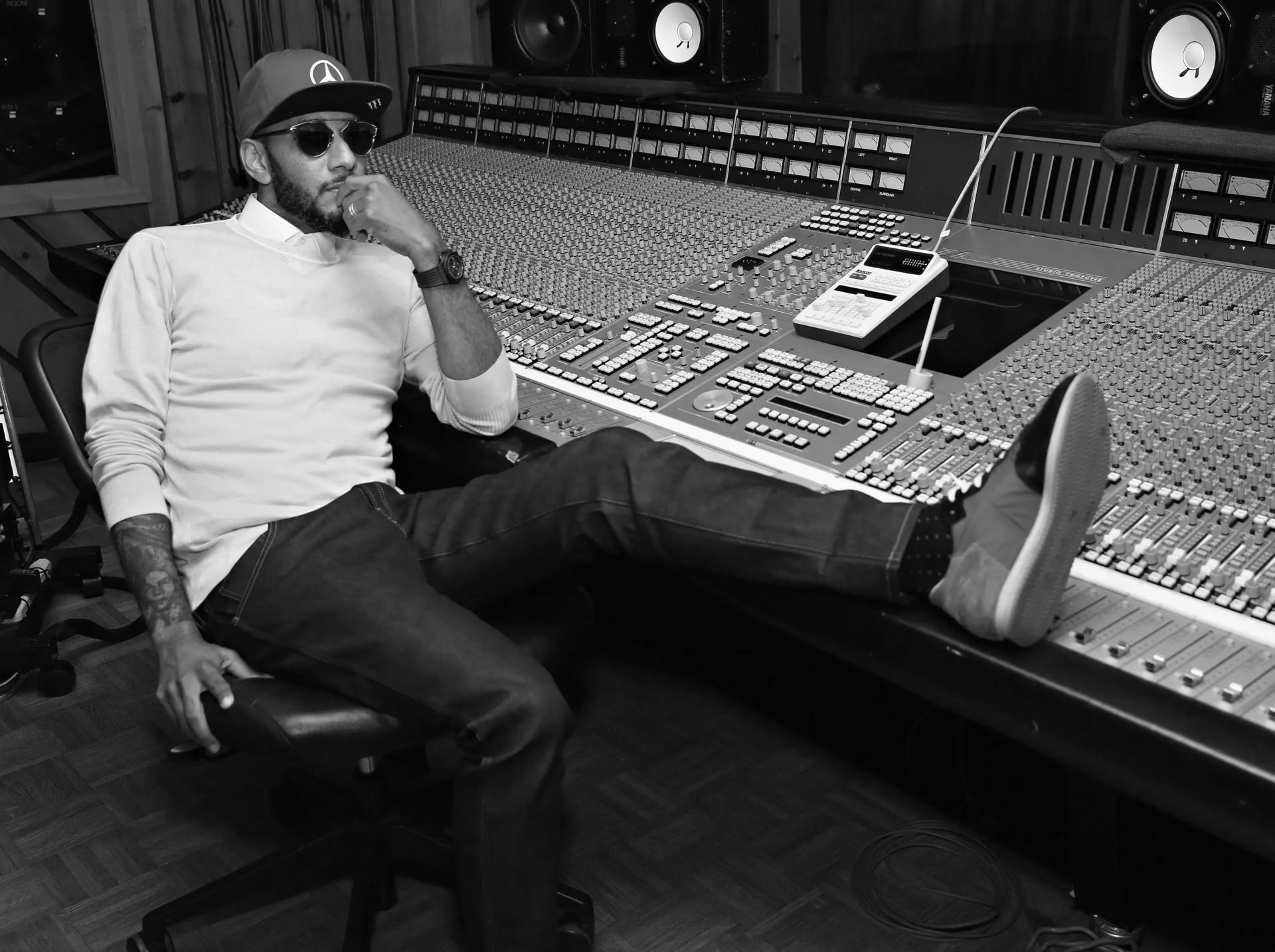
There is a distinct difference between beat-maker and a producer in the music world. While the former might get one’s foot in the door, the latter will determine the length of the stay. A seasoned veteran such as Swizz Beatz knows the importance of mastering both crafts.
Born Kasseem Dean in The Bronx, N.Y., Swizz’ production has permeated generations of ears throughout his 20-year career. His ability to create and direct sonic landscapes for a myriad of artists, from a heavy-hitting lyricist such as DMX to a beloved vocalist like Whitney Houston, has solidified his name among music's elite.
Though there was no survivor's guide for Swizz Beatz to follow, he cultivated a handful of philosophies from years of being regarded as one of music’s in-demand producers.
Trust Your Vision
Most family businesses can be a gift and a curse, and Ruff Ryders Entertainment was no exception. Founded in 1988 by Swizz’ uncles Joaquin Dean and Darin Dean, the New York label was built in the midst of hip-hop’s Golden Era.
At the time of the label’s founding, Swizz Beatz had built a reputable business as a DJ and had yet to flex his production muscles. But when the young talent yearned to get into making beats for his uncles’ roster, he was slighted. Undeterred, Swizz proved all he needed was one chance.
The first beat he created became “Ruff Ryders’ Anthem,” an instrumental ripe for the vocals of gritty Yonkers lyricist DMX. What the beat lacked in sophistication (due to Swizz’ limited production abilities and access to equipment at the time) it made up for in raw, unapologetic energy. Initially, DMX refrained from recording over it, deeming it to be a rock ‘n’ roll beat. He quickly came around after a room full of counterparts, including Swizz Beatz, hyped him up while recording the track.
<iframe width="620" height="349" src="https://www.youtube.com/embed/ThlhSnRk21E" frameborder="0" allow="autoplay; encrypted-media" allowfullscreen></iframe>
The song only reached No. 93 on Billboard’s Hot 100 charts, but quickly catapulted DMX and the then-unknown Swizz Beatz into commercial strata – evidenced by a Woodstock ‘99 performance in front of an endless sea of fans religiously chanting each lyric.
Since then, Swizz has made contributions to hundreds of albums, including the Ruff Ryder’s platinum-selling Ride Or Die Vol. 1 compilation album. He won his first GRAMMY alongside Jay-Z at the 53rd GRAMMY Awards for Best Rap Performance By A Duo Or Group for "On To The Next One."
<iframe allow="autoplay *; encrypted-media *;" frameborder="0" height="150" sandbox="allow-forms allow-popups allow-same-origin allow-scripts allow-top-navigation-by-user-activation" src="https://embed.music.apple.com/us/album/on-to-the-next-one-feat-swizz-beatz/1224232528?i=1224232537&app=music" width="660"></iframe>
“If you have a dream that your closest friends and family members can’t understand, stick to it,” he advised in a one-on-one interview with GRAMMY-nominated engineer Ken “Duro” Ifill. He continued, “If I would have stayed in that box as a DJ where they felt I was comfortable, we wouldn’t be having this discussion.”
Evolution Is Everything
In his purest form, Swizz was, and is, an audio architect who carefully surveyed his clients while laying the proper foundation to construct a masterpiece. In 1999 his instincts notified him when it was time to showcase beats with literal bells and whistles, like “Party Up (Up In Here)” for DMX, while tugs on his heart strings prompted a scaled-back bed of production for Eve to pour out her emotions on “Love Is Blind.”
<iframe width="620" height="349" src="https://www.youtube.com/embed/ODBDFGeZaSs" frameborder="0" allow="autoplay; encrypted-media" allowfullscreen></iframe>
But navigating the minds of an artist isn’t a simple task. The idea of chart-topping commercial success is alluring for any up-and-coming musician on the verge of superstardom. Swizz, however, challenges his collaborators to think past current trends and popular sounds.
“If we can’t make history, then it’s a waste of time,” he claimed.
Despite his past achievements, he prefers not to relish in them. Instead, Swizz craves to accomplish similar feats as an executive producer who orchestrates an entire body of work from top to bottom.
“When you’re really, really, managing a project, executive producing a project, and giving your stamp, it shows longevity, it shows responsibility. It shows the numerous choices that you’ve made that should be honorable.”
Remember Why You Started
The music business is filled with highs and lows, and Swizz admits to experiencing both.
“When you hot, your phone is hot. When you cold, your phone is cold," he said. "I learned to not take it personally.”
Though he has built an empire in and outside of the music business, he didn’t set out to make a lucrative living when he started making beats at age 16.
“I didn’t even know you could make money from music when I was doing it,” he admitted. “It was to the point where they were sending me checks, I thought they were fake.”
The skepticism eventually wore off. In 2017, he raked in $17 million for his musical contributions and a handful of savvy investments, some he credits to his Harvard Business degree.
In a full-circle moment the following year, Swizz was honored by the Recording Academy's Producers & Engineers Wing at their 11th Annual Celebration alongside his wife, GRAMMY-winning artist Alicia Keys. In front of a room full of industry titans, Swizz and Keys were the center of attention, feted for their devotion to the craft of making records.
Despite a 20-plus-year career, Swizz Beatz has seemingly just gotten started. As he strives to outdo past accomplishments, he provides a simple piece of advice to those looking to follow in his footsteps: “If you’re not having fun, don’t even do it. I don’t care how much money it is, don’t do it unless you’re having fun.”
Swizz Beatz is a member of the Recording Academy and can be seen in the Academy's We Are Music campaign.
