
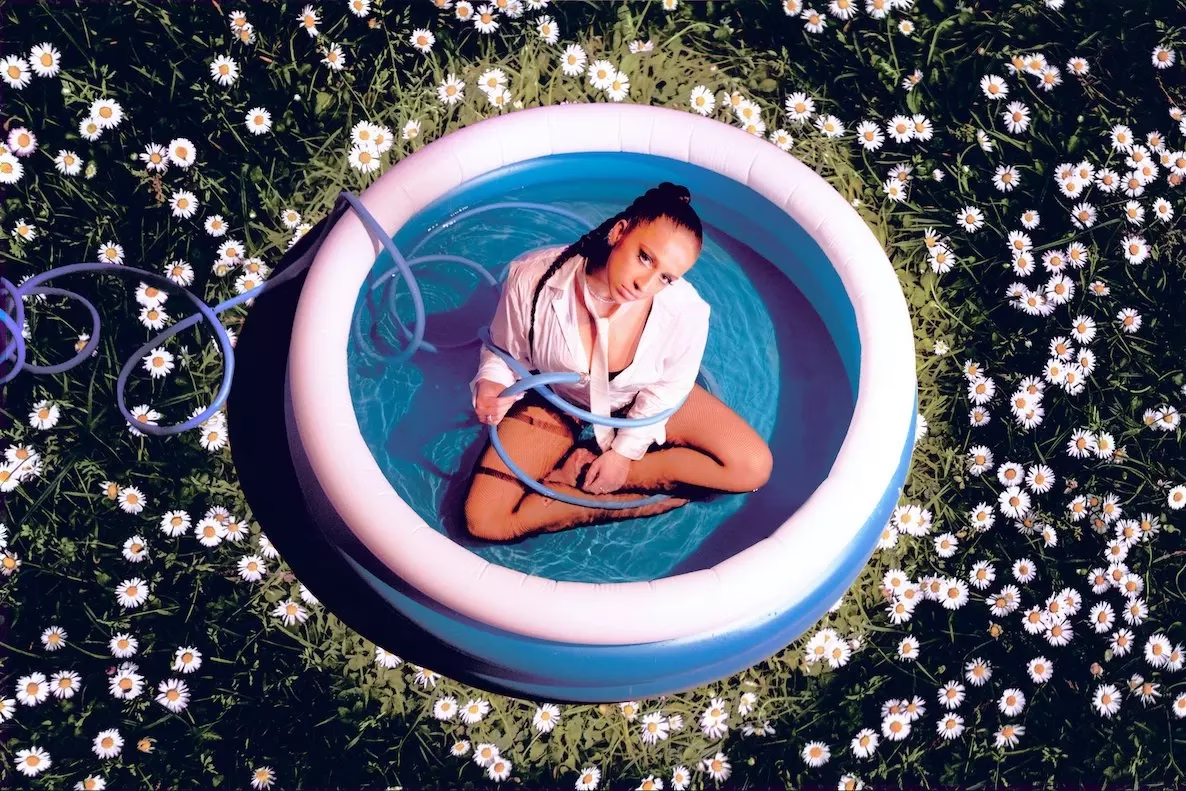
At 18, it may seem like Tate McRae is just getting started. But a career in music is something she's been working toward practically her whole life, posting her first original song on her YouTube page at just 7 years old. So how did she feel upon releasing her debut album, i used to think i could fly?
"The fact that it's actually here," she said on the eve of its May 27 release, "makes me want to, honestly, puke a little bit."
McRae has never shied away from being brutally honest in her music, which likely contributes to her nerves — but also, her appeal. The Canadian singer/songwriter's breakout single, 2020's "you broke me first," proved that her unabashed vulnerability is connecting. Peaking at No. 1 on Mediabase's Pop Radio chart in 2021, the song now has 1.4 billion combined streams worldwide.
i used to think i could fly continues McRae's candid lyricism while taking her sound from lo-fi to arena-ready, exemplified by tracks like the anthemic "she's all i wanna be" and the punk-leaning "what would you do?" Whether it's a hard-hitting ballad such as "chaotic" or an uptempo jam like the Nelly-sampling "don't come back," each track shows that McRae is ready to be one of her generation's most raw-and-real superstars.
GRAMMY.com chatted with McRae about why it's important for her to be so open, the "identity crisis" that influenced her album, and which lyrics hit her just as hard as they hit fans.
You've said that you treat your song like your diary entries. Do you ever have moments when you realize that this stuff that's really private and personal to you is about to be in the hands of everyone?
I'm a pretty private person otherwise — you know, aside from literally writing my feelings and putting them on the internet. But it is really scary when you think about real people listening to it, [especially] people that I know. It's terrifying because no one wants to ever look that sensitive or vulnerable. But I genuinely think that my true fans are gonna really appreciate the lyrics, and the honesty and rawness of the record.
Did any of the reactions to any of the songs that you've released — especially "you broke me first," since it became so big — inspire the way that you approached this album?
Actually getting to perform my songs for the first time influenced my writing a lot. Getting to see actual fans sing back my lyrics felt like I can't stand up on stage and preach something that I don't believe. I definitely need to be talking about real shit and real stuff that I really believe in, and I want others to hear too.
Are there any songs on this album that are so personal that you've thought, "Oh s***, is this really being released?"
There's this one song called "hate myself." This song definitely put me through a wringer as I was recording and writing it. I feel like a lot of people write from the perspective of blaming the other person because it's the easiest thing to do. But in this song, I point out all of my biggest flop flaws as a person, which is so scary. I mean, I'm just full-on exposing myself to the whole world.
It talks about how when you care about people, and sometimes when you love people so much, you push them away. And I think that's just a coping mechanism that I do. So that whole song is basically admitting that I push people away that I truly care about, and care about it — and that's really scary that I'm releasing it.
There are several lyrics that cut like a knife on this album. Obviously you've felt all of these lyrics at one point, but are there any that still kind of sting because of how raw and real you were?
The one lyric that really hurts in "i still say goodnight" is "I couldn't say much/ I was distracted/ You seem so anxious/ Like you had something to hide/ Tell me it's nothing/ I don't believe you/ I know that look you get when you're about to lie." That feeling of staring at someone dead in the eye and knowing that they're blatantly lying to you is so crazy because you can never know if someone's telling you the truth or not. It's all based on your intuition and if you trust them. It's terrifying!
Then there's also this lyric in "boy x" at the end of the chorus, "And when you get bored like you always do/ Tell me that you'll let her go before you look for someone new." It's [about] a wandering eye, when someone's in a relationship and they start looking for other people while they're still seeing someone. I think that's one of the grossest things ever. It perfectly targeted exactly how I felt about the situation.
On the opposite end, is there a lyric that you hear back and you're like, "Damn, I wrote that?"
My favorite bridge on the album is in "hate myself." "So off I go to hurt you again/ I'll shut you out to try and forget/ That I'm the one who's f***ed in the end/ 'Cause, baby, you'll be happier with someone else/ So if I go to hurt you again/ I'll shut you out to try and forget/ That I'm the one who's f***ed in the end/ 'Cause you couldn't hate me more than I hate myself."
I remember writing this with this producer named Blake Slatkin. It was just me and him in the room, and I had just finished writing all the lyrics, and we were like, "Okay, we need a big bridge." We were standing on opposite sides of the room like screaming this bridge. We were like, "F*** yeah! This is perfect!"
It perfectly summarizes the feeling of blaming yourself for everything, but at the end of the day, the reason why this is all so painful is because I pushed you away, and now I'm the one who's getting hurt because you're going to be much happier with someone else and I'm going to watch you live your life and be incredibly happy. And that's going to be the hardest part.
I have to say, for being 18, you're incredibly intuitive about this kind of stuff. I'm impressed. I also feel like that's kind of the nature of teenagers these days. They are really in their feels, and the music that's popular today — yours included — is really vulnerable. Does it feel like that way on the artist's side, that the most vulnerable music is the most popular?
There's generic lyrics and, like, party songs, and everyone can listen to that. But at the end of the day, what people are going to end up going back to is the stuff that they feel in their gut.
Especially my generation, with social media, and the pandemic happening, and everything that's going on, I feel like a lot of people are bad at talking about their emotions. So a lot of people my age go to music in order to get that outlet — they're like feeding for something that's gonna feel really honest to them. So as an artist, I'm like, "This is the kind of music that I want to listen to, so this is obviously what I want to write."
You've explained that you had a "big identity crisis" in the middle of writing this album, which in part inspired the title i used to think i could fly. Can you elaborate on what you were going through, and how this album helped you through it?
When I first moved to LA, I got put into a bunch of writing sessions with a lot of different people. And I was so confused because I was being fed so many different opinions on who I should be, how I should talk, what I should say and what kind of music I should put out. And I've never been one to listen to people — I mean, that sounds horrible. [Laughs.]
I've just always gone with my own gut, and I've always been like, "No, I'm gonna do it my way." And it was really confusing for a while, because I was like, "Who the hell am I?" And I'm not at home anymore. I'm by myself. I'm meeting a whole bunch of friends who I don't even know if they're my friends. I was going through my first heartbreak. There were so many factors that I was so confused, and I was having a full identity crisis. And then when I started writing music that was like, "Oh, this is how I'm feeling," that's when it started to settle down a bit.
This album takes your sound to another level, with fuller production and more fast-paced, anthemic songs. What were the main catalysts for that?
The aspect of live shows, doing that for the first time, I was like, I want to not have a boring show. I want to put on a show where people are able to scream at me.
It wasn't sprouted from, like, "I want to sound rock-y" or "I want to have this musical instrument in my music." It was very much like, if I was so pissed off one day, I ended up writing a really pissed off song that ended up turning into some sort of punky song. Then I was at Finneas' house and I was so sensitive that day, so we started writing this like really classic piano. The difference in all of my songs is so wide, but I feel like that's what perfectly captures an identity crisis — in a beautiful way.
I feel like there are so many options for what this album could have been called, like Identity Crisis or even just Mood. But I love the sentiment of i used to think i could fly, like the fact that when you're young and naive, you think anything is possible. But there is a point in time, and maybe it's when you're 18, that the reality hits and you're like, you can't fly.
Right. I didn't want this album to have a nothing title. I really do want there to be some depth and darkness in the title because I want people to take me seriously. I want people to know that I am analyzing all of everything over and over again in my head, and I'm not just picking a random title that came out of nowhere.
"Tate McRae Is Deep" is the headline here.
[Laughs] Tate McRae is actually super deep and super intellectual.
As far as getting your sound to this next level on this album, you worked with a lot of major pop players like Greg Kurstin, Finneas, Louis Bell and Charlie Puth. Did any of them in particular feel like they were crucial in getting you to this next sound level?
Yeah, Greg Kurstin. I had been doing a lot of writing sessions where I felt like I was being pushed in a lot of different directions, and he was one of the only guys that I was able to sit in a room and finally talk about — I remember, I wrote "chaotic," and that was one of the first songs that like was a switch in my album. That was one of the first songs that I was like, "Oh yes, this needs to be on my album."
His energy, and obviously, he's so insanely talented. and everything he was producing was so inspiring to me. I just feel like we gelled really well as writers and I love working with him. He's so incredible.
I've heard that for being such a prolific, superstar kind of producer, he's like the most low-key guy.
It's so funny, because everyone always asks me, "Oh, what was the process like working with him? How was the energy in the room? It must have been electric!" And I'm like, "Well…" [Laughs.]
Like, "she's all i wanna be" started as a ballad with piano chords. And I was like, quietly in the corner typing on my computer and wrote this song. I went into the studio and recorded it in full takes, and then I gave him a high five, he said "Good job," and I left. And that was the writing session. There was no discussion of the song, no nothing. The energy in the song was so personal that we were like, "Okay, good job. See you next time."
That's so funny, because that's the song that goes the most hard at your show.
I know, and I was like, whispering it in the corner of the [writing] room.
Did you have any particular moments during the tour where it really hit you that this is your job?
Well, I have really bad impostor syndrome. I have this vision that I'm not supposed to be there. So I'll show up to a venue or something, and I'm like, "No one will show up." It's very hard for me to grasp.
I went to Detroit and it was my biggest show that I played, and I just remember I released a song the night before or that night, and I was like, "Should I sing this song? It hasn't even been out for a few hours." I started singing it, and the entire place was singing the song. It was like thousands of kids, like a full choir screaming it. I remember getting full body chills and just crying. I was like, "This is wild. How is music doing this?"
And then also, at Lollapalooza [last year], it was my first big show. I did like maybe three shows that had like 100 people, but that was the extent of my singing performances.
They were really throwing you to the wolves on that one.
I was like, "What is Lollapalooza?" I had no idea. And I walked out on stage, it was like, 20,000 people, I'm like mind-blown. And I didn't realize what had happened with "you broke me first" at the time, because I [had been] like, in my basement at home in Canada. I just remember hearing people scream that song and I was like, "How do people know this? How is that like, random 42-year-old man in the back singing it?"
Your talent as a dancer got you noticed by Justin Bieber and your talent as a singer got you noticed by Shawn Mendes. Who are you hoping will notice you next?
I mean, okay, Justin Bieber, I didn't really do anything with him. It was like a one-time performance that a whole bunch of kids did.
I mean, you still made it onstage with Justin. Even if he didn't notice you, you still made it there.
If Justin Bieber knew who I was, I would freak out. That would be literally crazy.
Just tell yourself that he knows who you are.
Yeah, he definitely knows who I am, obviously.
Run The World: Inside Olivia Rodrigo's Stratospheric, Record-Setting Journey To Superstardom
