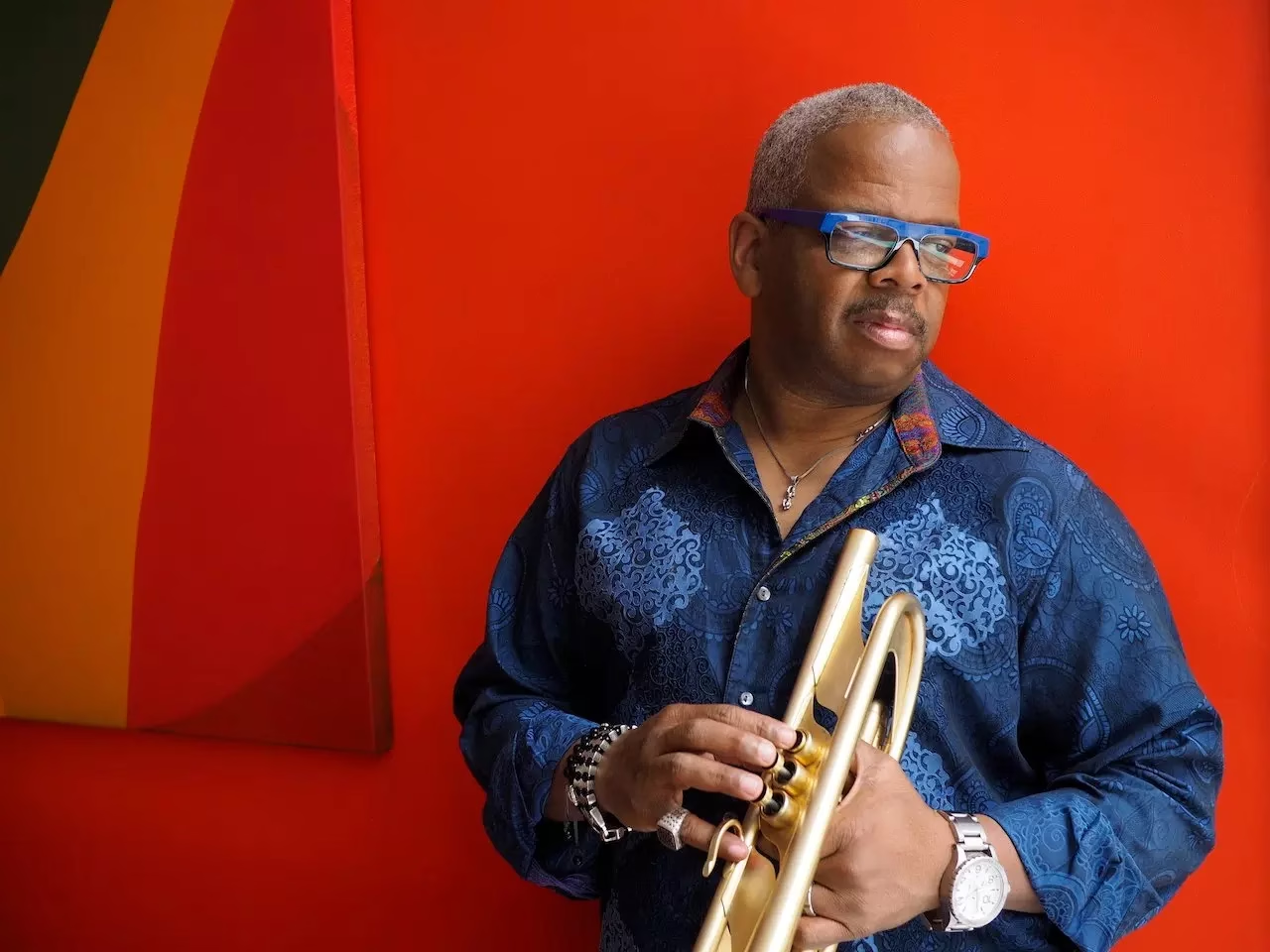
It's no wonder film director/writer Spike Lee and six-time GRAMMY-winning composer/trumpeter Terence Blanchard are lifelong collaborators—their level of mastery together makes for exquisite storytelling.
Blanchard first worked with the director in the late '80s when he performed on the soundtrack for Lee's 1989 breakthrough film, Do The Right Thing. The two have since worked together on more than 15 films including Jungle Fever (1991), Malcolm X (1992) and Summer of Sam (1999). Lee's 2018 film, BlacKkKlansman, which earned him an Academy Award for Best Adapted Screenplay, garnered Blanchard his first Oscar nomination for Best Original Score.
Blanchard now returns to the scoring seat on Lee's newly released Netflix film Da 5 Bloods, yet another gut-wrenching drama from the socially conscious filmmaker.
<style>.embed-container { position: relative; padding-bottom: 56.25%; height: 0; overflow: hidden; max-width: 100%; } .embed-container iframe, .embed-container object, .embed-container embed { position: absolute; top: 0; left: 0; width: 100%; height: 100%; }</style><div class='embed-container'><iframe src='https://www.youtube.com/embed//D5RDTPfsLAI' frameborder='0' allowfullscreen></iframe></div>
The epic war drama tells the story of four African-American Vietnam War veterans who return to the country in search of the remains of their fallen Squad Leader and the buried treasure they left behind decades ago.
The film's score, for which Blanchard utilized a 90-piece orchestra, features several songs from Marvin Gaye's iconic 1971 album What's Going On, which largely provides the movie's musical and thematic backbone.
"His music shapes the film in an immense way," Blanchard tells GRAMMY.com in a recent interview. "The lyrics are very powerful. I remember when Spike told me he was going to use it, it automatically just sent me down a direction, musically, where I wanted the score to have a grand feel to it. I wanted it to have more of a universal theme. I knew that Gaye's music was going to cover a certain aspect of the emotion of dealing with social injustice in this country."
GRAMMY.com spoke with Terence Blanchard about the musical vision behind Da 5 Bloods and how Marvin Gaye's quintessential album shaped the film and his own life.
<style>.embed-container { position: relative; padding-bottom: 56.25%; height: 0; overflow: hidden; max-width: 100%; } .embed-container iframe, .embed-container object, .embed-container embed { position: absolute; top: 0; left: 0; width: 100%; height: 100%; }</style><div class='embed-container'><iframe src='https://www.youtube.com/embed//MNsAcQUliBQ' frameborder='0' allowfullscreen></iframe></div>
With the recent Black Lives Matter protests, Da 5 Bloods seems even more timely.
Sadly, I kinda felt the film was timely even without those events because we are still dealing with those same issues. With the [tragedies] of George Floyd, Rayshard Brooks and Breonna Taylor, it's just amplified what we have been talking about for decades.
Spike has been known to constantly produce films that not only entertain, but make you reflect on the state of our social consciousness right now. I feel blessed that the movie is sparking debate, just like BlacKkKlansman did. But now, we have to go beyond debate and create legislation, change hearts and minds and really look for substantive change.
The opening montage of Da 5 Bloods, which illustrated the racially charged anguish of the Vietnam era in the 1960s, is heartbreaking to watch.
It speaks to the whole nature of … people of color [having] been screaming about injustice for decades. If people were really listening in places of power, then that portion of the movie would be irrelevant, you know? But the sad truth of it is, we haven't moved the needle as much as we'd like to think that we have. The mere fact that we have a president who is willing to have a rally on Juneteenth in Tulsa, [Okla.], a place where Black Wall Street was dismantled—that says a lot about racism in this country and how people are still trying to justify those actions. So when I see a montage like that, it's heart-wrenching.
But I know there are so many other stories to be told from our culture … Finally, it feels like people are starting to wake up to what is really going on and not constantly [falling] back into a position of defending. I think Spike has always been great at pushing that envelope, trying to make people reflect on what's been happening.
<style>.embed-container { position: relative; padding-bottom: 56.25%; height: 0; overflow: hidden; max-width: 100%; } .embed-container iframe, .embed-container object, .embed-container embed { position: absolute; top: 0; left: 0; width: 100%; height: 100%; }</style><div class='embed-container'><iframe src='https://www.youtube.com/embed//o5TmORitlKk' frameborder='0' allowfullscreen></iframe></div>
Speaking of "what's going on," let's talk about how Marvin Gaye's music served as the backbone of this film.
His music shapes the film in an immense way. The lyrics are very powerful. I remember when Spike told me he was going to use it, it automatically just sent me down a direction, musically, where I wanted the score to have a grand feel to it. I wanted it to have more of a universal theme. I knew that Gaye's music was going to cover a certain aspect of the emotion of dealing with social injustice in this country.
I wanted the score to partner with that in such a way to broaden the experience to hopefully draw more people to the film. One of the things we all know is that complacency is the enemy of change. We can't sit on the sidelines anymore. We have to become active and really do our part to effect change.
Read: Fight The Power: 11 Powerful Protest Songs Advocating For Racial Justice
What was Gaye's influence on your own life?
"What's Going On"—I remember when I first heard that, it was an impactful thing. As a kid, obviously we didn't have social media back then. That song made me feel like I wasn't by myself, that I wasn't crazy [for] feeling the things that I was feeling.
Marvin's music, along with James Brown's "Say It Loud – I'm Black and I'm Proud," were things that started to shape my thinking in terms of being proud of who I am, what I could accomplish in my life and hopefully what I could give back to the world.
If you chronicle what has happened in the music industry, Gaye was a heterosexual male who was socially conscious—a strong male figure in the '70s who was a R&B singer. He broke through to other areas of the music world; back then, we used to call it "crossover."
It's hard to find singers that have crossed over like that today. He wasn't afraid to talk about certain things or deal with issues. When you look at Sam Cooke, who was a balladeer, he sang a lot of beautiful songs. It wasn't until he sang “A Change Is Gonna Come" did people really start to understand that he was socially conscious.
With Marvin Gaye, we knew that; we got a sense of that. It felt he was out there speaking for us and to us at the same time.
Spike Lee (L) and Terence Blanchard (R) at a scoring session for Da 5 Bloods | Photo: Matt Sayles | © 2020 Netlfix Inc. All rights Reserved.
Working with Spike for the past 30 years, what has he taught you?
He's taught me a lot about how to follow your heart. One of the things I have always loved about Spike is that he is a film historian. He loves film and knows it backwards and forwards. He doesn't allow that knowledge of history to totally shape what it is that he does. He still has his own vision about what's possible and what could be done.
That is something that has always inspired me because I am the same way, being a jazz musician. You want to know your history, in terms of the music, but you don't want to be bound by it. You still want to use it as a springboard to move further and further into the future.
How do you use music to speak for you?
It's an interesting thing. I know it speaks for me, but I think a lot of it is me healing myself. With the types of films that Spike has done and my relationship with him, we have done topics that have been dear to my heart as well. In the process of dealing with that, you are trying to find some resolution. Hopefully, you are creating something that most people can relate to.
I tend to think there are more people going through exactly what I am going through. Witnessing the depth of George Floyd on national television breaks my heart, angers me and enrages me in such a way that I know there are a lot of other Americans out there that are going through the same thing. Being an artist, you cannot turn away from those feelings, those issues, that passion. You have to utilize that and allow it to help create the music. Not the intellect; that's how we study and know how to make things work. It's that combination of passion and brains that allow you to come up with the ideas for these projects.
What do you love more, performing your jazz music or composing?
I love performing, there's no doubt! But right now, due to the [coronavirus] pandemic, I love composing! I am a little nervous about being out in public; I have had friends and mentors succumb to COVID-19. It's just all too much at one time. It made me understand how real this issue is and how seriously we have to take it. It's unfortunate that the virus has been used for political gain. It potentially has put lives in danger.
Terence Blanchard at a scoring session for Da 5 Bloods | Photo: Matt Sayles | © 2020 Netlfix Inc. All rights Reserved.
It seems like you have a love for and commitment to socially conscious projects.
One of the things that has always drawn me to certain artists in the jazz world is their ability to chronicle what has been going on in their environment. Look at John Coltrane's [civil rights elegy] "Alabama" for the four little girls—[Editor's Note: In 1963, Ku Klux Klan members killed four young Black girls in the 16th Street Baptist Church bombing in Birmingham, Ala.]—and Max Roach's Freedom Now Suite ... I have always tried to be an artist that is always socially conscious. This is something that is a part of who I am. I feel like if I have a small, little platform, I should use it to try to raise people's consciousness.
In an interview with Variety, you talked about the racism you had encountered as a Black composer. Do you see this changing?
Of course it's changing. Like anything else, people always say the wheels of change grind slowly … We need more women and people of color to have opportunities to play. We all know they are out there. It's not a vacuum of talent; there's talent all over the place. Opportunities need to happen for a lot of folks.
<style>.embed-container { position: relative; padding-bottom: 56.25%; height: 0; overflow: hidden; max-width: 100%; } .embed-container iframe, .embed-container object, .embed-container embed { position: absolute; top: 0; left: 0; width: 100%; height: 100%; }</style><div class='embed-container'><iframe src='https://www.youtube.com/embed//cPZ0xkxCadE' frameborder='0' allowfullscreen></iframe></div>
What's next on your bucket list?
You know, it's that striving to write the perfect melody and the perfect piece of music, whatever that is. That's always been my passion: trying to strike the perfect tone between the intellect and the heart that will best represent any given moment of time in honor of our environmental experience—something that speaks truth to power.
You also scored the music for HBO's new crime noir TV series, "Perry Mason." What was your vision for that project?
My vision was to create something fresh that would be inviting for new viewers, but still harken to the period. Creating music for that genre is to allow the story to inform you. In any film, there will be gaps in the storytelling process, which is the reason why you have a score. The score can help push those emotional moments that help tell the story.
Freedom For My Body, Freedom For My Mind: The 'Panther' Theme Song Turns 25
