Now that we've shaken off the cranberry-sauce hangover, let's re-ask ourselves: who really broke up the Beatles? Was it Paul? Was it Yoko? Was it Magic Alex? Turns out it's none of the above — that beaten-to-death question and several others are currently circling the drain.
That's because Peter Jackson's new three-part, eight-hour Disney+ documentary, The Beatles: Get Back, exploded the two-dimensional lore of their final year, showing that nothing about the Beatles' latter-day dynamics was easily compartmentalizable. From the wounded glaze in John Lennon's eyes at Twickenham Studios to Paul McCartney's giddy "Woo!" when the cops raid the rooftop show, even the most fleeting microexpressions tend to broadcast a dozen emotions at once.
<style>.embed-container { position: relative; padding-bottom: 56.25%; height: 0; overflow: hidden; max-width: 100%; } .embed-container iframe, .embed-container object, .embed-container embed { position: absolute; top: 0; left: 0; width: 100%; height: 100%; }</style><div class='embed-container'><iframe src='https://www.youtube.com/embed//Auta2lagtw4' frameborder='0' allowfullscreen></iframe></div>
What has this ocean of fly-on-the-wall footage amounted to? For one, a fount of jubilant social-media expressions from countless viewers hiding from deranged relatives at Thanksgiving. "I'm finding the simple process of watching several uninterrupted hours of human interaction without cell phones entirely arresting," musician and journalist Elizabeth Nelson tweeted, awestruck. "They just stare out into space and smoke."
Now we can see the full picture — the deluge of love and joy and dread and confusion that only bootleggers had previously been privy to. Where do we go from here, though? Is The Beatles: Get Back only useful if you want to know more accurately what four people did a half-century ago? Or can it be more instructive than that — a masterclass in artistic collaboration, in coaxing people on different wavelengths to make magic?
Even with these questions, let's make no mistake: The Get Back sessions, which eventually led to the Beatles’ final album, Let it Be, were magic.
John Lennon at Apple Studios, January 1969. Photo: Ethan A. Russell / © Apple Corps Ltd.
While Phil Spector's rococo embellishments in post-production made Let it Be the black sheep of the discography, let's remember that this is the album that gave us "Two of Us," "Across the Universe," "The Long and Winding Road," "Get Back" and the hymnal title track. The album sounds far better than ever on this year's Super Deluxe Edition, putting it within spitting distance of its far more focused and generally better-loved predecessor, Abbey Road.
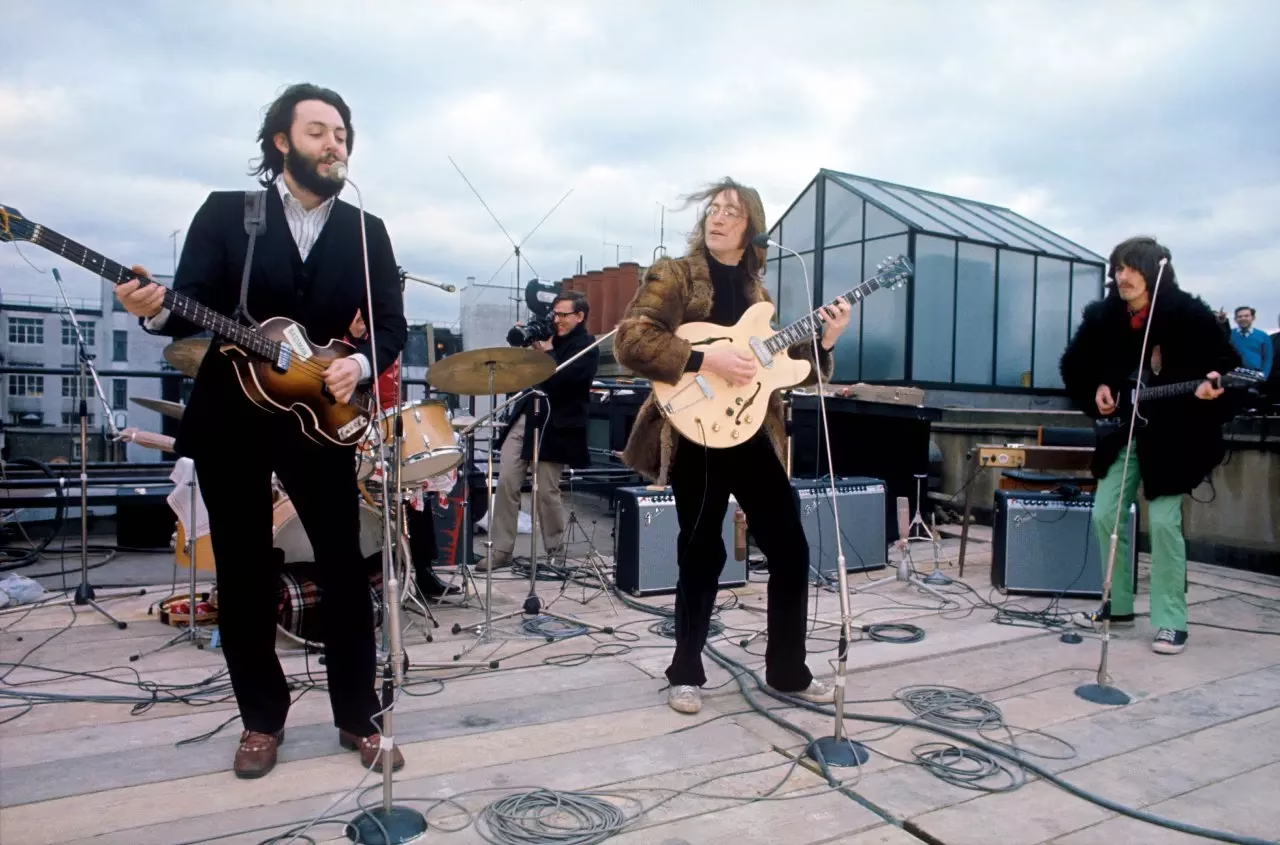
Not only this: the rooftop concert, which is captured in fabulous, multi-camera detail in Get Back, showed how a band can bow out stylishly, poignantly and memorably — even if they didn't know for sure if it was the end of the line back then.
So, yes, the music that NME slammed as "a cheapskate epitaph, a cardboard tombstone, a sad and tatty end" in 1970 was a success — a thunderously significant one.
To figure out how these four childhood friends — who were rapidly growing apart and questioning the world-conquering entertainment module they'd constructed — achieved what they did, it's worth examining three components of their interaction in Get Back.
More importantly, they show how viewers today can apply the Beatles' strategies to whatever group they belong to, whether it’s a congregation or a corporation.
Paul McCartney at Apple Studios, January 1969. Photo: Ethan A. Russell / © Apple Corps Ltd.
Accepting Leadership (Even When You Weren't Asked)
The overhanging black cloud at the top of the Get Back sessions is the lack of a clear leader. The group’s manager, Brian Epstein (whose responsibility for the band's success cannot be overstated), had died at only 32 of an accidental overdose. "Daddy's gone away now, you know," McCartney remarks at one point. "We're on our own at the holiday camp."
By then, Lennon, the group's natural leader from the jump, had basically abdicated his role — for some understandable reasons. His marriage had dissolved. His new partner, Yoko Ono, had suffered a miscarriage. His childhood trauma was seeping back in. He was wandering deeper into a heroin romance. (No, this isn't addressed, probably because this is Disney+.)
<style>.embed-container { position: relative; padding-bottom: 56.25%; height: 0; overflow: hidden; max-width: 100%; } .embed-container iframe, .embed-container object, .embed-container embed { position: absolute; top: 0; left: 0; width: 100%; height: 100%; }</style><div class='embed-container'><iframe src='https://www.youtube.com/embed//UocEGvQ10OE' frameborder='0' allowfullscreen></iframe></div>
Nobody asked McCartney to become their musical director, and sometimes, the band-wide irritation that he elected himself to that position is palpable. But it says something about his pragmatism and selflessness that he would make the call for the greater good.
McCartney isn't simply a hectoring micromanager throughout Get Back — he's open to the primal vibrations of the universe, pulling songs from the ether. It’s mesmerizing to watch him find the skeleton of "Get Back" in real time, stripping away extraneous elements and identifying the groove and vocal melody.
At first, George Harrison and Ringo Starr look distressed, as if they'd gotten calls about separate family emergencies. But as the tune takes shape, they change their tune — and begin adding to McCartney's nascent creation.
Really, Get Back is the most revealing look yet at how McCartney understood the mechanics of songwriting in and out — watch him at the piano, laying some wisdom on young film clapper-loader Paul Bond. "The great thing about a piano is that — there it all is," he says. "There's all the music ever."
All in all, without somebody to show up on time, nag Lennon to write new material, and, overall, keep the trains running on time, this misshapen, classic album wouldn't exist at all. The four freezing lads on the roof would vanish from our collective memory, and we'd have to find some other Turkey Day diversion this year.
Batting Down Bad Ideas (And Trusting Your Gut)
Many Beatles fans directed their ire at baby-faced, cigar-chomping director Michael Lindsay-Hogg, who captured this footage in 1970 for his own album doc. As author Steve Silberman tweeted, his "pervasive nagging and vapid scheming clearly had a corrosive effect on the Beatles."
While Lindsay-Hogg isn't on trial here (the man did give us The Rolling Stones Rock and Roll Circus, after all), Harrison swats down the filmmaker’s more out-there ideas, from sailing to Libya to performing at a hospital for children with broken legs. (Lennon, who delighted in skewering people with disabilities in his poetry and art, perks up at the latter suggestion.)
Even though Lindsay-Hogg called the shots to a degree as the director of the planned TV special, the ever-salty Harrison opted not to mince words. "I think the idea of a boat is completely insane," he remarks. "It's very expensive and insane."
Soon after, Harrison walked out of the sessions and the band — in turn, leaving the ball in his court as to how to proceed with the sessions, which involved leaving the drafty and vibe-less Twickenham for Apple Studios, their cozy abode where they made their masterpieces.
It's also worth noting that the Beatles' ability to quickly edit and hone each others' ideas was undimmed even when they weren't on the same page. This is apparent in an array of scenes, from avoiding the "corny" notes in "Don't Let Me Down" to Lennon tweaking one word in Harrison's "All Things Must Pass" ("wind" becomes "mind").
Is there a situation in your daily life that calls for quick, decisive action and trusting your first instincts? The Beatles made myriad mistakes in their decade, but boarding that ocean liner wasn't one of them. If Harrison hadn't spoken up, might the project have taken a harebrained and cash-hemorrhaging direction?
Ringo Starr at Apple Studios, January 1969. Photo: Ethan A. Russell / © Apple Corps Ltd.
Knowing When To Put Pencils Down (And Bowing Out In Style)
What if the Beatles simply faded from existence without the culture-shifting concert on the roof — four slightly bedraggled men envisaging the end of the line, yet having an absolute ball?
While nobody knew if that would be their final performance or not, it's beyond argument that the brief concert was a pitch-perfect move that aligned with who they were musically, visually and emotionally. It wasn't that calculated of a move — up to the eleventh hour, they weren't sure if they'd go up there. But, again, decisiveness won out.
After a final session captured at the tail-end of Part 3, the Beatles set the project aside, opting to return later in the year for Abbey Road, an album that had the patina of their finest works, like Sgt. Pepper's Lonely Hearts Club Band.
Perhaps that's the way to wind down any creative endeavor when it's running out of gas: doing it in style. By doing so, the Beatles fulfilled the old axiom of leaving the audience wanting more, for 51 years and counting. Just look at their Spotify numbers alone — when they burned out, their star became a culture-dominating supernova.
And even after eight hours of young, wealthy men who "stare into space and smoke," it's clear we'll never get enough of them.