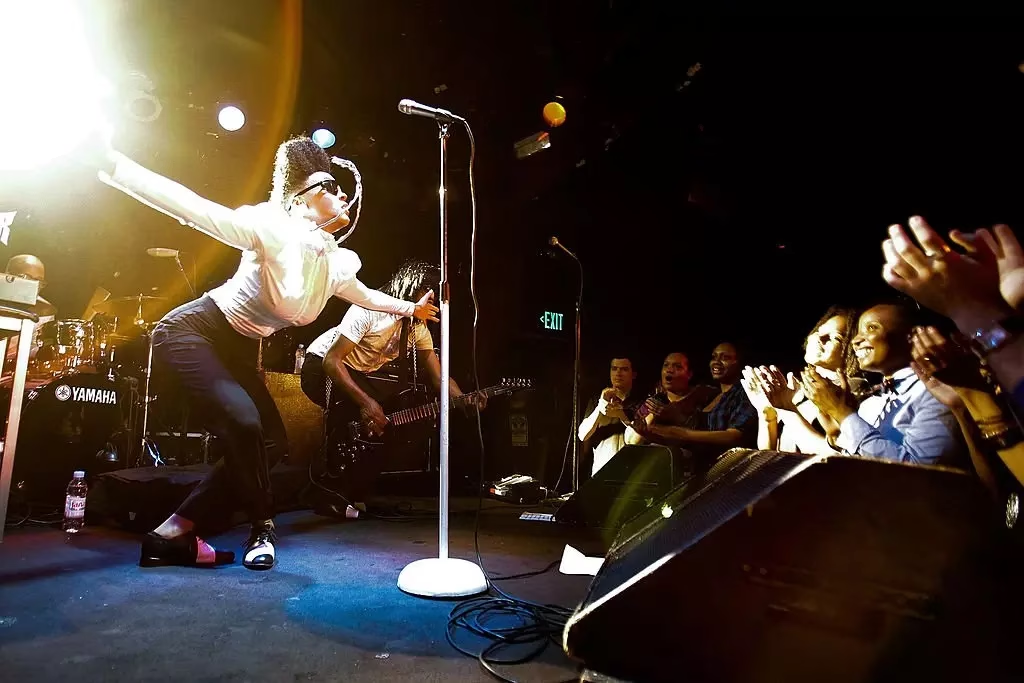
Over the past 15 years, Afrofuturist artist and activist Janelle Monáe has arguably become the Renassiance woman of modern popular culture. After all, she’s achieved a virtually matchless amount of professional success and eclecticism in several fields, such as acting, business and fashion. Clearly, she's a multitalented tour-de-force whose ambitions, skills and perseverance know no bounds. That said, while those ancillary achievements are undeniably remarkable, it’s always been her dazzlingly varied, targeted and clever music that reigns supreme.
In particular, her debut LP, The ArchAndroid, set the stage for all that’d she’d come to be. Released in May 2010 through a partnership between her label Wondaland Arts Society, Bad Boy and Atlantic Records, its fusion of star-crossed sci-fi chronicle, genre-splicing wonderment and interwoven social and personal commentaries signified Monáe as not only a wildly imaginative and capable creator, but also as a fearless spokesperson for external progressivism and internal agency. Unsurprisingly, it resonated with people from the get-go, and although she’s subsequently continued the narrative on 2013’s The Electric Lady—before abandoning her cybernetic veil to fully own her identity with 2018’s Dirty Computer—The ArchAndroid remains her magnum opus.
Conceptually, the record picks up where 2007’s Metropolis: Suite I (The Chase) EP—itself a brief but brilliant appetizer that overtly alludes to Fritz Lang’s 1927 film—left off. At this point, Monáe has already introduced listeners to the plight of her central protagonist and real life alter-ego, Cindi Mayweather (an android who faces oppression and termination in the midst of falling in love with a human, Anthony Greendown). Therefore, she expands Mayweather’s role as both victim and vindicator on The ArchAndroid, with Mayweather continuing to fight against bigotry, tyranny and inequality by becoming a messianic champion of unbridled love, co-existence and free will. Fascinatingly, scholars Daylanne K. English and Alvin Kim—in their text "Now We Want Our Funk Cut: Janelle Monáe’s Neo-Afrofuturism"—suggest that the even character’s surname is symbolic, as it "combines sunny spring and the possibility of death (she ‘may’ or may not ‘weather’ her trials)."
<style>.embed-container { position: relative; padding-bottom: 56.25%; height: 0; overflow: hidden; max-width: 100%; } .embed-container iframe, .embed-container object, .embed-container embed { position: absolute; top: 0; left: 0; width: 100%; height: 100%; }</style><div class='embed-container'><iframe src='https://www.youtube.com/embed/pwnefUaKCbc' frameborder='0' allowfullscreen></iframe></div>
Of course, Monáe is far from the first visionary to tackle such storylines, parables and apperances. In terms of both plot and presentation, her early 2010s aesthetic mirrors that of David Bowie’s 1972 classic Ziggy Stardust, when he also wrote about a dystopic world through the eyes of a sexually fluid savior. (Likewise, his "look" was perhaps just as provocatively prophetic as Monáe’s; however, her famous tuxedo variants are rooted in her upbringing, as they represent a stylish nod to the working class jobs—janitor, maid, trash truck driver, etc.—she and/or her parents had). Similarly, you can’t overlook the parallels to George Clinton’s Parliament-Funkadelic, whose visuals, sounds and messages were similarly colorful and liberating. Also, films like Terminator 2, District 9 and Blade Runner had previously explored the relationship being us and aliens or androids, all the while centering on the central question of what it means to be human. Hell, Monáe’s electronic/alt-rock hodgepodge "Make the Bus"—which also wears its Prince influence on its sleeve—directly references the last film’s inspiration, Philip K. Dick’s 1968 novel Do Androids Dream Of Electric Sheep?
Beyond that, Monáe has never relented from her messages of acceptance, understanding and redefinition regarding the phenological Self and Other. Self-identified as bisexual and pansexual, Monáe’s main goal with every endeavor is to champion civil rights for all marginalized people, be they connected to race, patriarchy, class, faith, or the vast LGBTQ+ spectrum. In a July 2010 interview with The Guardian’s Hattie Collins, she even stipulates: "The ArchAndroid is a mythical figure who went around for centuries, similar to the archangel, or a Neo from The Matrix . . . [it] represents the minority, whether it's a black person, an immigrant, or coming from another country." Thus, the LP follows in the footsteps of other creative benchmarks—like the heavily allegorical X-Men—and solidifies Monáe’s aforementioned prominence in Afrofuturism.
<style>.embed-container { position: relative; padding-bottom: 56.25%; height: 0; overflow: hidden; max-width: 100%; } .embed-container iframe, .embed-container object, .embed-container embed { position: absolute; top: 0; left: 0; width: 100%; height: 100%; }</style><div class='embed-container'><iframe src='https://www.youtube.com/embed/f7eqD91GMP0' frameborder='0' allowfullscreen></iframe></div>
It’s also worth noting the importance of Monáe helping to reestablish the concept album format as beloved and viable. Sure, the artform was quite popular from the late 1960s to the late 1970s; yet, outside of niche subgenres like progressive rock/metal and a few major exceptions (namely, Green Day’s American Idiot), they’re largely absent from the zeitgeist. With its immediate and sustained popularity, though, The ArchAndroid bucks that trend. Not only does it alternate between a multitude of styles—funk, pop, hip-hop, rock, neo-soul, R&B, and a bit of folk—as it houses weighty themes beneath a compelling narrative, but its use of symphonic "Suite" overtures and recurring motifs are just as striving and uncommon in mainstream music. Thus, The ArchAndroid evokes artists like Kate Bush, Madonna, Michael Jackson, James Brown and Simon & Garfunkel while connecting to everything from The Who’s Tommy and Quadrophenia to Kendrick Lamar’s To Pimp a Butterfly and Kid Cudi’s Man on the Moon series.
It’s no shock that a lot of work went into making the album. In fact, it was recorded between 2007 and 2010 at Wonderland Studios in Atlanta; produced by five people (Monáe, Nate "Rocket" Wonder, Roman GianArthur, Chuck Lightning, and Kevin Barnes); and featured many guests, including Saul Williams, Deep Cotton, Of Montreal, Big Boi (with whom Monáe worked on Outkast’s 2006 disc, Idlewild), and a host of orchestral players. As for its cover, John Calvert—in his Quietus write-up "Janelle Monáe: A New Pioneer of Afrofuturism"—wisely sees Monáe’s Egyptian headdress topped by the golden Metropolis as an "homage to free-jazz pioneer Sun Ra . . . who also declared himself a messianic savior and whose aesthetic was the first example of a black musician overtly appropriating sci-fi iconography."
Naturally, all of that effort—as well as the elaborate and intensive promotional period, which included many TV show apperances and a thought-provoking music video for "Tightrope"—paid off, as The ArchAndroid received praise from outlets like The A.V. Club, Entertainment Weekly, NME, Spin and Pitchfork. As a result, it earned her a GRAMMY Award nomination for Best Contemporary R&B Album, the top spot on several end-of-year music magazine lists, and her highest Metacritic score to date, 91. True, it didn’t dominate sales charts at first, but it nonetheless debuted at a respectable #17 on the Billboard 200, and it did comparatively well in Europe.
<style>.embed-container { position: relative; padding-bottom: 56.25%; height: 0; overflow: hidden; max-width: 100%; } .embed-container iframe, .embed-container object, .embed-container embed { position: absolute; top: 0; left: 0; width: 100%; height: 100%; }</style><div class='embed-container'><iframe src='https://www.youtube.com/embed/e8t7GhdeHGw' frameborder='0' allowfullscreen></iframe></div>
In hindsight, The ArchAndroid seems even more special and triumphant. Although every piece of the puzzle is essential, some certainly stand out the most. The Wizard of Oz-esque "Suite II Overture" is a marvelous and mysterious nugget of classical imperial instrumentation that foreshadows bits and pieces of the ensuing trek (such as the heavenly gospel fable “57821”). Smartly, its closing handclaps—which conjure another exceptional modern concept album series, The Dear Hunter’s Acts pentalogy—give way to the ingeniously hooky hip-hop/synth pop/R&B mash-up duo of "Dance of Die" and "Faster." We’re only three tracks into The ArchAndroid and it’s already showcasing a superlative level of songwriting, production and sequencing.
Later, "Sir Greendown" feels like Monáe put a mid-1960s Beach Boys backing behind a classic Motown ode. In contrast, follow-up "Cold War" presents its battle cry of underground revolution ("All the tribes comes and the mighty will crumble / We must brave this night and have faith in love") via an irresistibly peppy and elegiac blend of new wave and Afro-funk. Its vocal-centric ending is beautifully harrowing, too. Delightfully, the LP takes another sharp turn with "Tightrope," a celebratory soul and rap declaration (with help from Big Boi) about keeping a level head throughout the ups and downs of life. Next, the surreal sound collage "Neon Gumbo" cleverly reprises "Many Moons" from the Metropolis EP.
There’s wonderfully folky and hip-hop sorrow within "Oh, Maker," whereas "Come Alive (War of the Roses)" is a sleek and raucous rocker that really swings. Then, "Neon Valley Street" adds delicate strings, invigorating beats and Hendrix-esque electric guitar licks to its core piano ballad yearning before the irresistible “Wondaland” adds intellect and innovation to what might otherwise be mere sugar pop excess. The penultimate "Say You’ll Go" is peppered with the melodic fluidity and altruism of Stevie Wonder, while closer "BabopbyeYa" wouldn’t be out of place in a 1940s jazz piano bar, especially with its interwoven noirish symphony. It absolutely works as a grand finale that leaves you eager to see and hear where The Electric Lady will take you next.
<style>.embed-container { position: relative; padding-bottom: 56.25%; height: 0; overflow: hidden; max-width: 100%; } .embed-container iframe, .embed-container object, .embed-container embed { position: absolute; top: 0; left: 0; width: 100%; height: 100%; }</style><div class='embed-container'><iframe src='https://www.youtube.com/embed/9QnhRpmRj7E' frameborder='0' allowfullscreen></iframe></div>
Ten years on, The ArchAndroid is as potent and poetic as ever, capitalizing on the potential of the Metropolis EP to reveal Monáe as master of her craft. The sheer amount of variety and novelty inherent in its arrangements and production is magnificent, perfectly complementing the splendor of her motivated melodies and lyrics. Best of all, her plot never falters from its dual purpose as totalitarian fiction and cautionary tale. Hence, she honors a longstanding tradition of using pop culture to educate and incite her audience, transporting listeners to a breathtaking fantasy so that they’re better equipped to fight injustice upon their return to reality.