If you’ve been following the Billboard charts lately, you may have noticed that country music is having a moment. Artists like Kacey Musgraves, Lil Nas X and Taylor Swift have found unlikely allies in coastal America, where the genre has been historically overshadowed by other sounds. Hipsters in Brooklyn have even dressed as Musgraves for Halloween.
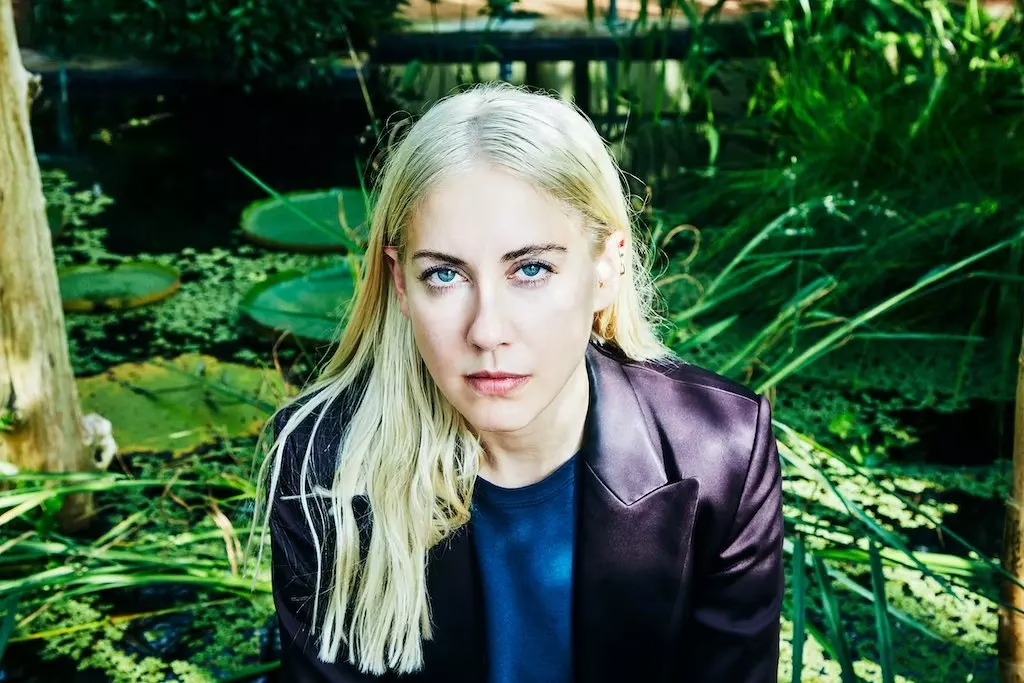
Mackenzie Scott, who performs as TORRES, named after her birth mother’s maiden name (Scott is her adopted parents’ surname), has a boot in both worlds. Reared in Macon, Ga., a town Little Richard helped put on the map, Scott grew up playing music in the Southern Baptist Church. She then went off to college in Nashville, Tenn., and eventually ended up in New York City.
<style>.embed-container { position: relative; padding-bottom: 56.25%; height: 0; overflow: hidden; max-width: 100%; } .embed-container iframe, .embed-container object, .embed-container embed { position: absolute; top: 0; left: 0; width: 100%; height: 100%; }</style><div class='embed-container'><iframe src='https://www.youtube.com/embed/kf-HONSewU8' frameborder='0' allowfullscreen></iframe></div>
The nuance of Scott’s country twang, combined with her ability to shed some skin and sing about her past, made her stand out in New York. Her 2013 self-titled debut album, dubbed “a masterclass in intricate and tender storytelling,” received praise for its “tricky, messy subject matter.” She’s been compared to Cat Power, Jason Molina and PJ Harvey, titans of alternative rock.
For her second album, Sprinter (2015), she teamed up with PJ Harvey producer Rob Ellis and scraped even deeper into her past. On lead single “Strange Hellos,” she poured scorn on a woman’s attempts to disguise their destructive behavior by completing random acts of kindness. One of the year’s best rock songs, it helped propel Sprinter to No. 20 on Billboard’s Heatseekers Album chart. Scott continued to examine her formative years on Three Futures, released in 2017 by British indie 4AD.
Read: Miranda Lambert Talks Her New GRAMMY-Nominated Album 'Wildcard,' Pistol Annies & More
To understand where Scott’s at now, it’s best to read an essay she published last January on the Talkhouse website where she discusses her lifelong battle with depression, her sexuality and her relocation to New York City. The essay is an excellent introduction to her newly released album, Silver Tongue, out today (Jan. 31) via Merge Records.
Silver Tongue is Scott’s first truly New York album—the events she sings about, her romantic endeavors, the passing of time (lots of time) happened mostly in Brooklyn and Manhattan—but it’s also a lil’ bit Southern. Country music motifs punctuate the highs and lows of her raw, emotive voice as she sings of pursuing love in the Big Apple. “You, in the corner watching me / You, with the gaze I’d die beneath / You smoked Parliament Blues in my living room / And I went and hoarded the ash,” she sings over a weepy synth on “Records Of Your Tenderness.”
Following the release of Silver Tongue, The Recording Academy talked to Scott about being Southern, retaining information like an elephant and how the spoken word has the power to shape reality.
<style>.embed-container { position: relative; padding-bottom: 56.25%; height: 0; overflow: hidden; max-width: 100%; } .embed-container iframe, .embed-container object, .embed-container embed { position: absolute; top: 0; left: 0; width: 100%; height: 100%; }</style><div class='embed-container'><iframe src='https://www.youtube.com/embed//92QzqQcdXEA' frameborder='0' allowfullscreen></iframe></div>
You’ve described Silver Tongue as a “Gregorian country record.” What exactly does that mean?
There are a lot of melodies that are derived from Greogorian chanting—the monastic, holy quality to the vocals and the melodies themselves—but they’re also infused with a lot of twang. I’m from Georgia, so that persists in my music because it’s my accent, it’s in my language. My lexicon is very Southern, so I wanted a way of describing if something were a little monk-like, but also a little bit country, hence the term Gregorian country. There is something haunting about Gregorian chanting that I love, that sort of hollowed-out, very austere quality, and I love combining it with the humorous elements of country music. I think they go really well together.
In the song “Good Scare,” you sing, “You make me want to write a country song folks here in New York get a kick out of / I’ll sing about knocking you up under Tennessee stars on the back of my red Chevrolet pickup.” I love the humor that accompanies those lyrics. Do you think country music is viewed differently in New York compared to how it’s viewed back home in Georgia?
Most certainly. In the South, country music is taken very seriously—it’s holy ground. Mostly everyone there is a country music fan. And not just any country music, Top 40 country music. But I think the genre has been wholly disregarded here in New York, even though I think a lot of people in New York are fans of country—you know, who doesn’t love Dolly Parton, Willy Nelson or Johnny Cash? Contemporary country is widely dismissed here.
So because I’m from that world, and now I’m in this world, I’m always looking for ways to bridge the gap, or my perceived gap, in ideology, musical taste, food taste, language, even political preferences. I’m always trying to use the language of one to influence the other so that we can find common ground, and that was the idea here [with Silver Tongue]. As a New Yorker, but also someone who is from the South, I’d like to change minds about what’s cool and what isn’t.
Read: Orville Peck On The Music That Made Him, 'Pony' & The "Visual" Way He Creates
Country music has found a broader audience over the past few years thanks to artists like Kasey Musgraves, Maggie Rogers and even Lil Nas X. Would you agree with that?
I’m not saying this in a disparaging way, but I think a lot of people just want to step into those boots. I guess I’m doing it, too, but the difference is that some of us are actually Southern and some of us are not.
There are some powerful moments on this album where you vividly recall some agonizing things that have happened to you in New York. On “A Few Blue Flowers,” you sing, “You had the car drop us eight blocks from your apartment / You dropped my hand before we turned the corner.” Do you have a compulsion to hold on to a lot of uncomfortable memories?
Yeah, I’m really bad at letting things go. I don’t really do it. Part of that is just because I have a photographic memory; I remember everything, I’m like an elephant. It’s good in some ways, and in other ways it’s torture. Some people are really good at blocking out the things they don’t want to dwell on, a lot of people are good at moving forward, but I’ve never been that way. It’s something I’ve worked really, really hard on, and I think I’ve got a little better at it. But I retain everything. And I don’t just retain things, I retain the feelings that accompany them.
<style>.embed-container { position: relative; padding-bottom: 56.25%; height: 0; overflow: hidden; max-width: 100%; } .embed-container iframe, .embed-container object, .embed-container embed { position: absolute; top: 0; left: 0; width: 100%; height: 100%; }</style><div class='embed-container'><iframe src='https://www.youtube.com/embed//KUC13edzkkY' frameborder='0' allowfullscreen></iframe></div>
In an interview with WNYC in 2015, you said you don’t feel comfortable talking with your loved ones about a lot of things, but that you’re comfortable putting them in songs. Is that still the case?
I have always had the hardest time communicating with family. I am better in general at writing songs than I am communicating with my words when something is actually happening. I tend to be kind of a mute, and that’s something that I address on the album in a song called “Records Of Your Tenderness”—that I have a hard time communicating with people when it matters.
For me, so much of songwriting is about saying the things that I never could say, for whatever reason, when it counted. Songwriting is like cheating a little bit in that way. I’m getting the last word by means of writing a song. It’s like cheating because it’s all written after the fact, and it’s all so condensed and edited to say exactly what you want it to say. But the truth is, that’s my superpower. It compensates for a severe deficit that I’ve got in the real-life communication department.
You sing often of your religious upbringing on your previous three albums. But on Silver Tongue, you rarely broach the subject. Do you feel you’ve told that part of your life story now?
Each record is a reflection of where I’m at in that moment, and it just so happens that the first two or three albums were written at a time when I was explicitly dealing with a lot of complicated thoughts and emotions around my religious upbringing. I do feel like I have exorcised those demons now; it’s just not something I struggle with anymore. I am at peace with my upbringing. I love my family very much, and our relationship is better than it’s ever been. Silver Tongue is a reflection of where I’ve been at over the last two or three years, and my relationship to religion and everything that I have sung about [in the past] is not part of that experience.
Where did the phrase “silver tongue” come from?
That title and theme emerged out of this idea that whatever we speak into existence is what will be. It’s something that I’ve learned firsthand: Whenever I say something, that’s what happens. So I started this experiment of speaking things that are not as if they are, and I’d just watch things appear like magic. When you speak, other people are listening, and you have the ability to tear other people down or to create life in them. That’s something else that I’ve been paying attention to recently, not only how words affect what forms in the material world, but also how it affects other people when you speak. You can make believers out of people simply by speaking.
In the case of the song “Silver Tongue,” it’s about telling the person that I love that I’m not going to make them stay, but they will stay anyway. Helping someone to believe something before they believe it themselves is a new thing for me. But in that same breath, you have to be careful what you say to people, because if it’s selfishly motivated or if you’re using this power that you have—words are what create the reality around us—you have to be really careful about what you say because the moment you say something that you don’t want to be true, you’re in trouble.