
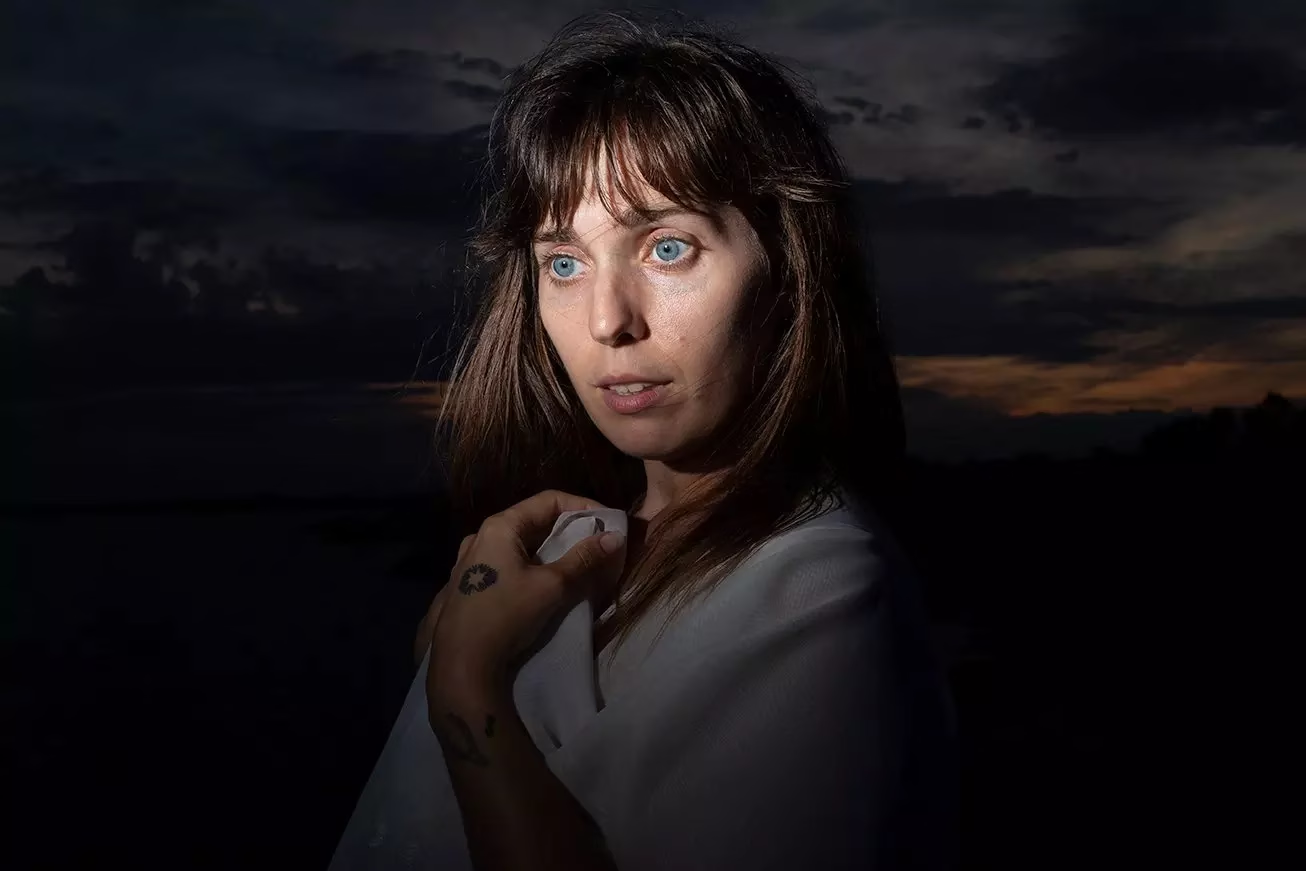
"If we can all get away from feeling embarrassed, we'd be doing a lot better," Meg Remy says with an audible smile. "We wouldn't be where we are now if we hadn't done the things we might be embarrassed by."
It's tempting to think of Remy's flip phone as a metaphor—a technological rebuke of embarrassment, perhaps, of a refusal to keep up to date or a staunch adherence to the adage "if it isn't broke, don't fix it." But as evidenced in her new album as U.S. Girls, Heavy Light (out today via 4AD), Remy is constantly changing. "You can listen to this album, and you can listen to the entire body of work that I've made for the past 13 years," she says. "It's fascinating for me to see how I've continued on, how I've changed, and as importantly what has stayed the same."
In addition to new material, Heavy Light finds Remy re-envisioning three tracks from that expansive catalog. But while early U.S. Girls albums were often the result of solo recording sessions, the Toronto-based musician relishes growth on reinterpretations of tracks like "Red Ford Radio" and "Overtime"; there's a mythic scope to these new takes, an embrace of just how wide a screen Remy could project her poetic lyrics onto.
<style>.embed-container { position: relative; padding-bottom: 56.25%; height: 0; overflow: hidden; max-width: 100%; } .embed-container iframe, .embed-container object, .embed-container embed { position: absolute; top: 0; left: 0; width: 100%; height: 100%; }</style><div class='embed-container'><iframe src='https://www.youtube.com/embed/UGQ1UAX0aYo' frameborder='0' allowfullscreen></iframe></div>
"Denise, Don’t Wait" is powered by ice cube vibraphone and '60s pop aura ("girl groups, Ben E. King and The Drifters, all that sparse, dramatic, reverb-drenched stuff," Remy explains), while complex layers of percussion drive opener "4 American Dollars"—both showcasing the range she's grown to encompass. The live-recorded tracks comprise the work of more than 20 musicians (including Slim Twig, Basia Bulat and E Street Band saxophonist Jake Clemons). But as the Chessmaster aligning all the pieces, Remy sits at the heart of the arrangements, her increasingly florid and powerful voice invigorating every composition.
Remy spoke with the Recording Academy about the influence of coming up in the punk scene, her E Street Band tattoo and sharing her most intimate songs with a 20-person band … and the world.
You've lived in Canada for a while now. Do you see differences in the music industry compared to the States?
They're kind of the same industry, but the main difference is that there's funding here. There are artist grants and things like that, but in typical kind of capitalist fashion, the more money you make, the more grants you're able to get. It’s so bizarre. It was interesting to see how Canada allows itself to be so tied to the American industry and those standards. People don't really think that they've had any success unless they've "made it" in the States. And I think that's too bad. There are a lot of people that live here who are into music and appreciate it and support it. But it's hard to live above the culture monster that is America.
How do artists get out of that trap? Does it mean working more in a community? Is ignoring that impulse enough?
I think it means making things and not looking at the internet as much as possible. [Laughs.] Don't compare yourself to other people on the internet or to anything that's in the press. Anything in the press doesn't show the road that was taken to get to that article, all the behind-the-scenes things. The best thing you can do is study the history of capitalism, the history of PR, the psychology of PR, and find out what you actually really like about making music. Do you really like making music or do you like making photos of yourself to post? Or do you really like performing and not writing? Whatever it is, find out what you like and do that. Don't worry about anything else. And know that you're most likely not gonna make any money because nobody's making money. You're either not making any money or you're making too much.
Have you always been focused on working in a community?
Yeah. I entered music through my local punk scene. Most shows we threw were a benefit of some sort. Everyone shared gear. Being famous or getting rich was never a goal of mine. I’ve always tried to stay with those kinds of people.
To that end, there are more than 20 musicians on your new album. With so many musicians working on their own, that's an astounding feat. Did you just naturally amass that specific group, or did you have to seek out people that matched arrangements?
It was a bit of both. There were some people that it was a no-brainer that they were going to be a part of it. On the other hand, I really wanted a woman playing upright bass, so I had to ask around to find the right person. But the songs and arrangements dictated that, particularly because we recorded it live. We wouldn't have needed three percussionists, for example, if we were just layering tracks on top of each other.
The percussion choices are so interesting. The record as a whole feels more rhythmically focused than In A Poem Unlimited.
For sure. The last record was the first time I played and toured with a percussionist, and that opened my mind. One of the players that we play with, Ed Squires, is a classically trained percussionist. So when I knew I wanted to do a record that was more rhythm- and voice-based, I immediately went to him. I'd give him demos or references for each song, and then he would go from there. He worked with two other percussionists, and they took it into their crazy percussion world. They're like, "You're using an artillery shell from the first World War as a percussion piece." It was crazy.
<style>.embed-container { position: relative; padding-bottom: 56.25%; height: 0; overflow: hidden; max-width: 100%; } .embed-container iframe, .embed-container object, .embed-container embed { position: absolute; top: 0; left: 0; width: 100%; height: 100%; }</style><div class='embed-container'><iframe src='https://www.youtube.com/embed/8cFnewlPpzI#action=share' frameborder='0' allowfullscreen></iframe></div>
You hear the care and thought in choices like the piano on "IOU" and the vibraphone on "Born to Lose." How were your writing and voice affected by that arrangement? Did you find yourself being pushed in a different direction?
I was majorly challenged by the nature of recording live. I had prepared for many months, but it was pressure for everyone. Everyone had to be on their game because no one wanted to be the one that had to call for another take or say that they messed up. It was a lot of prep work not just to sing, but perform at record quality. But at the same time, when you don't have the ability to go in and touch up vocals, you have to just let things fly as they are, which is what I love about performing live. You're thinking about the overall effects, not that one syllable that was slightly out of tune or something.
It was always just peeling back to the necessary elements. You can always add more. [Laughs.] It's like when you're putting makeup on. You can just keep going, but you maybe don't want to. [Laughs.] Everything about the record was about being intentional, being transparent and going for an overall thoughtful sound.
Read More: Meg Remy On U.S. Girls' Ongoing Art Pop Music Experiment
You also recorded new versions of three previously recorded songs. What drew you to reimagining those songs in this live-recorded context?
I realized I had worked in this rhythm- and voice-based form before: it's really where I started making records. It was interesting to bring these songs forward, and say, "How will I do these now that I have not only a budget [laughs] but access to real percussionists?" I didn’t have to be the percussionist or use a loop that a friend made for me. I could work with other voices.
That kind of reflection is so daunting for a lot of people. What did you realize in that process about your progression as an artist?
I realized I couldn't sing at all! I mean, I could. [Laughs.] I could and I did, and I'm glad that I did, but I had no ear. I didn't even know what pitch meant. I was really a screaming poet. I couldn’t believe I had the courage to put that out and stand behind it, and then also do it live and continue on. I've been in vocal lessons since 2014, and it changed everything. You can hear it in the songs and the scope of what I'm trying to pull off. The spirit's still the same, but it actually wasn't embarrassing listening back. And that's the thing: if we can all get away from feeling embarrassed, we'd be doing a lot better. We wouldn't be where we are now if we hadn't done that stuff. If you find a misstep or an embarrassing thing, it's part of it.
E Street Band member Jake Clemons plays the sax solo on "Overtime." How did that connection come about?
That song had a hole in it. It had a vocal solo on it that was great, but we all agreed that a sax in there with the vocal would take it over the top. We met Jake a couple of summers ago and asked him to come play with us at a festival that he was playing at as well. We just really enjoyed hanging out. It just so happened that we were recording near where he lived, so I got in touch with him to see if he wanted to come in—and it just worked.
<style>.embed-container { position: relative; padding-bottom: 56.25%; height: 0; overflow: hidden; max-width: 100%; } .embed-container iframe, .embed-container object, .embed-container embed { position: absolute; top: 0; left: 0; width: 100%; height: 100%; }</style><div class='embed-container'><iframe src='https://www.youtube.com/embed/SSaesUhgM_Q' frameborder='0' allowfullscreen></iframe></div>
I can only imagine how important Springsteen must have been for you?
Yeah, I love him a lot. I have an "E" tattooed on my arm for the E Street Band that I got when I was like 20 years old. Someone did it with a needle. Springsteen's music was real big for me as a kid, growing up, and as a teenager. I still love it. That's in there for sure, but maybe I'm flipping the bird at it a bit too. [Laughs.]
The fact that so many musicians are involved in an album that is also heavily personal for you is quite a fascinating dichotomy.
Yeah. You’re right. It’s interesting to allow so many other people to come in and touch something that feels so personal to me. It was hard, but it was something that I worked on and talked about with everybody that was a part of it. A lot of the people on this record are some of my closest, closest friends. They knew how heavy this was and they would check in with me and still check in with me now. It was difficult in the studio to have to be present, to perform and emote, and then need to discuss it technically when a take ends. And then I'd have to go back into that real personal space, and then back to the technical. The bouncing back and forth was very weird. I definitely had a freakout at one point where I was just like, "This is my life. [Laughs.] This is my life that you all are working on." I needed to have my private moment with my friends where I kind of freaked out one night at the end of recording, and then it was fine.
I don't want to be isolated in my personal experience. I want to share it and hear other people's experience back so I can compare and contrast, or at least know I'm not the only one that feels this way or has gone through something. Being vulnerable is something I've definitely learned over the past few years. Being vulnerable is not only such a gift to yourself, but to anyone else who witnesses it because it tells them you can be vulnerable too.
"State House (It's A Man's World)" is a brilliant way to explore an idea that is often ignored, to share it with other people.
It was really real. That song was written years ago in the throes of jealousy over another woman. That's a real thing that I'm embarrassed to have to admit. I have no reason to feel that way. But we do this with each other and we go into competition. I am screaming at myself in that song, not the listener.
<style>.embed-container { position: relative; padding-bottom: 56.25%; height: 0; overflow: hidden; max-width: 100%; } .embed-container iframe, .embed-container object, .embed-container embed { position: absolute; top: 0; left: 0; width: 100%; height: 100%; }</style><div class='embed-container'><iframe src='https://www.youtube.com/embed/tzcDjRYlgps' frameborder='0' allowfullscreen></iframe></div>
Even structurally within the record, you make it clear that your voice is just one in a set—seen in the framing of the spoken word interludes. What was the first seed of an idea of doing that on this record?
I had gone to a theater workshop where they had given us prompts to write on. I had never done something like that and it was really effective. Those prompts are really common in writing classes. I started asking people about prompts they’d encountered and collecting the ones that fit thematically with the record. The recordings are all the people from the record. One person at a time went into the booth. They didn't know what I was going to ask, and they could say whatever they wanted. They could also pass if they wanted to. I then took all the recordings and started editing them, layering them and messing around. I accidentally listened to all of them at the same time once. [Laughs.] I realized that your ear can listen to more than one person at a time. It was really interesting and effective, and also a good metaphor. We have to talk over each other, but that doesn't mean that we can't also listen.
Did you get some satisfaction out of being in control and sending people to the booth?
Definitely. Of course! I definitely was way too into it, but I think people were into it too. We all took it really seriously. There was something very intimate about it. It was really intense. And I'm so grateful that I collaborated with people that allowed me to do this and trusted me. They share their life. That's not scripted stuff.
Doing that also must have put people at ease. If they felt nervous tackling a song that they know matters to you, they're being vulnerable in that moment too.
Of course. That's definitely a lesson learned on stage. The more I go crazy and look like a fool, the more the band will. [Laughs.]
Once you're going through something and it's really working, how do you define success in that moment?
I think when I stop thinking about it. [Laughs.] When my mind goes blank, when there's nothing else to think about or critique, and there's a settled excitement that feels a little bit electric. I know when to call it. And with this record in particular, we had so many people calling it. When you have that many people working together, there's a moment when you get the take. Everybody feels it. Everything was in place. This record was a collective knowing.
I also have an attitude where each record is never going to be the last thing I'm going to make, so the pressure's not that much. If it's not perfect or I wish I had done it differently later, whatever; I'm going to do something else totally different in six months time, six years time, 16 years time. It's not that important. Even though it's everything to me, it can’t be that important.
Courtney Barnett Talks Life, Music And (Almost) Everything
