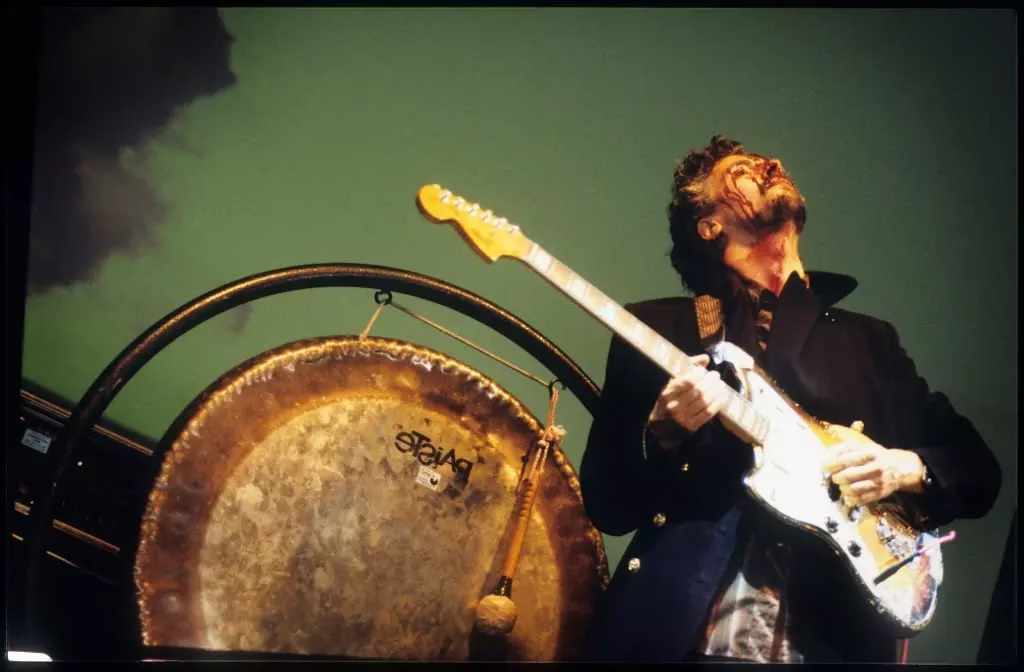
The Flaming Lips have always been a high-stakes band, and 1999’s The Soft Bulletin is their summit. Lyrically, it deals with mortal spider bites, parental grief and a scientists' cure for humanity. The trippy, outsized music lurches between darkness and light. Today, at 58 and expecting a baby boy, frontman Wayne Coyne is mostly free of these heightened states.
Not that he's forgotten them completely. "I have a lot of energy, and I'm very intense," he tells The Recording Academy. "Now, all that stuff doesn’t seem so chaotic to me."
Today (May 17) marks the 20th anniversary of The Soft Bulletin; in September, the Flaming Lips will perform the album in full on three dates while promoting their newest, King’s Mouth, which arrived last month for Record Store Day.
If The Soft Bulletin is a perforated levee of feeling, King's Mouth is a trickling, tranquil river. "The king in my story is a very gentle, loving entity," Coyne says. "There’s no great fight that he’s fighting for." A low-key set with spoken-word narration from the Clash's Mick Jones, King’s Mouth reflects Coyne's newfound calm and clarity.
Such are the band’s twin emotional poles; they’ll be diving back into their most intense album, while mentally miles away from the addiction and drama that fed it. "I wouldn’t want to be in that state of mind ever again," he says. "We got to make The Soft Bulletin and live to tell about it."
Here, Coyne opens up about his memories of making The Soft Bulletin, his more subdued approach in 2019 and how he worked through his intense, competitive nature.
<iframe width="620" height="349" src="https://www.youtube.com/embed/XvvGYEjloOg" frameborder="0" allow="accelerometer; autoplay; encrypted-media; gyroscope; picture-in-picture" allowfullscreen></iframe>
What headspace were you, Michael and Steven in while making The Soft Bulletin?
We were making two records together: Zaireeka, the four-CD behemoth, and we knew we were going to make this record. In the beginning, it was very much about experimenting. But I think the experiment really pushed us into making emotional music that was effective. It awoke us to the potential that we were making music that we liked, rather than just banging around on things.
And I think we were considering that it would be the last album Warner Bros. was going to allow us to do, so we were just going to go for it. We were considering what we were doing to be like, "This is going to be our own trip. Don’t follow us. This isn’t going to lead to success." We had been on a good, stable creative run since 1989, and all these things were crescendoing. But we couldn’t have known that at the time.
Steven was at the very end of the worst of his heroin addiction. Every minute of every day was [reminding us] how finite it is and how serious it is. But it’s still meshed with a lot of fun and exhilaration. I look back on those guys, and I’m so glad they did it. Even though I’m one of them.
Where do its existential themes come from? I’m sure Steven’s struggle with addiction added to that.
I think that’s probably where its main power comes from, but I don’t think we were writing about that. That’s the greatest thing about music. Because it’s abstract and you’re not quite sure what it’s talking about, it can go on a deeper level. There's some connection to the very beginning of your ability to hear.
I think about that because my wife is about to have a baby in a week. He can hear us in there. He can hear stuff coming from the outside. He can tell who his mother is. He can tell that the dog's there. All these sounds are going in there at the same time that your emotional brain is being formed.
Of all the things that you’re going to experience, music is going to get you the deepest. So deep that you can’t even explain it. So, I think it’s just a good combination of words and music. One evoking the other.
<iframe width="620" height="349" src="https://www.youtube.com/embed/5qVaP7mNphA" frameborder="0" allow="accelerometer; autoplay; encrypted-media; gyroscope; picture-in-picture" allowfullscreen></iframe>
What’s the first music you remember hearing?
It’s probably The Wizard of Oz. I don't remember when that started to be played every year on TV. But it would be one of these movies that would play, I think, every Easter. If I sat with a psychiatrist for a week, I’m sure we could find out where the music came from.
Then, when I was three years old, it was the Beatles on the Ed Sullivan Show, and they haven’t left us. It’s probably a magic combination of those two things, and they would repeat every year. I mean, I can look back so far that I can’t remember being alive.
Are you trying to create music on that subconscious level?
It probably wants me to make it more than I want to return to it. There’s some evocative nature to that part of my mind, helping my real mind. When you do it, it ignites it, and it makes you want to do it more. That’s the thing with all creative people. If you don’t do it, you go crazy. If you do it, you go crazy, too. But a little less crazy. That’s my excuse.
I have a lot of energy, and I’m very intense. I try to remember that that intensity can be good, or it can be the enemy. There’s a lot of quagmires of being young. I think I had a lot of testosterone when I was young, which intimidated people into doing what I wanted to do. As I get older, I don’t have as much testosterone, which I think is better for me now. To just be nice and to be consistent.
Has your intensity come back to bite you?
All the time. When you’re in a band, you’re traveling the world, you’re meeting freaks, you’re doing freaky things. It’s a mile a minute. Luckily, I could spend some of my intensity in all that muck, where you don’t really know what’s going to happen day-to-day.
Now, all that stuff doesn’t seem so chaotic to me. Up until I turned 50, I felt like I had to f**king get up and get going, or else this whole thing was going to fall apart. Then, I talked to people who were like, "Dude, your band’s already going for 20 years. I don’t think it’s going to fall apart tomorrow." And I would dismiss it.
Then, once I turned 50, I thought, "This is the way your life is. If you keep being so intense, you’re going to ruin it instead of just having it." That was a good thing for me. To relax about it. If it doesn’t get done today, it can get done tomorrow. I changed my way of doing things.
<iframe width="620" height="349" src="https://www.youtube.com/embed/_Qta162ot5k" frameborder="0" allow="accelerometer; autoplay; encrypted-media; gyroscope; picture-in-picture" allowfullscreen></iframe>
King's Mouth is so minimal and peaceful. Does that reflect your life today?
It’s not existential, and I’m glad. It’s based in home and heart and love and silly things like that. It’s not a storm trying to break through to another dimension like The Soft Bulletin. You're changing your soul, and you want those timpanis, those distorted horns, because they’re going to get you to the other side.
How do you relate to the king in your story?
I liked the idea that the king in my story is a very gentle, loving entity. There’s no great fight that he’s fighting for. There’s no great cause that he’s killing somebody else for. He's just a gentle, fun hippie weirdo in the story, like the Wizard of Oz.
Making King’s Mouth, we weren’t thinking [affects strangulated voice] "We’re becoming different men!" I wouldn’t want to be in that state of mind ever again. We got to make The Soft Bulletin and live to tell about it.
OutKast Examine Their Southern Experience On 'Southernplayalisticadillacmuzik'