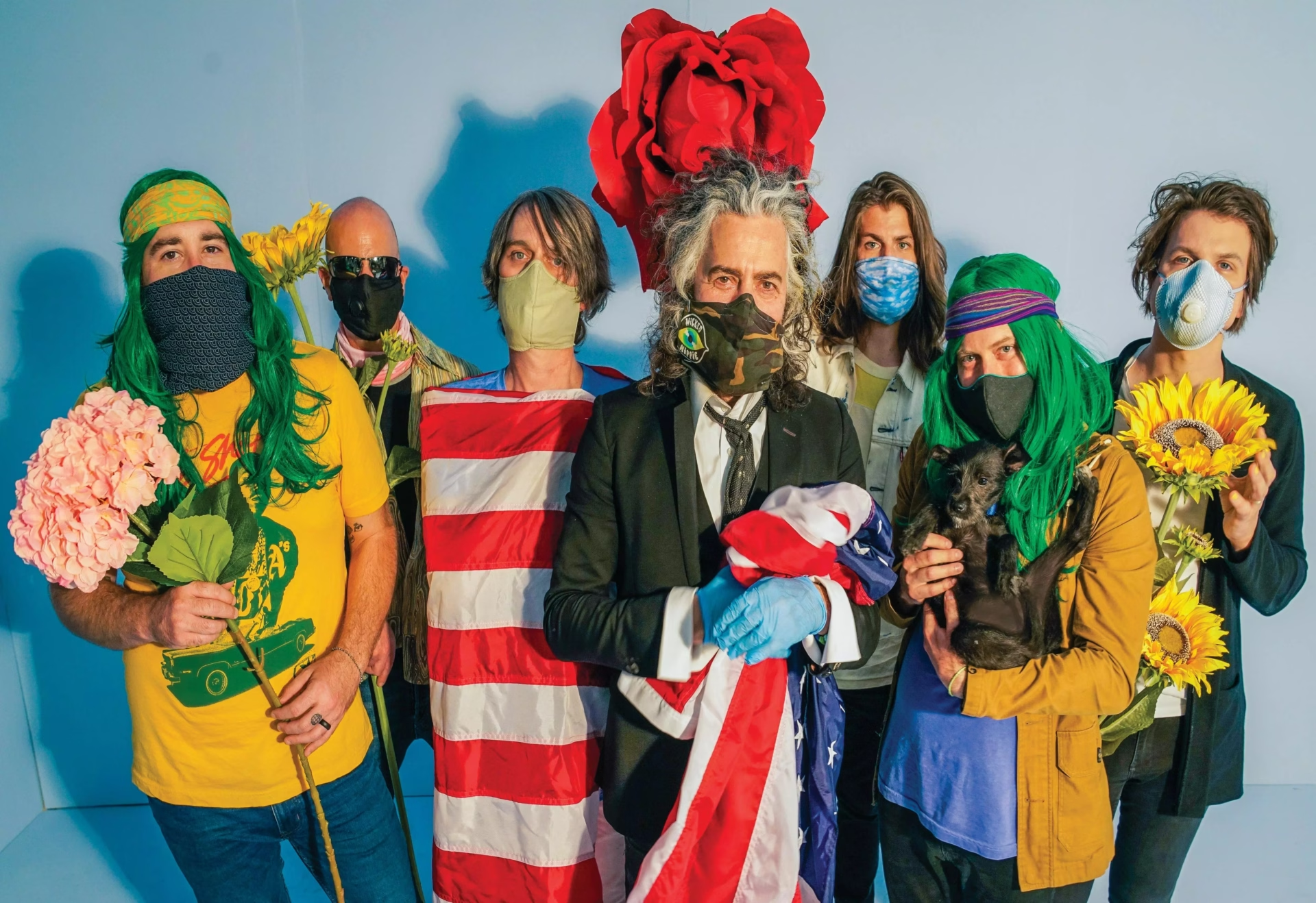
When Oklahoma City alt-rock oddballs The Flaming Lips put out their debut LP, Hear It Is, in 1986, it's unlikely that anyone involved would've imagined they'd be a major, GRAMMY-winning act releasing their 16th studio album 34 years later. And when lead singer Wayne Coyne first performed in his space bubble at Coachella 2004, there's no way he could've known that, 16 years later, said spherical orbs would look a lot less silly during an unprecedented health pandemic. But the lived experience of 2020 isn't really what any of us had on our vision boards—and yet here we are.
If anyone is primed to help guide us safely to the end of this absurd year, our bets are on Coyne and the Flaming Lips. Luckily, their latest technicolored dreamscape, American Head, drops tomorrow, Sept. 11. Its 13 tracks are a trip through the band's latest alternate universe, specifically a fantastical daydream imagining a "lost" Tom Petty album he and his band might have made after a wild drug detour in Oklahoma in the '70s. "Space Cowboy" Kacey Musgraves and frequent collaborator Particle Kid help add extra doses of magic to the story and bring it to life. As the Lips music so often does—with shimmer and effortlessness, nonetheless—tales of bad trips, longing, death and escape take on a playful, effervescent and even comforting tone.
Ahead of the new album, we caught up with the loveable frontman, who takes us deep into the wild daydream that inspired it, the creative process and recruiting Musgraves, who offers haunting vocals on three tracks. He also talks collaborating with Miley Cyrus, accidently predicting 2020 would be the year of the space bubble and the "wonderful" creative chaos he now hears on Clouds Taste Metallic. Read on for more, and enjoy the ride!
I want to start with American Head. In the press release, you talk about the vision you and Steven Drozd had that sort of sparked the album, where you imagined Tom Petty and the Heartbreakers on this mythical drug trip that involved your older brothers in Tulsa in the '70s. It's hard to not giggle as I say this-
I'm wearing a Tom Petty concert shirt right now. Well, before they were Tom Petty and the Heartbreakers, they traveled from Gainesville, Florida, trying to make their way out to L.A., but the producer sort of halted them and said, "Hey, meet me in Tulsa, Oklahoma. Let's do a little bit of recording there before." I suppose it was his idea, before they got corrupted by all the drugs and wild women in L.A., or something like that. But what he didn't know is that my older brothers, especially in 1973, 1974, were dealing all kinds of crazy drugs and knew all kinds of crazy drug dealers and bikers and freaks. They could have easily ran into my older brothers if they spent a couple of weeks in Tulsa recording way back then.
Now, there's no proof of this. This is all speculation turned alternative-history-fantasy, but it did get my mind going. I mean the dilemma is if I ask my oldest brother who's 68 or something now, he would want to help me. If he thought it would be better if he met Tom Petty, he would be very much like, "Yeah, I think I did. It was great." So I never really confronted him about it because I know he would want to help me no matter what the cause was, and the truth would get to be second to helping me.
But it did help Steven and I gravitate towards an identity—a sound, a mood and a feeling and all that—that we know is a fantasy. But even if you create it yourself, some sort of direction to go in is always helpful. I mean, whenever I work with people where I'm not the director, I always say, "Tell me what to do. I'll gladly do whatever you tell me to do, because it helps me." So we kind of do that with ourselves, give ourselves a goal, a direction and see how that works.
And so, once you had that fantasy daydream vision, how did that develop into the album and the different storylines in the songs?
Well, I mean, you got to have songs. Without songs, we're all just kind of floating around in the process. We a couple of these songs, including "Mother I've Taken LSD" and "Dinosaurs On the Mountain," that were already in a longing kind of nostalgic vein, which we do a lot. I think we were just looking for some excuse to do more of that, which is always a bummer. You don't know if you should you be reinventing every molecular thing, reinventing the wheel every time, or just get a good vibe going and try to capture eight or nine of these feelings within this vibe. That's our greatest dilemma, when you don't know which way to go.
I think once we got this idea that we would be making this "lost" Tom Petty and the Heartbreakers album, that let us feel like, "Oh, it's going to be an album. It's going to be like eight or nine songs in this vein." And we ever really tried to sound like Tom Petty, but in a mode of singer/songwriter with ordinary backing group, great songwriting, so that would be our idea for this record. It would be more singer/songwriter with cool ensemble behind him, which we're really not. Steven and I oftentimes are just the two of us recording and just making everything up. Rarely is there really an ensemble playing and recording. I mean, we do that sometimes, but not very often, so it's just us sort of making up a scenario.
The album opens with "Will You Return / When You Come Down"—how do you feel like this track sets the tone for the rest of the album? And was this one of the first songs you worked on?
I think we were waiting on like a song like this to happen. Steven's had that little refrain that starts the song for a couple of years now. We knew there was some magic in it, so we didn't want to mess with that, but we thought, "We have to turn this into a song. What are we going to do here?" We just kept waiting and waiting until we knew what we could sing about.
I think what helped is that Steven and I've been doing this podcast called "The Sorcerer's Orphan" for a couple of years now. We try to tackle one song per episode, which is about 45 minutes, and we want to fill it up with cool stuff. We talk about stuff like, "What did you mean by that? Why did you do this? And why would you do that?" Since it's just the two of us, we would talk about in-depth things that we probably know a little bit about, but wouldn't have gotten as far.
He could say something like, "Well, I was playing with my dad, and I remember when my mother died." In casual conversation, you don't keep going but in the show I'd ask, "Well, man, how did you feel about that? And how could you just continue the next day?" Or something of that ilk. And you get deeper and deeper into it, because you're looking for something to put into the podcast. I think the byproduct of that is that we really started to figure out a lot of why we are so much alike and why we like each other and why our songwriting works.
I think all that was leading up to us being able to do an album where we talked about the way we feel about it. On "Will You Return / When You Come Down"—Steven wouldn't say this—but for me it feels like he is in a sense talking to his dead relatives. I don't think he really is. We don't really write songs like that. But I interpret it as him somehow having a little bit of survivor's guilt in the same way that I do, about when people died, and when things would happen to my brothers and their friends when I was younger. Steven and I didn't want to be like our brothers—even though we were really exactly like them—because we wanted to pursue doing music and art, and life. We didn't really want to just take drugs and go to jail. I mean, that's what scared us.
For the longest time we wouldn't admit that or write a song about that or even want to think that. But now that we're both older, there's a way of sort of admitting that about ourselves or being proud of it or ashamed of it or whatever it is. We thought, "Well, if we try to put it into a song, no matter what it is that you're saying, that always makes it kind of beautiful." I think that's one of the things that art does for the person that's creating it. You sort of set your things into this beautiful thing.
"We thought, 'Well, if we try to put it into a song, no matter what it is that you're saying, that always makes it kind of beautiful.'"
I think in that way, we were hoping for just a really great, emotional, melodic, rollicking kind of song. And this was towards the very end of [working on] the record. We'd already done a lot of songs. 13 songs on an album is a lot of songs for us. And we had all this stuff up and running, and we just got lucky. And then this two-hour session we did with an engineer here at my house was just blammo. We put that together in just a couple of hours. And when we presented it to Dave Fridmann, our [long-time] finishing producer guy, he was just like, "Oh, man, this sums it all up." You don't really know that until someone outside listens to it.
I think that's what we were trying to do. We wanted something that was simple, but carried emotion and carried some epic-ness and some secret story to it. But doesn't every songwriter? Everybody that writes anything says, "I hope what we write is f***ing cool and not stupid, like I think I am." And that was one part of American Head. We were determined to somehow say this thing.
Do you know the documentary maker Ken Burns? We love everything he does, and he is the quintessential American documentary maker. We thought, "If Ken Burns approached us about making a documentary about The Flaming Lips—which he's not—what would that music sort of sound like?" Because his take on the American past and the American life or whatever, it's almost religious sounding, even though it's really not. It's based in some kind of gospel vibe, but it is epic and biblical without being religious. And so, it's a hard vibe to catch accidentally. You kind of have to be in a mode. For me, those strings that kind of erupt out of the guitar solo at the end of "Will You Return / When You Come Down," is that epic American life that though it's gone, lives on forever.
What was the flow of working on the songs for the album?
For us, we still think of albums as being the first song to the last song. For me, I almost always listen to the first song, all the way through an album. It's like making a movie or anything, you want the beginning to be really, really great and special, so people don't just shut it off. You want a good 15, 16 minutes of, "Man, I'm into that."
So, even though "Will You Return / When You Come Down" was almost the last song that we came up with, it ended up being the first [on the album]. And then the second song ["Watching the Lightbugs Glow"] is a track that we wrote knowing that Kacey Musgraves was going to be the voice of it. Once she agreed to do a couple of tracks on the album, we made this track figuring the night that we got together we'd have a few things prepared. If the first thing went well, we'd get to the second thing and maybe third thing. So that would've been the third song we did with her.
I think Steven wrote it in the tone of what Kacey's voice would do and he was right. When she was doing it, you could hear her little inflections. And Steven and I looked at her, "Man, that's exactly what we were hoping would happen—in a good way."
So you put these things together just because you want the listener to kind of be like, "Oh, man, that's easy listening." I always say, I want it to be easy for people to feel what's going on and not make it too difficult, especially when we're singing songs about your mother being dead or your brother dying of a drug overdose.
For me, it's not a story at all if it's not warm and loving and regretful and mournful. I mean, no one wants to hear a story about people they don't care about. So once you start caring and loving people, the music sometimes is so comforting as though it allows you to tell any deep, horrible story that you can or want to, and you feel like you're in good hands.
Swaddling them with the sound, so the story is not so hard.
I wish I'd said swaddling. Yeah, exactly that.
Watch: Kacey Musgraves On 'Golden Hour,' "Space Cowboy," Katy Perry & More
I feel that. I want to talk more about Kacey's contributions to the album because, like you said, they just fit so well. I love her backing vocals on "Watching the Lightbugs Glow" and "Flowers Of Neptune 6," where she sounds kind of like an alien goddess. What was it like working with her on this project and how did the collaboration happen?
We knew that she was a fan and we were looking for an excuse to approach her. You never really know what people are like or will say. You always fear the worst. She covered our song, "Do You Realize" at her Bonnaroo show last summer. I had a lot of people text me that were there and said, "Hey, she just did your song. It was great. I can't believe it." Once she did that, we thought, "Well, we could probably approach her and at least she would be nice about it." But you kind of have to come up with the songs to present to her. You have to work in this void of, "I hope this all works."
The first one we did with her was "Flowers Of Neptune 6," which she really liked. We already knew we were going to do that one. After, that's when we made "Watching the Lightbugs Glow." And then out of just sheer dumb luck and timing, the "God and the Policeman" track happened right before we went to see her. It was very short before we added Kacey into it as a duet. We elongated the song, and Steven did another Kacey-type of demo so she could hear it. She immediately loved it, like, "That's the one." I said, "If it goes well, we'll try to get to other ones." And she agreed.
You're trying to make it as easy as possible for someone to do something really great. The way we approach it is we have the song and all the parts, and you can do a stylistic thing that you want with them, but you don't have to worry about making up something. All you got to do is show up and as long as the recording equipment works, it's probably going to be pretty good.
It was quite magical when she did it. I always worry that's not going to happen. Even when it's happening, I can't quite get out of the mode of worrying that it's not going to happen, up until the point where people have it in their hands.
But there were moments when she was doing it, I felt quite good about it. Like, "Oh, man, we really did it." She was really the only person we were trying to get. I mean, there's lots of people that we love, don't get me wrong, but for this particular album, she was the only one. I think if we wouldn't have gotten her, we probably wouldn't have anybody on it. What a great moment of luck.
Where Is She?: Miley Cyrus Releases 'She Is Coming,' Announces EP Trilogy
Listening to the album, her voice fits so naturally with it. It's a collaboration where you go, "Wait, have you guys worked together before?"
We've done lots of collaborations with people, but none, I don't think, that were as crafted for that other person. Obviously, we've worked with Miley Cyrus, and a lot of those songs were written for her. I don't think she knew that we were writing them for her. In this way, Kacey knew in advance, "Here's what we're going to do."
With Miley, a lot of times we would have the stuff and she would record for 20 minutes in between a bunch of other weird shit she's doing. And that would be the song. You don't really know what's going to happen. I think with Miley, we always thought, "Well, this is fine, but we'll get another couple of sessions out of her." And then the next time we'd get together, we'd do something completely different, and it would go another way. We always sort of felt like, "Well, one of these days we'll get all this stuff together and it'll be great." Before we could do that, it [2015's Miley Cyrus & Her Dead Petz] was all put out, which I love. I think that's the great fun about working with other people, they have their own trip.
But with Kacey, the song was pretty much finished, we just needed to get her on it. So that felt really good. She's real normal and sweet and easy and all that. Miley is normal and sweet and easy, but we were recording most of her singing at her house. By the time we would all show up, a lot of times—I mean, it's quite a long time ago now, but back in 2014—there would be a raging pool party going, and you'd have to remind her at 4:00 a.m., "We still have to do the singing, because two of these guys are flying out in an hour, and we have to get this done." It would be fun, but it would be a bit of a challenge.
In the music video for "Will You Return / When We Come Down" you guys are performing in the same room but separated by filmy dividers, and then in "Dinosaurs on the Mountain," you're performing in your bubbles. It's wild how it feels very 2020 now.
Well, that was what we wanted. The one where we're separated, part of that we just did because we knew there were going to be a few more people there than usual, and we did really want to be safe. Derek [Brown], our guitar player/keyboard player, he's got three young girls. And his wife paints people's faces, so she's always out in the public, warily, with masks and taking precaution. We're always trying to be aware of everybody's situation, because not everybody is in lockdown as much as [my wife] Katie and I are. We've always been kind of in lockdown at our house.
For the second video, it was more like, "Well, we're going to do this anyway." [The bubbles] ended up looking really marvelous in the video, so we sort of exaggerated it. I made a kind of a commentary cartoon where I drew the Flaming Lips in 2019 and I'm the only one in the space bubble on stage, and the Flaming Lips 2020, with everybody on stage and in the audience in a space bubble. I drew this on the very first day of the lockdown here, I think it was March 15th.
I just drew it like, "Isn't this funny?" Not really funny, but not thinking this will become true or anything. And little while after that, the guy who books musicians on the Stephen Colbert show got ahold of me. We were talking about doing at-home concerts, which none of us really knew what those were. They were still sort of conceptualizing it and he hinted that they wanted to see if I could do this space bubble performance like that [cartoon]. I said, "I do want to do that, but you have to help me because I need more of the space bubbles."
In the beginning, I don't think any of us thought it was going to last more than a month or something, really. That was my feeling. Pete and I, the talent buyer, conceded that if the bubbles take too long to get in, this thing will be over and it won't really be relevant. It aired at the beginning of June, which, by now, seems like kind of the beginning of the whole thing, even though we thought it would be over by then. It's happened in real-time. There was no plan. None of it was opportunistic. It was just, "Well, let's start to do this and see."
But I have to say, it is true, it is absolutely safe in that way. Once you get in the bubble, there is a lot of air in there. It's not like you get trapped and you're going to suffocate. We've done plenty of tests with three people in those bubbles for an hour, and plenty of air. It does get kind of hot and stinky. [Laughs.] There's no way anybody could know those things about it except for us because we're the only ones that do it. All of that was absurd to us too. As it would happen, it would start to be like, "This is really going to happen. This is really absurd and really true."
<style>.embed-container { position: relative; padding-bottom: 56.25%; height: 0; overflow: hidden; max-width: 100%; } .embed-container iframe, .embed-container object, .embed-container embed { position: absolute; top: 0; left: 0; width: 100%; height: 100%; }</style><div class='embed-container'><iframe src='https://www.youtube.com/embed//YUCzn_eMFF4' frameborder='0' allowfullscreen></iframe></div>
Read: Doves On Their First Album In A Decade & Why They’re Still Trying To Stay Patient
How has the quarantine affected the band? Especially as you're about to release an album and, like you said, having to figure out at-home shows and that sort of thing?
In the beginning, this record was supposed to come out in May or June. When this happened in March, luckily, it wasn't really up to us. Some of the pressing plants and those sorts of things shut down even before we shut down, and we already knew that's going to be a delay, and we accepted that. And in the beginning, we didn't really want to promote anything. We felt embarrassed to be like, "Hey, look at us. We have a record. I know your grandmother's dying, but…" We didn't do any of that. We hated that.
Then after a couple of months, we would begin to look at things that weren't just the news. We would start to watch stuff on Netflix or whatever and be very glad there was some ridiculous entertainment that took you in another way, and then you can go back to the news. We were also very glad about there being really great emotional things. We didn't want to just be swept away in some stupid fantasy. We liked that there was cool shit happening still. So by the end of May into June, we were glad we had something to do, and that we can do the way the Flaming Lips have always worked for the past almost 20 years. We record at our house. We go to New York when Dave produces us as a finishing thing. We just spent a lot of time there. But a lot of it, we're doing here at our house and we make videos and all that sort of stuff here anyway. A lot of it's always been done with just a few people, never with big productions. All of that was all still pretty easy, and none of us got sick. We would meet and shoot videos, or I'd shoot a video by myself with just one or two crew guys. All that was pretty normal.
And at the beginning of the pandemic—I don't like to say it because it's horrible for everybody—we were relieved that we didn't have anywhere to go. No one wanted us to go anywhere, there weren't any shows to go to, or art openings or birthday parties to go to. Which we're very usually open to, we say yes to everything and we almost always regret it. We end up on a Saturday night going to two birthday parties, an art opening, a concert, then someone's throwing a party later that night. We just do too much. I think for the first time, during the beginning of the pandemic, we realized the value of time. You have to have the time to do things because otherwise there's just flashes coming at you, and you're doing the best you can. For us, that was great. I have a painting studio here and the recording studio. All of these things I can just do and not really feel like I have to make time for it. Although, in the beginning, you didn't know if you're going to look outside and there's going to be bodies piling up in the street. But after a while, it didn't seem like it was going to be that way.
[Without COVID-19] we would still be traveling all around the world playing shows even now, from March to Halloween, playing festivals all summer. And though it's fun and amazing, and you make tons of friends and have great times and make tons of money, it's a mile a minute. There's never even time to think about anything. Katie and I have been very glad to be with our little boy. He turned a year old in June. So for us, it's been amazing. But there's plenty of people out there that don't have any work and their family is sick, and it's horrible.
It's definitely been a moment to slow down, which is not standard for most American lifestyles, to just be at home and chilling.
Yeah. I don't know if we realized that we were fast. You do spend a lot of times at sound checks and airports. It's not dead time. To me, everything you do can be amazing if it can be done with love. But you do get tired and you only have so much energy and there's only so many hours in the day. We were glad to be going to sleep at 9:00 at night. It was wonderful.
Do you miss performing live? Obviously, the band is super loved for your shows and that energy and colorfulness you bring on stage. Do you feel like there is a space or a void when you're not sharing your music in that way?
Well, the answer is no. But if everybody else was doing it and we weren't, I think would feel like, "Man, I want to be part of this thing." The reason we're not doing it relieves us from any of that, because it's like, "Well, we can't do it, and it would make people sick, and it's just not right." But none of us are those type of performers that get up at a party and sing and dance. We're not performers, really. I know we perform. And we love what we do! In our minds, we're doing a very specific thing. We're providing this moment for Flaming Lips fans that we get to sing these songs to them while doing some crazy, absurd, over-the top-shit. It's not like I want to go and perform at a club downtown. We just don't have that desire. We love doing our thing, and we love doing it with our audience. But, no.
We're introverts. We like making art and we love the isolation of that. I think we've made the Flaming Lips shows not necessarily even about us. We've made it about the lights and the unicorns and the space bubble and, "Come join us, it'll be great!" We would never say, "Come watch us and look at us." I know it is the same thing, but for us, we're going out there and presenting a big show. We're not presenting us as the show. To me, that would be the difference between being Rihanna or being the Flaming Lips. She's like, "I'm Rihanna. They're coming to watch me." And I'd be like, " I'm Wayne in the Flaming Lips. They're coming to listen to the Flaming Lips while we do crazy shit." It's not about me.
We just don't have that confidence or that sort of extrovert vibe. I know it could look like that, and that's why I don't really worry about it, because they can really look to be exactly the same thing. We never get done with a show and go, "Motherf***ers, yeah!" We're just so relieved that it went well, nobody got hurt, and it just seemed like everybody loved it. I mean, it's a wonderful relief that they sang along with us and they loved the songs and it worked. It's like when the plane lands after you've flown to Australia for 18 hours; "Yes! We didn't crash and we didn't suffocate or get diarrhea."
The seventh Flaming Lips album, Clouds Taste Metallic, turns 25 in September. What do you hear and feel now when you listen back to that album?
Well, I think we celebrated it at 10 years and 20, so, I mean, we've revisited it. And we love all of our records. We never are like, "Ugh, let's not talk about that." We love all of them. And especially that time, as we had our crazy guitarist Ronald Jones, that's really probably the peak of his stuff he did. Steven and I made great efforts to have him really shine on that album. I mean, we thought he was going to shine on all of our albums after that, we didn't know he was going to leave. But Ronald was very shy—I mean, we're introverts, but he was absolutely an introvert.
When we say that we like our music, I am a part of it, but a lot of it's not me, anyway. A lot of it is the group and the other players and songwriters. I'm not saying, "I love me!" I'm just saying I love that whole thing that happened, and Dave Fridmann's production, and all that.
The album really does end a period of the Flaming Lips. It's the marker that says, "We used to be a rock group." We all played guitars and they were loud and rockin'. We loved that but we were looking for a way out. We had been doing that since 1982, so by then, it was a long, long time. And I think we were relieved that it wasn't all that successful, because it led us to sort of say, "Well, let's do something else." As soon as Ronald left, Steven and I started just to go full throttle this other way, into making more music that wasn't just loud guitars and stuff. Which we probably would have done anyway. I think Ronald would have loved that.
But at the time, he had a really great, creative surge, and we were very encouraging and wanting that. So that record, to me, is us being a great, great songwriting group and a great recording group for him, to play his crazy shit over. I'll always be grateful for that because no one plays like him. No one's mind was like his. And he doesn't do recordings on his own. He's such a freak. The only way he would record would be if some determined, driven person like me says, "Well, we're going to do this." Because it would be a lot of stops and starts and all that.
So for me, it's wonderful. I love that record. It's got great songs, but it's mostly got Steven and Ronald—their playing is just, man, it still blows our minds. Part of us, after that, we didn't even really want to continue to play guitars because Ronald became the sound. He became the guitar player. And once he left, it was just kind of such a loss of character that we were like, "Well, we'll just do something else."
Another Great Convo: Jerry Williams Is Swamp Dogg
And what space was the band in when you were working on Clouds Taste Metallic?
Well, the previous record came out in 1993, but it wasn't really successful until 1994 and 1995. So we had played lots and lots of shows. Back then, we would play a couple of hundred shows a year. And they would not be glamorous, easy shows. There'd be a lot of struggles and a lot of stress. And Ronald didn't like that. Steven and I were quite used to all that by then, but he didn't like that very much, and you could tell. I felt bad for him because I was like, "We kind of have to do this. This is how we're going to be able to be successful and do what we want." But I could tell it was wearing him out. We kept thinking it would stop, anyway, and we'd have time.
And it really didn't stop, and so we started to make the record, Clouds Taste Metallic, while we're still playing and playing and playing. I could tell that was hard on him, but I didn't really think about it that much. You're kind of caught up in your own thing and you're just going out and doing it. We didn't really sit down with psychiatrists and see how each other were doing. And a lot of what was happening to us was great. People were liking us. We were playing great shows, coming up with some great songs.
So [Clouds Taste Metallic] is all that. I think people sometimes make their best records when there is a little bit of chaos going on. That's why I'm always making so many things. I kind of like the energy of, "It's just another f***ing thing. Let's do it. Who cares?" I think everything gets a little bit ruined if it's too important, in music and art, anyway. It's not that way if it's your baby's brain surgery. Stop everything. Do that. But making music and dumb art, it's better that it's just a flow of you believing in something.
We loved it. But I do think it would have been frustrating if we didn't move on from that. In that time, Steven was just the drummer. And we talked about it a lot, he didn't want to just be the drummer. He wanted to sing. He wanted to play guitar. And I would just say, "We should just f***ing do it. Let's change the way the group is." And then when Ronald left, it was all these things that we thought about, suddenly, we were free to do them. Free to do whatever. And so it was exhilarating.
So when I listen to the record now, I hear all that. I don't really even feel like it's a group breaking apart. The Flaming Lips have gone on—25 years later, we're still here. I never think about that much. There are times when I think maybe this would be the last record that we get to make where get to have Dave Fridmann or Steven or whatever. But I wasn't thinking that then. I thought, "Oh, we're just getting started."
