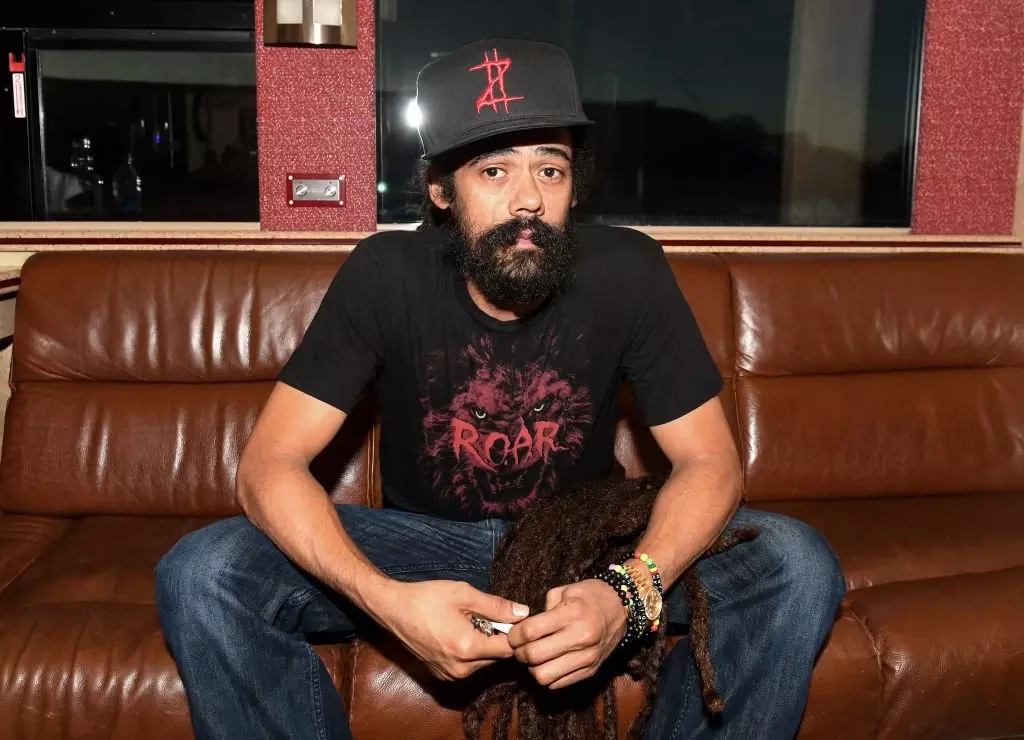
"Reggae is more than just a party," Damian Marley admits. "It has spiritual depth, social commentary, and social consciousness. It's an awakening music."
On September 12, 2005, Marley released a record simultaneously steeped in the multifaceted vitality of his family legacy and showed a path forward for his unique ability to blend deejaying, hip-hop, and more into reggae’s political, social and spiritual depths.
Welcome To Jamrock earned Bob Marley's youngest son rave reviews around the world, reaching number seven on the Billboard 200 and earning two GRAMMYs—one for Best Reggae Album and the other for Best Urban/Alternative Performance for the title track. The album featured international star power, with features reaching from Nas and The Roots' Black Thought to New Jack Swing throwback Bobby Brown, as well as Jamaican heroes such as Bunny Wailer and Eek-a-Mouse. Damian’s brother, Stephen, co-produced the album, further keeping the circle tight around Damian’s righteous strength and incisive criticism of a sociopolitical system of racism and oppression.
The title track rolls and riots, Damian exposing the world to the reality of life in the poverty-stricken areas of Jamaica, to the ravages that both gangs and politicians can wreak. That gritty realism powers the entire album, Damian refusing to play to the expectations of reggae put on by the masses or the music industry.
In honor of the 15th anniversary of Damian Marley’s Welcome to Jamrock, the pioneering reggae artist spoke with GRAMMY.com about the value of family, the spirit of reggae and making his name through powerfully political art.
<style>.embed-container { position: relative; padding-bottom: 56.25%; height: 0; overflow: hidden; max-width: 100%; } .embed-container iframe, .embed-container object, .embed-container embed { position: absolute; top: 0; left: 0; width: 100%; height: 100%; }</style><div class='embed-container'><iframe src='https://www.youtube.com/embed/_GZlJGERbvE' frameborder='0' allowfullscreen></iframe></div>
Tell me a little bit about where your head was when you were working on Welcome To Jamrock. How were you feeling in terms of your career and creativity?
My album prior to Welcome to Jamrock had been on Motown, and that relationship didn't really work out for me and had just come to an end. So at that point in time, I was saying to myself, "I'm going to just make the music I love. I'm not going to make music to try to appease a record company and try to make international singles. I'm just going to try to make some music I want to listen to and my friends can listen to." Then when the title track came out as a single and started to do very well internationally, it put us back in somewhat of a state of making an international record. So toward finishing the album, we worked on some new collaborations with Nas and Black Thought and rounded it out a bit more to capture the momentum.
Was there something you tapped into for this album that you hadn’t explored previously?
Ah! The way that we were picking singles is probably the biggest thing. We were picking songs and trying to put songs together that would be appealing to American radio. If you listen to the single, it's not really built to be a commercial single for radio. It's really a hardcore street single. So I would say it’s more in the approach of how we're releasing the music than how we were making the music. Instead of trying to put together a very polished single with a nice sing-along hook, I just wanted to put out the kind of music I listened to, which at the time would have been really hardcore music.
You worked very closely with your brother Stephen on the album, and it's clear that family and your dad's legacy have had a huge impact on your entire career. Is that just inherently part of you or is that something you've focused on intentionally?
We are very family-oriented people. Our original home is Jamaica where we were born and grew up, and a lot of us live here now in Miami. But those of us who live in Miami still live just five minutes away from each other. So we are very close-knit as a family. And as you mentioned, Steve has been a big brother who has been a guiding force in my life since I was very young. He does a lot of production on all my albums. On the earlier ones, before I was able to do a lot of production for myself, he would take all of the responsibility of production. So over the years we've always been involved with each other's careers.
<style>.embed-container { position: relative; padding-bottom: 56.25%; height: 0; overflow: hidden; max-width: 100%; } .embed-container iframe, .embed-container object, .embed-container embed { position: absolute; top: 0; left: 0; width: 100%; height: 100%; }</style><div class='embed-container'><iframe src='https://www.youtube.com/embed/9Fgp93HIa6I' frameborder='0' allowfullscreen></iframe></div>
Does having that community and trust shift the way that you approach the actual production of the music?
Yeah. There's a value in that in terms of life, and music is just a part of that. I rely on family for support. I believe in family support, 100%, in whatever you do. So you can only imagine how important that is in music. It's also good to have artists' opinions around you, people who give you their honest opinions, and it's also good to have fresh ears sometimes. I do a lot of work with my family, so it's important to bring in new people and new energy too. Music is all opinion-based, and I don’t always have to agree with their opinions. But there are certain people's opinion that, whether or not I agree with it, I respect it. Those are the kind of people I like to hear out.
This album was immediately beloved, both by fans and critics. How did it feel for you at the time to get that reception?
There were a lot of things going on at the time. First of all, because of the situation with Motown, there was a bit of anger. I was angry about that whole situation and I felt like I needed to prove myself. So the success of this record was proof that I had potential as an artist.
As an artist, when you put out music, you hope for the best of everything. You don't put out a song and when it becomes successful say you were surprised. You put out the song hoping it would be successful. Now, we didn't know exactly what would happen, but it's very satisfying when you put out a song and it becomes popular because that's the aim of what you're trying to accomplish. It felt like I was finally accomplishing my dream of having music that is internationally known and becoming a hit. I was very proud of that.
I had also lost a very close friend of mine right around the time of all of this too. So I was very introspective at the time. He was a musician also, and actually the beat of "Jamrock" was supposed to be something he and I worked on together, and it didn't work out that way.
And then there's also the fact that when you're in the middle of it, it happens so fast and you're so busy that it's more so when you step back that you can analyze how you were feeling then. At the time you're just going through the motions very quickly. You get busier than you've ever been in your life. The phone is ringing off the hook. Every other day I'm flying out to take a meeting or going to do some radio show or whatever. The pace of everything becomes so fast and you get more caught up in thinking about when's the next flight and when's the next phone call instead of actually enjoying the moment of the success.
<style>.embed-container { position: relative; padding-bottom: 56.25%; height: 0; overflow: hidden; max-width: 100%; } .embed-container iframe, .embed-container object, .embed-container embed { position: absolute; top: 0; left: 0; width: 100%; height: 100%; }</style><div class='embed-container'><iframe src='https://www.youtube.com/embed/IBGYRtVqVSM' frameborder='0' allowfullscreen></iframe></div>
Beyond winning a GRAMMY and having the title track become a hit, I can imagine it must have felt so rewarding to have such a politically important song hit so much crossover success. That doesn't happen very often.
Just like I was talking about being angry about the situation with Motown, when I look back now in retrospect, I say to myself, "I'm glad that things worked out that way because the song that I got known for is the kind of music that I like to do." It’s not trying to really put together something to appease popular culture. It's more what we feel at heart. Being able to be known for politically driven themes in my music has been a blessing for me in my career. That's where my heart is to begin with. So if I had blown up on the previous album, perhaps I wouldn't be known for this kind of content. I'm glad that the song that the world knows best is “Welcome To Jamrock," which is a politically driven song.
It's important to note we're talking about the anniversary of this record in the midst of the Black Lives Matter movement, that some of the issues of oppression and racism that you were speaking about then are still sadly relevant. How does it feel to have those political messages still feel so vital?
This is what we live. We're not advocates now just because it's time to be an advocate. We have been advocates from the very beginning. Even right now with the atmosphere that's going on, I don't have an urgency to release music that's speaking on the topics of what's going on now, because I have albums of that. I have enough material about that already. That's what we live. It's been a privilege for us to be able to come and present that music and be known for that music instead of being known as a romantic artist or something of that nature.
Your music has always taken from many different traditions and infused it into reggae. Have you seen yourself as having a responsibility of bringing reggae to the world in that way?
I think when it comes down to the spirit of my music, I'm a reggae purist. When I say I lived this advocacy, the genre of roots spiritual reggae music, there's many other people who have been doing the same thing. From my father's generation coming up, a lot of reggae musicians stand for these values. So, it still comes through in the lyrics. It still comes through in the sounds, the songwriting. The themes are still very authentic to reggae in terms of what the reggae movement and its philosophy is all about.
What is that spirit to you?
It's a concern for people. Reggae is more than just a party. It has spiritual depth, social commentary and social consciousness. It's an awakening music. I don't want to use the cliche "one love" phrase, but that's still a part of what it is. It's "one love" in terms of mutual respect for one another. That is a common theme. And of course, rastafari, our faith, is always present in our music. It's a music that is dealing with very serious topics and very serious issues.
A good example of that is the track "Confrontation," which sets a tone and preps people for what they're about to experience musically, spiritually and politically. You have an introduction from Bunny Wailer and a sample of Marcus Garvey. It's just such a smart way to deliver your themes.
Bunny Wailer had done the intro for my previous album, so we stayed consistent with having him open this album. It was really my brother Steve's idea to put in the Marcus Garvey sample for that particular track. Ideas like that aren’t really pre-planned or premeditated. Sometimes it comes in the moment of working on a track when inspiration comes and you try it out. You have to remember that what the public hears is what worked. They don't hear the things that we tried that didn't work. You try different things to get something that feels right.
"Road To Zion" featured Nas and in a sense launched your collaborative album, Distant Relatives. What was it about that connection that proved so fruitful?
I'm a fan of a lot of music, but not every musician would necessarily go well together because of what they stand for as opposed to what we stand for. It doesn't mean that we can't enjoy their music, but we like to do music with people that we feel have a common message. We've always had that admiration for Nas even before knowing him, based on his lyrics. A lot of the time when we try get someone to collaborate with, we're already hearing their voice on the beat, just their cadence and their tone.
We had a few tracks that were left over from Welcome To Jamrock that didn't make the album, one of which was a song about Africa. So the idea came up to use that leftover track and do a few more tracks for an EP based on Africa, which ended up becoming an album. So you're right in saying that you would never have Distant Relatives without Welcome To Jamrock.
<style>.embed-container { position: relative; padding-bottom: 56.25%; height: 0; overflow: hidden; max-width: 100%; } .embed-container iframe, .embed-container object, .embed-container embed { position: absolute; top: 0; left: 0; width: 100%; height: 100%; }</style><div class='embed-container'><iframe src='https://www.youtube.com/embed/uDsJB_zUquo' frameborder='0' allowfullscreen></iframe></div>
Is there anything about the album or its creation that you would change?
If you had asked me that question maybe eight years ago, I'd probably give you a different answer than I'd give you now. For example, when we did "Welcome To Jamrock," that was the first single from the album. The second single, at the time, the company wanted to go with "Beautiful," the song with Bobby Brown. But I chose to go with "Road To Zion" as the second single. "Beautiful" may have had the potential to become a bigger commercial single than "Road To Zion" ever became, because Bobby Brown was really hot at the time because of his reality show. But again, out of "Road To Zion" comes Distant Relatives and other things. So, in retrospect, I'm glad that I'm known for "Road To Zion" as opposed to being known for "Beautiful."
So where I am in my life, looking back, no I don't think I would have really changed anything. It worked out in the end. Doing other things may have brought me more immediate commercial success, but there's a certain integrity that I've gained by those choices. This album will forever be my stamp. The previous album, I won a GRAMMY for that album also, but it doesn't compare to the stamp that Welcome To Jamrock made. It hopefully solidified my place in music as perhaps one of the greats of my genre.