What's the greatest opening track on a debut album? Is it the Beatles' "I Saw Her Standing There"? Guns N' Roses' "Welcome to the Jungle"? N.W.A.'s "Straight Outta Compton"? Whatever's your favorite, chances are it's the sound of a young, hungry artist with a chip on their shoulder and something to prove—not to mention full of jitters about being in a studio.
For better or worse, that's exactly what Wolf Alice sounded like on their 2015 debut album, My Love is Cool—and they readily admit it.
"It's a mixture of nerves, anticipation, excitement, and rage kind of blurring into one project," drummer Joel Amey tells GRAMMY.com. From an adjacent Zoom square, lead vocalist and guitarist Ellie Rowsell echoes his statement. "We're 10 times better than we were when we started off," she says. "For [bassist] Theo [Ellis], Joel and I, we were very new to our instruments, weren't we?" (Guitarist Joff Oddie rounds out the quartet.)
<style>.embed-container { position: relative; padding-bottom: 56.25%; height: 0; overflow: hidden; max-width: 100%; } .embed-container iframe, .embed-container object, .embed-container embed { position: absolute; top: 0; left: 0; width: 100%; height: 100%; }</style><div class='embed-container'><iframe src='https://www.youtube.com/embed//0xjD7KbxgGQ' frameborder='0' allowfullscreen></iframe></div>
Flash-forward to 2021, and Wolf Alice are stumping for their third album, Blue Weekend, which dropped June 4 on the British indie label Dirty Hit. On tracks like "Lipstick on the Glass," "How Can I Make It OK?" and "The Beach II," the GRAMMY-nominated alternative rockers' studio vision finally catches up to their ambition—which they were never lacking in the first place.
Plus, they have a new, crack producer—three-time GRAMMY winner Markus Dravs—on the case. "When you're a garage band at home, you have vague ideas of reverbs and things like that," Amey says with a laugh. "It was really fun to explore those things with people who actually know what they're doing."
Throughout the interview, Amey and Rowsell speak with a sense of awe about the mechanics of music-making, from nicking a Sufjan Stevens guitar sound to paying homage to the Roches' "Hammond Song" to drifting along on an Arthur-Russell-style drum loop.
GRAMMY.com caught up with Wolf Alice's Ellie Rowsell and Joel Amey to discuss the creative trajectory that led to Blue Weekend, why the mercurial-yet-democratic Fleetwood Mac is a fount of inspiration, and how a demo blooms into a full-fledged track.
This interview has been edited and condensed for clarity.
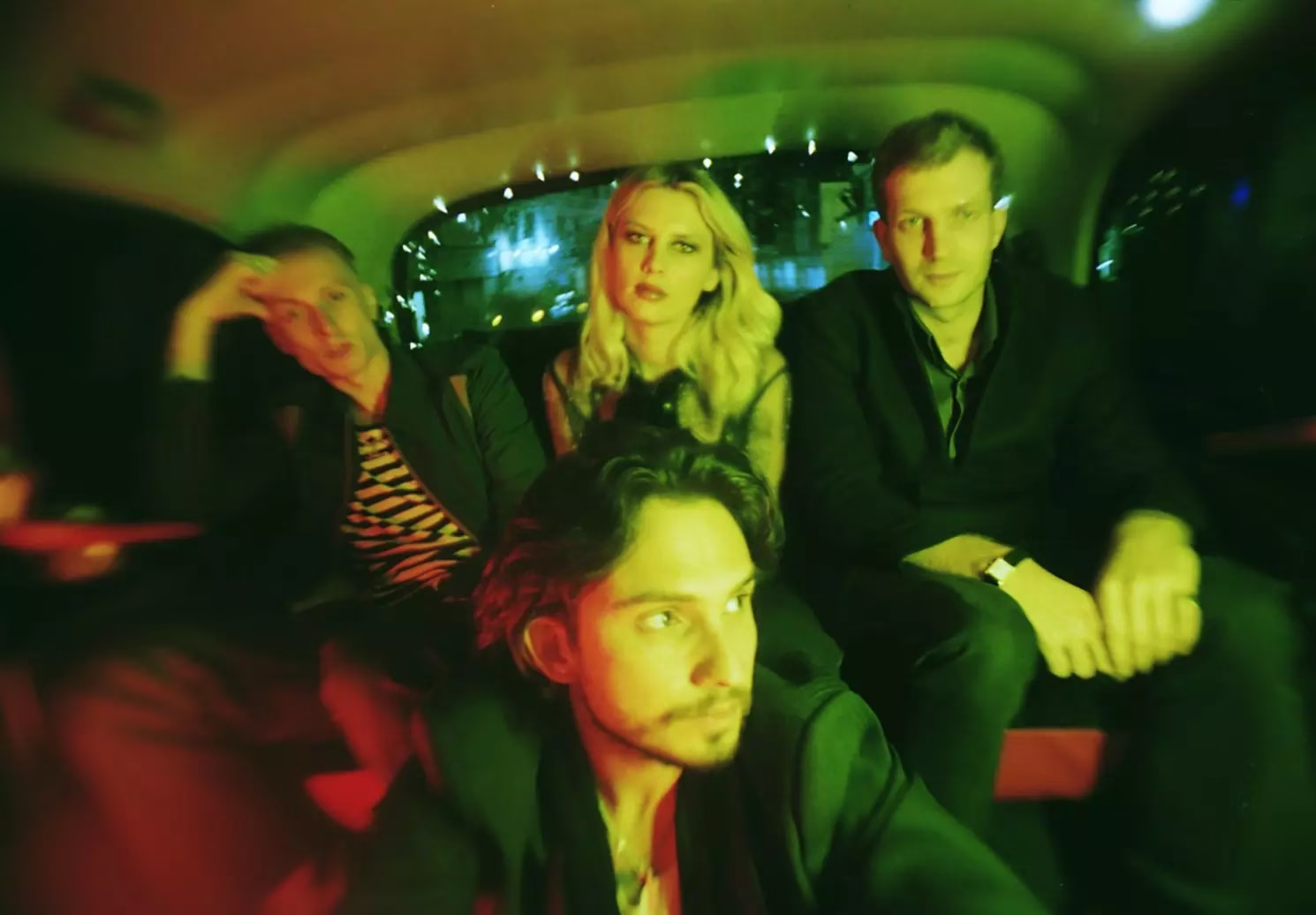
Wolf Alice | Photo: Jordan Hemingway
Congrats on the new album. How do you feel?
Rowsell: Super excited. It crept up on us, hasn't it?
Amey: It really has, yeah.
Is there a release show of any type? Or are you still doing the virtual thing a year and a half into this situation?
Amey: In the U.K., we can do a socially distanced thing; a very small capacity can come in. I actually went to one last Friday. It was cool to hear live music, but it was sort of strange. It was a bit like an examination hall layout in terms of tables and a rock band playing.
How do you feel the band has developed creatively across your three albums?
Rowsell: God, I feel like it's probably easier for someone else to hear it rather than us. We've been, obviously, fully immersed in being us as a band. But I think we've gotten better, for sure. As musicians, we're 10 times better than we were when we started off. For Theo, Joel and I, we were very new to our instruments, weren't we?
Amey: That's a polite way of describing how we were.
Rowsell: I think we sound better. [Knowing laugh].
How would you describe yourselves at the beginning—perhaps from the standpoint of your limitations?
Amey: I think we've always been in our own world—ambitious, considering what we can do. Maybe when we started—I don't know if "ideas bigger than our stations" is the right phrase—but we've always thought of the little details, I think. My Love is Cool was done in four weeks, and it's a mixture of nerves, anticipation, excitement, and rage kind of blurring into one project.
Then, Visions of a Life—actually, our guitarist, Joff, said something that was kind of interesting: It's quite experimental by our standards. We went on loads of different tangents and we were encouraged to have a real adventure in the studio by Justin [Meldal-Johnsen], our producer, who was super encouraging about going down the rabbit hole of loads of ideas.
I feel like there's a lot of each person's personality in Blue Weekend. We've kind of distilled it down to what we appreciate from songwriting and being in the studio. It's more focused.
On the topic of anticipation and nerves, I think of the Beatles or Joy Division on their debut singles. They sound jittery like they can't believe they're in the studio.
Amey: Yeah, it's like a toy shop for people, isn't it? When you're a garage band at home, you have vague ideas of reverbs and things like that. It was really fun to explore those things with people who actually know what they're doing. [Chuckles.] You get tips!
Which wells were you drawing from for Blue Weekend? Who—or what—were your inspirations, or archetypes in rock history?
Rowsell: [Long ponder.] I think we were thinking a lot about Fleetwood Mac and how, despite being a kind of rock band in many ways—or a guitar band, at least—[they] wrote these massive pop songs. They're a perfect marriage of the two genres, and that's inspiring to me, I think, in the same way that the Band are to us. Yeah, lots of stuff. All over stuff.
I don't feel like there's one thing that's overarching. It's here and there. We take inspiration from multiple different artists.
What are some of your favorite moments on Blue Weekend? Let's start with "The Beach."
Rowsell: Well, I love call-and-response. [Laughs.] So, I'm glad we got call-and-response on the album. When I listen back to that bit of the song, I imagine hundreds of people chanting it. I think we tried to make it sound a bit like that as well. It was always kind of funny! I'm proud of us that we were like, "Yeah, let's make it sound like hundreds of people are chanting this thing!"
Amey: I think it's one of the few songs we have where all four of us recorded vocals.
<style>.embed-container { position: relative; padding-bottom: 56.25%; height: 0; overflow: hidden; max-width: 100%; } .embed-container iframe, .embed-container object, .embed-container embed { position: absolute; top: 0; left: 0; width: 100%; height: 100%; }</style><div class='embed-container'><iframe src='https://www.youtube.com/embed//-9-mjj0TfKg' frameborder='0' allowfullscreen></iframe></div>
How about "Delicious Things"?
Amey: I think "Delicious Things" was a bit of a breakthrough moment for us when recording. We started working with a revered producer, Markus [Dravs]. We didn't do too much hanging out and drinking together. Your first relationship is making something off the bat and hitting "record." That's kind of how we started this.
We got to a stage where we listened back to what we were recording, listened to "Delicious Things" and said, "Maybe we're holding back a bit?" He said, "Less is more," and we had this thing about "Less is more." Then we decided, "No." This was the moment where we plugged in a MIDI keyboard and put on trumpets, put on strings, and just went for it.
I think there was something in the four of us we weren't quite doing up until that point. From then on, we had a new confidence to write the songs in a maximalist way if we wanted to. Not having to strip every song back to, like, four people, which we maybe tried to do at one point.
<style>.embed-container { position: relative; padding-bottom: 56.25%; height: 0; overflow: hidden; max-width: 100%; } .embed-container iframe, .embed-container object, .embed-container embed { position: absolute; top: 0; left: 0; width: 100%; height: 100%; }</style><div class='embed-container'><iframe src='https://www.youtube.com/embed//PIU_gvwEr3E' frameborder='0' allowfullscreen></iframe></div>
Moving on to "Lipstick on the Glass." Any thoughts or stories about that tune?
Rowsell: Yeah, we kind of struggled with this one.
We had a demo version, which was soft and slightly electronic, and we had a full-band version. I think Markus at one point said, "It sounds like Las Vegas," which we weren't really happy about! We got into the studio, split between these two versions. Sometimes, you can only really get the good ideas to come out when you're not supposed to be in the studio.
There was one night when we were supposed to be going home since it was late in the evening. I was talking to Iain [Berryman], the engineer, saying, "Please, can we just throw a few things at it? It's not going to be serious. It's just jokes." That's when you can feel confident enough to make things you were once scared of.
From then on, we kind of thought, "OK, this is starting to take on its own identity." We put strings in there. We programmed stuff into it. We'd just been listening to Sufjan Stevens' song ["Mystery of Love"] from Call Me By Your Name, and we were like, "Put those dry, noodly nylon-string guitar things in it!" Basically, just copy what he does.
<style>.embed-container { position: relative; padding-bottom: 56.25%; height: 0; overflow: hidden; max-width: 100%; } .embed-container iframe, .embed-container object, .embed-container embed { position: absolute; top: 0; left: 0; width: 100%; height: 100%; }</style><div class='embed-container'><iframe src='https://www.youtube.com/embed//NV39h7GHDYs' frameborder='0' allowfullscreen></iframe></div>
Now, we get to "Smile." I'm curious how that one came about.
Amey: Early on, when we had a Dropbox of ideas, I had an instrumental with that riff. I brought an acoustic guitar and a fuzz pedal and was kind of mucking around and made it into an instrumental—just noodling and trying to practice my production a little bit.
It kind of hung around for a while. Ellie had these amazing lyrics from another demo called "Smile." It became one of those ones where we crossed them together. Then, we took it into the rehearsal room and [it] became much more of a live band song. It existed as more like an electronic piece before.
<style>.embed-container { position: relative; padding-bottom: 56.25%; height: 0; overflow: hidden; max-width: 100%; } .embed-container iframe, .embed-container object, .embed-container embed { position: absolute; top: 0; left: 0; width: 100%; height: 100%; }</style><div class='embed-container'><iframe src='https://www.youtube.com/embed//8cJnXjjUXmE' frameborder='0' allowfullscreen></iframe></div>
How'd you execute "Safe From Heartbreak (if you never fall in love)"?
Rowsell: We were kind of inspired by "Hammond Song" by the Roches. It's a brilliant song. I wanted something that had those kinds of dry, up-front, outsung, stepped vocals. We had the two parts, so it's a male-female part, because, obviously, Joel is a great singer.
We then struggled a little bit to know what music should be going on in the background because this is a vocally driven song. Again, Joff's noodling came to mind. He did it on two guitars—kind of a dueling fingerpicking thing—and it was really hard because it was mechanical. It needed to be precisely played.
<style>.embed-container { position: relative; padding-bottom: 56.25%; height: 0; overflow: hidden; max-width: 100%; } .embed-container iframe, .embed-container object, .embed-container embed { position: absolute; top: 0; left: 0; width: 100%; height: 100%; }</style><div class='embed-container'><iframe src='https://www.youtube.com/embed//Ba_K8oNrDv0' frameborder='0' allowfullscreen></iframe></div>
Can you talk about "Feeling Myself"?
Rowsell: It came about from a little demo that I had. I didn't really think it was something we'd use. It was just synth-y stuff. The guys really liked it. We worked on it and we kind of fell in love with the middle-eight of it, the music of that and note choices and stuff. It became a favorite moment of ours. I think because of that, we really wanted it on the album. It's a new direction for us that's exciting.
<style>.embed-container { position: relative; padding-bottom: 56.25%; height: 0; overflow: hidden; max-width: 100%; } .embed-container iframe, .embed-container object, .embed-container embed { position: absolute; top: 0; left: 0; width: 100%; height: 100%; }</style><div class='embed-container'><iframe src='https://www.youtube.com/embed//WoBzpdm_h0c' frameborder='0' allowfullscreen></iframe></div>
We're almost done with the record. "No Hard Feelings."
Amey: It was something Ellie sent over as an intro to a longer demo. I remember when I first heard it; it sounded like [it had] a Motown-y, girl-group-y kind of vibe to it. Then, it moved onto a different track. We became really fixated with this intro and tried to do a band version of that intro vibe.
We just tried different things, you know? Happy accidents. Joff just felt inspired and came up with this Arthur-Russell-y loop that just kept going and going. He sent the vocals and we were all visibly moved.
<style>.embed-container { position: relative; padding-bottom: 56.25%; height: 0; overflow: hidden; max-width: 100%; } .embed-container iframe, .embed-container object, .embed-container embed { position: absolute; top: 0; left: 0; width: 100%; height: 100%; }</style><div class='embed-container'><iframe src='https://www.youtube.com/embed//FlrgtxkmnTM' frameborder='0' allowfullscreen></iframe></div>
Last but not least: "The Beach II."
Rowsell: Yeah, this came from one of Joff's demos that he made on his phone, I think. It had some classic Joff sounds in it: big reverb and distorted guitar noises, electronic drums. We really loved it; it sounded quite old school. We were struggling to find a good melody or lyrics over the top of it.
At the very end, while in the studio, I had another crack at it. It took this song to a different place that had much more of a home on the album. It had all the components of Wolf Alice in one tune: The shoegaze-y stuff, the pop stuff, the electronic stuff, the folky stuff, the rock stuff.
How Do You Follow Up A Blockbuster Album? Let Royal Blood, Who Just Released Typhoons, Explain
