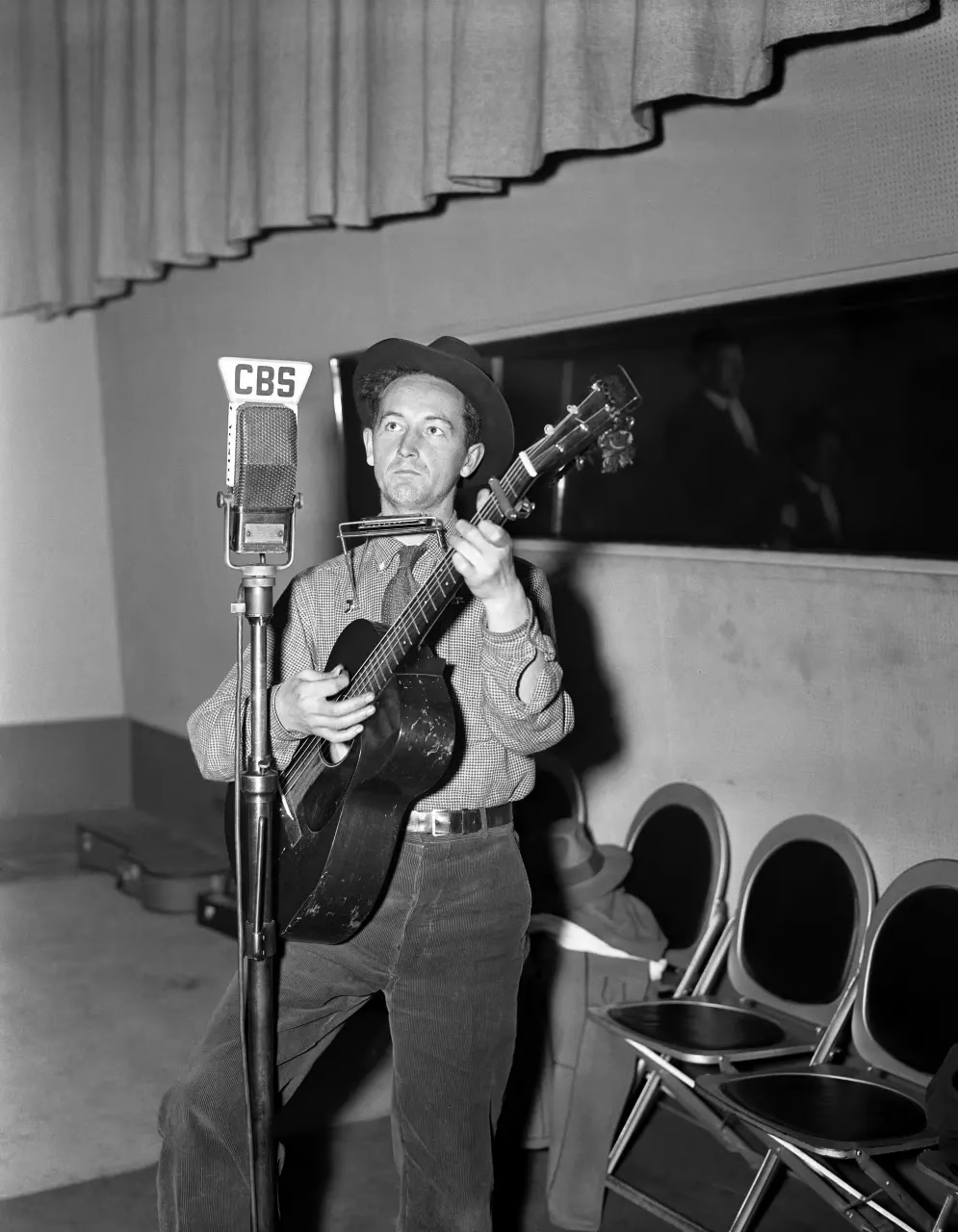
From California to the New York island, each city, town, and corridor of America tends to grow its own distinctive type of artist. What about Oklahoma, where Woody Guthrie came up in the tiny town of Okemah?
"Oklahoma culture is really interesting because it's not the South, and it's not the Midwest," singer/songwriter Parker Millsap—a proud Okie himself—tells GRAMMY.com. "It's really new; it wasn't a state until 1907. So it's a unique place because it's in the middle of everything but also far away from everything."
In the 21st century, this sums up Guthrie, who died in 1967. Born 99 years ago, he cataloged the plight of Dust Bowl migrants and caught accusations of Communism—both concepts that tend to molder in history books. While its meaning remains contested, "This Land Is Your Land" remains somewhat frozen in amber as a classroom singalong. Bob Dylan, Bruce Springsteen, and the Byrds have long since given his other classics, like "Pretty Boy Floyd" and "Ain't Got No Home," their own spin.
<style>.embed-container { position: relative; padding-bottom: 56.25%; height: 0; overflow: hidden; max-width: 100%; } .embed-container iframe, .embed-container object, .embed-container embed { position: absolute; top: 0; left: 0; width: 100%; height: 100%; }</style><div class='embed-container'><iframe src='https://www.youtube.com/embed//VSehQKKeKNE' frameborder='0' allowfullscreen></iframe></div>
Despite all this, Guthrie keeps bobbing to the surface, whether it be reports of his tussling with a certain landlord named Trump or Lady Gaga's cover of you-know-what at the Super Bowl. But as a handful of contemporary artists attest, these songs could have been written this morning.
Home In This World, a track-by-track remake of his 1940 Dust Bowl Ballads album, arrived September 10, featuring modern Americana acts like Waxahatchee ("Talking Dust Bowl Blues"), Watkins Family Hour ("Blowin' Down This Road"), and Swamp Dogg ("Dust Bowl Refugee"). The point? All these decades later, class struggles, economic pain, and the rising tide of neo-fascism remain global enemies to reckon with—and sing about.
Woody Guthrie. Photo: John Springer Collection/Corbis via Getty Images
Unlike other mid-20th-century musical icons like Elvis Presley and Frank Sinatra, Guthrie didn't have a "music career" in the way we understand it today—both in its cyclical nature and that stars didn't usually pal around with leftist activists and union organizers.
Instead, he was more of a documentarian—hitchhiking, riding the rails, hanging out with roustabouts and ne'er-do-wells, and generally soaking up the struggles of ordinary people during the Dust Bowl.
Most crucially, he externalized these experiences, churning out volumes of songs, poems, and prose. (To say nothing of his brilliant, partly fictionalized 1943 memoir, Bound For Glory.) Billy Bragg's and Wilco's Mermaid Avenue, Vols. 1 and 2, which set previously unheard lyrics to music, crucially unfroze him from his political context, demonstrating his diverse moods, feelings, and interests. All of this adds up to an unadulterated, livewire artist—in other words, the real deal.
Parker Millsap. Photo: Tim Duggan
"He stood for people, not money and rock stardom," Millsap explains. "Music stardom has been associated with a certain corporatism, and Woody was doing his thing before that took off with Elvis and the Beatles." So perhaps Guthrie remaining commercially unfettered—and, as such, free to express anything he wanted—is partly why his music has endured.
But this alone doesn't guarantee timelessness. To earn that adjective, Guthrie would need to tackle specific, evergreen problems. Case in point: "Vigilante Man," which Millsap covered for Home In This World. "Why does a vigilante man/ Carry that sawed-off shotgun in his hand?" Guthrie asks in the song. "Would he shoot his brother and sister down?"
<style>.embed-container { position: relative; padding-bottom: 56.25%; height: 0; overflow: hidden; max-width: 100%; } .embed-container iframe, .embed-container object, .embed-container embed { position: absolute; top: 0; left: 0; width: 100%; height: 100%; }</style><div class='embed-container'><iframe src='https://www.youtube.com/embed//RX2FnGNDz5c' frameborder='0' allowfullscreen></iframe></div>
"I just think it's powerful and resonates with the rising consciousness of police power and what that entails, and what should and shouldn't be allowed," Millsap says. "When police kill people without giving them the right to trial, they're playing the judge; they're playing the jury; they're playing the prosecutor. They're taking the law in their own hands beyond what they're allowed, and so, to me, that makes them vigilantes."
"I thought: If he was alive today, there's no way he wouldn't have written songs about Breonna Taylor and George Floyd and the countless others who have fallen victim to police brutality," he continues. Because of this, Millsap took the liberty of adding new verses, casting "Vigilante Man" in the light of the Black Lives Matter movement.
Lillie Mae. Photo: Misa Arriaga
As for Nashville singer/songwriter Lillie Mae, Guthrie's work's sense of unchecked social injustice resonates with her, especially in this era of layoffs, lockdowns, and federal stimulus checks.
"If these songs were popular in the Depression, it seems like a more modern version of that," she tells GRAMMY.com. "We're absolutely in—not a similar circumstance, but hardships left and right for everyone. I think that is probably very similar to what was at the time when he was writing these songs. I don't think they could have picked a better time to put out a project."
<style>.embed-container { position: relative; padding-bottom: 56.25%; height: 0; overflow: hidden; max-width: 100%; } .embed-container iframe, .embed-container object, .embed-container embed { position: absolute; top: 0; left: 0; width: 100%; height: 100%; }</style><div class='embed-container'><iframe src='https://www.youtube.com/embed//CC2jFbuf0Mc' frameborder='0' allowfullscreen></iframe></div>
For this project, Mae picked "Tom Joad, Pt. 2," about a homicide parolee who finds his family has been driven from their farm. He and "Preacher Casey" flee with the Joad family to a "jungle camp," where a deputy sheriff shoots an innocent woman in the back—and Casey lays him flat for his trouble. Instead of being exonerated for self-defense, Casey is hauled to jail and escapes—and "vigilante thugs" ultimately corner him and gun him down, too.
"They killed the good guy. Like, the good guy's standing over the bad guy, and then they wipe out the good guy," Mae says with a hint of astonishment. "That is very accurate, still in today's world. That happens all day long, every day."
"He was obviously a brilliant human being," she continues. "What a cool gift—to receive things he saw and word them in ways that resonate with so many people. He's a great songwriter who, for good reason, is standing up with the test of time."
John Paul White. Photo: Alysse Gafkjen
John Paul White, a Muscle Shoals native who used to be one half of the GRAMMY-winning folk duo the Civil Wars, admits he's a man out of time. A devotee of songwriter's songwriters like Tom T. Hall and Don Schlitz, White loves story songs—which, he freely admits, are no longer a popular mode of expression.
"I've always been a sucker for those," he tells GRAMMY.com. "I gravitate toward discernible storylines, front to back." This description exactly describes the Guthrie outlaw classic "Pretty Boy Floyd," and that's why White chose it for this collection: A great yarn never goes out of style.
<style>.embed-container { position: relative; padding-bottom: 56.25%; height: 0; overflow: hidden; max-width: 100%; } .embed-container iframe, .embed-container object, .embed-container embed { position: absolute; top: 0; left: 0; width: 100%; height: 100%; }</style><div class='embed-container'><iframe src='https://www.youtube.com/embed//EIbrIRhpvDo' frameborder='0' allowfullscreen></iframe></div>
Another Guthrie lesson that resonates with White is how the legendary songwriter passed the torch to a generation—specifically, the time Dylan visited Guthrie at Brooklyn State Hospital when he was dying of Huntington's disease. Just as Guthrie had learned from the Western artists he loved as a boy—and the migrant workers he learned from on the road—he, in turn, gave numberless folkies in his wake a song, a conscience, and a lineage to belong to.
"It's like a movie," White says. "I think of those things, and I think: I should do the same thing. I should seek out my heroes and the people that mentored me without knowing it. I should go to their bedside and learn all I can and make sure they know they're revered. I don't do a very good job of that."
Perhaps Guthrie's son, Arlo—of "Alice's Restaurant Masacree" fame—put it best in a recent tweet: "Seems like the longer he's gone the more popular he gets. Joking aside, he left an indelible mark on me and a big chunk of the world." Granted, Guthrie is rarely celebrated in the mainstream like other figures of his era. But everyone who picks up a guitar and pen has to reckon with him at some point.
And ultimately, that's what this collection proves. To the average person, maybe Guthrie is "far away from everything," as Millsap said of his native state. But music fans who understand what's really going on—that history is currently rhyming—also grasp that Guthrie remains completely relevant, aged like wine, right here in the mix. He's at home in this world, just like he was in the last one.
Here's What Went Down At Bob Dylan's Mysterious "Shadow Kingdom" Livestream Concert
