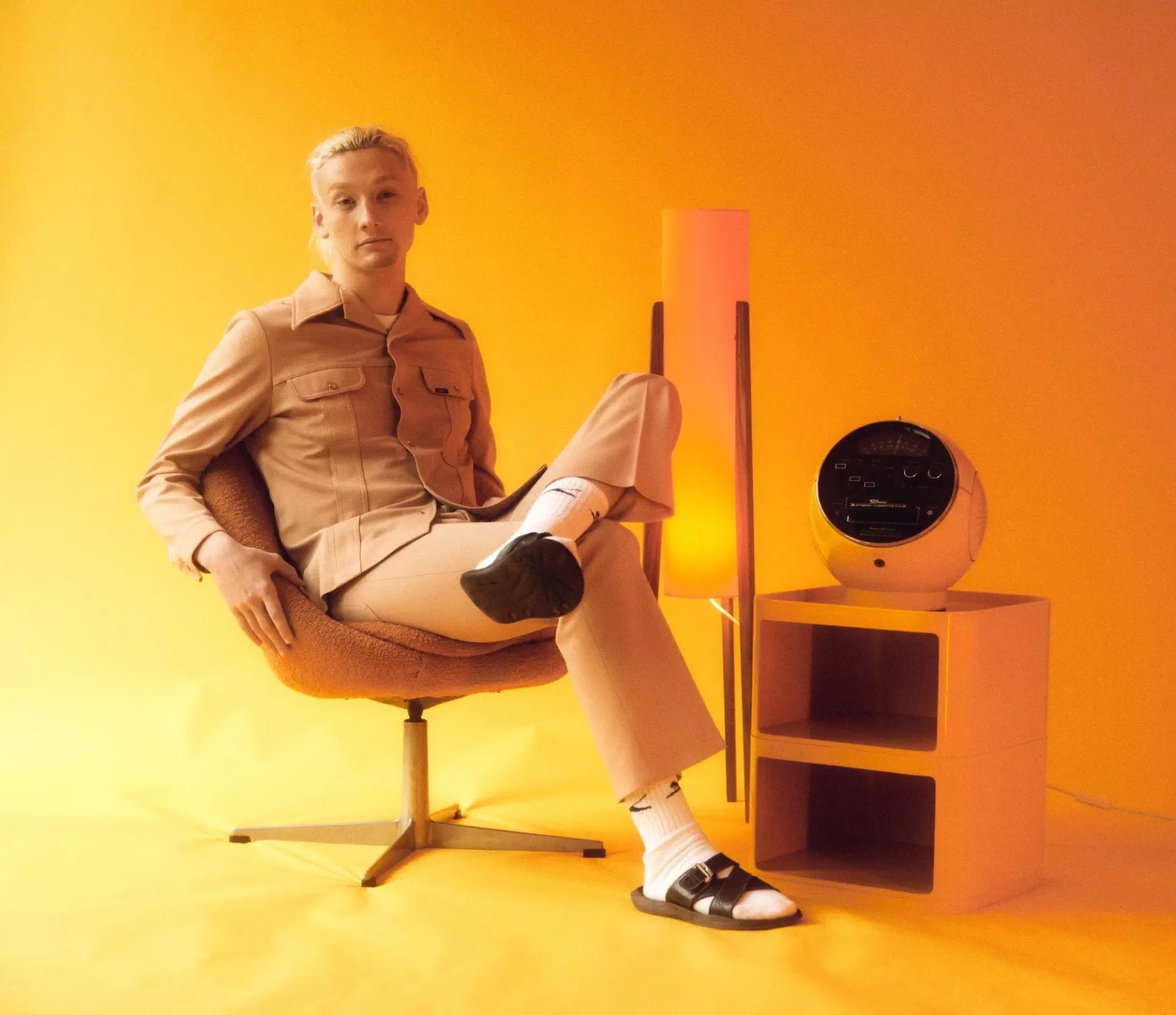
"They don’t want you to say what you want to say…but you got to be free!"
George van den Broek doesn’t mince words. Right out of the gate, on "Be Free," the opening track of A Day In A Yellow Beat, his second album as Yellow Days, the 21-year-old U.K. singer and songwriter makes it clear that he’s going to do things his way, and more than ever, he has. The result is thrilling.
His musical gifts are no news to anyone who’s followed the soul prodigy since his come-up four years ago, when, as a teenager working out of a garden shed-turned-studio in Haslemere, Surrey, he crafted Yellow Days’ debut EP, Hidden Melodies, and a first album, Is Everything Okay In Your World? Marrying a love of jazz, soul and the blues—Howlin’ Wolf, Etta James, and personal hero Ray Charles were early influences—with a Gen Z teen’s honest, poetic bouts with depression, anxiety, heartache and ennui, songs like "A Little While," "The Way Things Change," "A Bag of Dutch" (weed was a recurring muse, too) and "A Gap in the Clouds" resonated with disaffected youth. With R&B legends as inspirations and voice that often sounded well beyond his years, Yellow Days offered a fresh take on classic sounds. It was something to hear, and see—as sold-out crowds on several continents did. At the end of the day, though, save for a few players and producer Tom Henry, the project was, creatively, George, alone. But a new vision for Yellow Days soon developed—something more ambitious, collaborative, and as George began to discover the grooves of 1970s Curtis Mayfield, Marvin Gaye and Weldon Irvine, funky.
Which brings us to A Day In A Yellow Beat, a sprawling sophomore full-length that in scale, sound and mood is on an entirely different level to those moving but modest garden shed creations, and will challenge any notions of Yellow Days as an unassuming indie-soul project, forever caught up in melancholy feels. The new album is being released on Columbia Records, partly because it takes behemoth Sony Music’s money to make an LP as ambitious as this one: 23 tracks recorded over two years in two cities—London and Los Angeles—with dual teams of seasoned musicians bringing the funk and soul heat, plus multiple engineers and production collaborators, all overseen by a musician who only this year turned 21.
That a major label allowed a Zoomer who in the digital age really ought to be sitting at a computer making cost-effective music and staying in his lane to instead sow his musical oats like the old cats did half a century ago, at considerable expense, is a testament to Columbia’s faith in George's talent, a faith that has paid off beautifully. A Day In A Yellow Beat is an expansive ride that is not pastiche revivalism, but rather George's own modern addition to the legacy of funk, disco, jazz fusion and soul. There’s romance (the breezy "Let You Know," the wah-wah of a "drugged up ballad," "You"), a sexy, spacey jam ("Keeps Me Satisfied"), a dancefloor gem (“Love Is Everywhere”) and generation-spanning guest appearances: Shirley Jones, of '70s R&B trio The Jones Sisters, on three tracks; Bishop Nehru, on "!," an unlikely stoner rap track; and George’s do-anything inspiration, indie-rock everyman Mac DeMarco, playing guitar on highlight "The Curse."
Most of all, though, the new album delivers positivity. Even as he explored funk, George also emerged from one. That "Gap In The Clouds" he sang about through dark times in 2016 has given way to full beams of sunshine: you won’t hear a record this year that is more start-to-finish unrelentingly upbeat. The song titles alone are those of a man on a mission of optimism: "Keep Yourself Alive," "Let’s Be Good To Each Other," "Open Your Eyes" and "Love Is Everywhere." "It’s bout time I broke out this funk," he croons on "The Curse"; on "I Don’t Mind" he carries a "little bag of sunshine / just to keep those clouds away"; and the most full-throated statement of peace of mind comes in "Getting Closer": "It’s been a long time/ It’s been a while/ Since I spent the whole day/ With a smile," he sings. George calls it a track about "getting over a hump in life," and an "unapologetic ode to positivity and better days ahead."
There may be cynics greeting all this cheer—there always are—and George acknowledges as much on "Let’s Be Good To Each Other." But Yellow Days, for here and for now, is about peace, and offering something to hang onto. "You have to give them hope," the late, great Harvey Milk famously said. And in a year in which hope has often seemed in short supply, we’ll take it—especially when it’s delivered in as fun and funky a musical package as this.
George and I talked at length about A Day In A Yellow Beat, over two Face Time calls—one found him at an airport in Berlin and a second at a studio in London where he and his band, along with U.K. soul singer Lynda Dawn, were rehearsing a soon-to-be-filmed gig showcasing this electrifying, inspiring new album.
<style>.embed-container { position: relative; padding-bottom: 56.25%; height: 0; overflow: hidden; max-width: 100%; } .embed-container iframe, .embed-container object, .embed-container embed { position: absolute; top: 0; left: 0; width: 100%; height: 100%; }</style><div class='embed-container'><iframe src='https://www.youtube.com/embed/HVs-JXBQYp4' frameborder='0' allowfullscreen></iframe></div>
George, I was gonna start by asking what is different about this impending release as compared to the last two. But then I thought—between the sound, the size, the expense, the guests, the locations, this COVID year, no tour—I guess pretty much everything is different?
Definitely. I would agree entirely. It’s been a transformation for me! I mean, I have now had a few years to write and to travel and to tour, and to be inspired. And I think those two years had a big effect on me, and I think coming back with this record, I think that people can hear that. I’ve signed my big deal, I’m hooked up with all these players, and I’m coming at it from a slightly older perspective. And my writing’s got better, my playing’s got better. I’ve been listening to Marvin, to my Curtis, listening to Al Green! I’ve just been so inspired by '70s fusion acts like Don Blackman and Weldon Irvine. And so all those things cumulatively have kind of caused this kind of change. But I think you can still hear me within it.
Doing something of this size, coming from a mostly D.I.Y. situation before—had you always had dreams of something on this level?
I toured the first two records for like two years, and we were just kind of surfing away having fun. And I think I became very ambitious from touring. I think maybe sitting and watching other acts, in their headline slots, and sitting back and thinking, "You know, I could write songs that put us up there." You know what I mean? I think I was sitting up there and I got very hungry, and ambitious. And I think you can hear that on this thing. I think that I am kind of amping myself up, firing myself up for something in a way that I haven’t done.
So the record began in London?
Yeah, with this fantastic producer called Blue May, he’s worked with Kindness, other people. He's a great guy, and a real gear head, knows analog gear in the studio. It was at Konk Studios in London, which is actually owned by The Kinks. I can’t remember which one of The Kinks, but so I used to see him kind of wandering around the studio. We would kind of bump into each other, and yeah he’s a real interesting character…
Ray? Or Dave?
I think it was…Ray? But anyway that was incredible, and it was his studio so we were using all his kind of stuff. And I mean he didn’t know who the hell I was—I was just that goofy kid smoking weed and running around the studio!
So you did the Konk sessions and is that kind of how it went, and then Blue moved to L.A. and then you ended up migrating to Los Angeles?
That’s correct. I love Blue, but he left me in a fairly sticky situation, moved from London to Los Angeles, which definitely added six months onto our plan, you know?
And so we had to re-approach. And funnily enough we ended up going with an American producer called Mike Malchicoff. And me and Mike just kind got on like a house on fire. I think it’s important to note that Blue and Mike, both of them took a very like old-school engineer approach, which I think really helped anchor the whole thing.
There's this beautifully designed booklet that comes with the record, and the care you take to actually offer some nice thoughts in there about each and every person on this near-30-person production, down to the engineer's assistant. It’s very thoughtful and, I think, too rare.
Definitely, man. You know, one thing for me—I am a self-taught musician. I’ve kind of come out of nowhere. I didn’t go to school for it, I didn’t train or anything, and I’m sitting with these amazing jazzers, and they respect me for what I do, because they know I can write. So, we kind of complete each other, and we had a great time. And I think I’ve been introduced to the L.A. community, a bit of London, a bit of New York. And I just love these people, and respect them so much. And they inspire me massively. And I am trying to do what other people don’t do right now, and kind of put them out there
Was there a difference between the London players and the L.A. ones, in terms of performance?
Definitely, I would say the U.K. players are incredibly authentic, incredibly vibe-y, and they have a great sound. But I would say there is something about the L.A. players where there is just a funkiness. That’s what I would say is the difference. I would say my U.K. players bring hold down such a warm, authentic, almost like maybe a '60s sound, or '70s. But the guys in L.A., they’ve just got the funk. It’s as simple as that. They’ve got the pocket and the feel—cause they’ve been playing on like, disco and stuff.
I imagine you learned a lot.
Oh yeah, I am a bit of a sponge. Just being around people like that, who’ve played with Kanye, Nas, Frank Ocean, Mark Ronson—they just change things. Just spending an evening playing with these guys, it’s something else. Because they come with so much authenticity, so much passion, so much talent. And for me, who’s a young musician who’s just progressing, they have helped me unlock so much and see beyond so many hurdles.
It’s not every 19, 20-year-old who can get Columbia Records to sign on to a project that is this ambitious. How did that happen?
So the story is, my A&R from my very first deal [Scott Jason], he got a job over at Sony/Columbia, and we definitely were looking to sign a big deal and all the rest of it, but he came through and said, “Look guys, I’m here. Why don’t you come hijack the system with me, and we can take this thing for a ride? See what happens?"
So did you go into Sony and say, "Look, this is the kind of record I want to make. I am not going back to the garden shed, folks." Were you that blunt about it?
Definitely! Yeah I think I had to be, there were times when I had to say, "Look, this is it," you know. It kind progressed, honestly, though. It kind of was a long journey, to doing it. And really as things became clear exactly how it was gonna go, I’d say it was about one year before everyone was booked in and they were with me on this funky thing. I had to work harder as well. But I think musically, and in terms of production, I think the extra work has paid off massively. Because I’ve been doing this whole thing based on trying to pioneer something. That’s been the bottom line for me, is trying to bring a new sound. I’m not trying to recreate something that exists; it’s more an idea of trying to pioneer, trying push a genre in a new direction—to continue the story.
I mean you pretty much lay it all out there in "Be Free"—it’s kind of a shot across the bow of anyone who’s gonna try and tell you what to do.
Exactly. That was the most important thing for me was making that statement, straight away. You know, to them and to everybody, because creatively, you have to be free. There’s no two ways about it.
There are some amazing guests on here: Shirley Jones, kind of an unsung R&B legend; and you’ve got Bishop Nehru on "!" which, I have to say, I wasn’t prepared for a rap track in the middle of this funk 'n soul album!
Well, Shirley is just such an amazing lady. I started digging into The Jones Girls a few years ago, discovering them, and she is carrying the torch for her sisters who sadly have passed away in the time since they stopped making records. But Shirley has been a huge inspiration to me. And then Nehru, we actually haven’t met because of this crazy lockdown—that was all done online. But there is such stamina to the way he raps, a young guy, but another one kind of carrying the torch, for hip-hop. And I just wanted to bring some Cypress Hill-type stoner beat, some "green energy" to the record.
And then of course there's Mac [DeMarco], who turns up on "The Curse" and who I know to be one of the nicest dudes in music. He was also a longtime hero, right?
For sure. I remember when I was a kid, like 11, watching the family computer, I was on YouTube, and there was a video for "My Kind Of Woman" [2012] and he was running around naked, and cross-dressing, all this stuff, and I was just a kid but I remember looking at it and thinking, "Wow, yeah, this is incredible. This guy represents everything I want to pursue in life." Like, he cared so little what people think and he was so sure of himself. And I remember thinking, "Yeah. This is it." And that was my moment with him. So to think that years later we’d become friends, I’ve opened shows for him, and to think that I would be sitting with him making music with him is just crazy.
<style>.embed-container { position: relative; padding-bottom: 56.25%; height: 0; overflow: hidden; max-width: 100%; } .embed-container iframe, .embed-container object, .embed-container embed { position: absolute; top: 0; left: 0; width: 100%; height: 100%; }</style><div class='embed-container'><iframe src='https://www.youtube.com/embed/ChIVsNgzaAo' frameborder='0' allowfullscreen></iframe></div>
Apart from the musical shift, I think some people who kind of thought they knew what Yellow Days was about will also be surprised at the happiness and positivity that kind of radiates from the record.
It’s definitely just a peaceful time for me, and I think it’s funny—you know, you talk about people not expecting this to be what Yellow Days is about. I think Yellow Days is whatever the hell I do! And I think anyone who says different is crazy, you know? But it’s funny, there is a real thing about that with kids at the moment, where they just can’t get their head around that someone does one thing and then they want to do another thing. You know you hear artists saying that all the time. You know, "I just wanted to try this, do that, and the kids are like.." with Mac they’ll say, "Where’s Salad Days?" or with Tyler [the Creator], "Where’s Wolf?" You know? It’s always the same. But yeah. I took inspiration from The Beatles, you know? Where on every single record they would reinvent themselves and progress and be inspired by a new thing.
For me there’s nothing more kind of blissed-out than "Getting Closer." And I love the way you described it as "an unapologetic ode to positivity and better days ahead."
That’s right.
So my only question about that is, why you use the word "unapologetic"? To me that suggesst that you anticipate there might be people going, "Why’s he so happy all of a sudden? What’s he got to be so happy about?"
Yeah yeah—that’s exactly the crux of it. It’s, you know, the expectation that people won’t be enamored with it. But no, I think "Getting Closer" is, to date, one of my most positive tracks ever. I was having a conversation with my manager, we were talking about it and looking back, and I think probably "Baked In the Sunshine" and "Gap In the Clouds" were maybe the only kind of feel-good tracks I had ever written to date, before this record. But to me, I’m not concerning myself with those kinds of things. The truth is, I’ve gone through spouts of depression and mental illness, since I was, you know, 14, 13. It’s just who I am. And I’m lucky to have had a girlfriend—we’re best friends—who has been there with me this whole time. But this is a good time.
Your honesty about that depression obviously connected with a lot of young fans. In 2018, you told VICE about a girl who told you she didn’t kill herself specifically because of Yellow Days music. That’s a lot. Are songs like "Keep Yourself Alive" meant for those people?
Definitely. It’s a message to them, and I think it’s a message to uninspired musicians—you know, those musicians who can’t quite finish that EP, or musicians who really need to work on stuff, or feel like, "Oh I really want to do this, but I just can’t write that song"—who are having trouble writing. And also to people in my life—to my girl, as well. You know, like saying, "Keep yourself alive, life’s just begun" kind of thing. You know, like, "Don’t get disheartened. You’ve only just started."
<style>.embed-container { position: relative; padding-bottom: 56.25%; height: 0; overflow: hidden; max-width: 100%; } .embed-container iframe, .embed-container object, .embed-container embed { position: absolute; top: 0; left: 0; width: 100%; height: 100%; }</style><div class='embed-container'><iframe src='https://www.youtube.com/embed/HVs-JXBQYp4' frameborder='0' allowfullscreen></iframe></div>
That’s a sentiment echoed by Shirley at the end of “Getting Closer” when she says, "Life may be tough, children. But don’t give up now! It’s only just begun." And I know you’ve said before that Yellow Days is a project for the youth, but as someone who is, let’s say, no longer a youth… I can tell you that your messages resonate with older people as well!
Yeah, I would genuinely say it’s for anyone who’s alive right now. Because we’re all subject to the craziness of this 21st century world, you know? No matter how old you are. And I think my crowds—they vary in age. We see all kinds of ages come through. Because we’re all living in a world where there is a camera looking at us on our phone all day long, a world where celebrity culture and reality TV is more prevalent than ever, where there’s a synthesis of everything, and corporate greed? There’s a lot to be worried about. And people are full of thoughts and anxiety, and nothing to do with them. I think we’re all in the same boat, you know?
I think the mind is an incredible thing. I think we’re all really lucky to have the most complex thing known in the universe, sitting inside our skull. And we live in a world that is completely overstimulating this beautiful organ, and we’re all struggling. But I think you have to express mindfulness, and there’s no better way to do that than to listen to some soul music. So that’s what I’m here trying to do.
Yellow Days’ A Day In a Yellow Beat was released Sept. 18. George and the band will tour the U.K and Europe beginning in March, and, COVID permitting, North America after that.