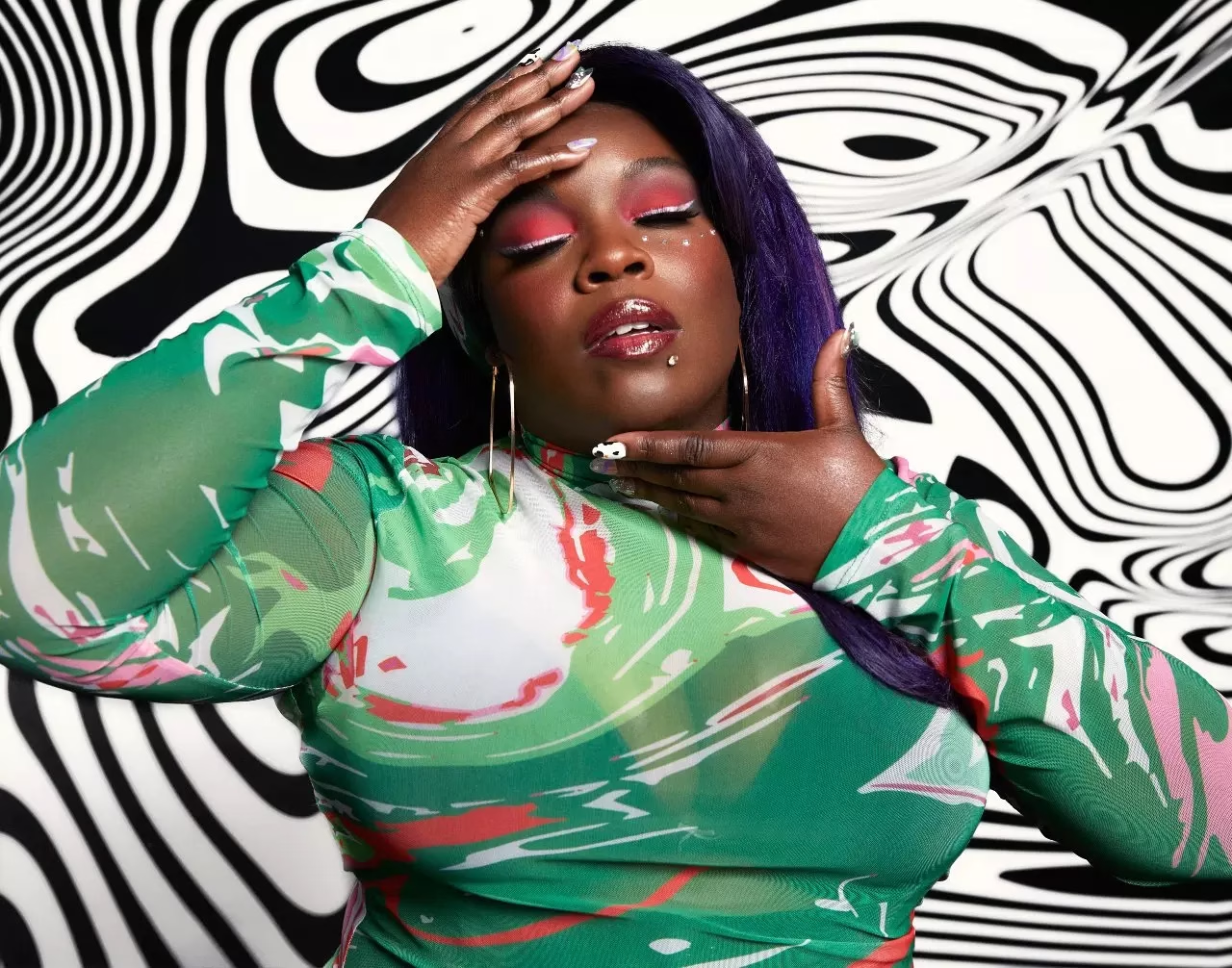
In the wake of George Floyd's murder, a feeding frenzy for diversity officers and employees of color began. While this sea change in culture speaks to a valid and long-overdue reckoning, singer/songwriter Yola sees an insidious threat even in well-intentioned spaces. That menace, to her, is tokenism—the act of perfunctorily recruiting marginalized people so as to not get yelled at.
To Yola, tokenism isn't just a side effect of trying to do the right thing: It's a calculated wing of white supremacy. "The second that you find somebody that is different from you, you group them with a bunch of people that are different from you, so you have less work to do," she tells GRAMMY.com. "You're economizing." Because of this, Yola made Stand For Myself, which celebrates individuality over arbitrary pigeonholing based on melanin content.
Stand For Myself, which was released July 30, is a blend of soul, country, blues, rock and R&B, which shows both Yola's flexibility and how Black innovators created all those styles—a reality that remains depressingly lost on many. The music, however, is merely a vehicle for Yola to communicate who she is at her core, which may not jibe with what the public expects her to be.
"I'm a massive softie. I'm sentimental as heck," she says. "I want to be treated with a sense of nuance and tenderness. I don't have to be tough because I'm a Black woman. I don't have to be servile because I'm from some other community. I don't have to be 'Put up or shut up' because I'm seen as a moral authority."
GRAMMY.com caught up with Yola, who kicks off her national tour on October 7, to discuss the individualist philosophy behind Stand For Myself, why Black musicians still aren't given ownership of their inventions and how she exercises her agency in her music.
This interview has been edited and condensed for clarity.
In the press release, you mention an insidious component of discrimination: Tokenism. Can this form of overcorrecting be destructive?
It's funny: I don't really think it's overcorrecting. I think it's an actual function of the white supremacist paradigm. The second that you find somebody that is different from you, you group them with a bunch of people that are different from you, so you have less work to do. You're economizing. That was a mainstay of my life for a long time: The sense of people economizing. They go: "I see a Black person." Can you tell one from the other?
I have a dear friend who gets mixed up with Mavis Staples. There's nothing [in common between them]—least of all, the considerable decades separating them. It gets to the point where you're not listening with your ears anymore. You're listening with your eyes. So, tokenism is one thing that is part of that paradigm: That "You're all the same, really."
Like, "Isn't it weird that you're in country music?" No, it's Dolly Parton. She's got records everywhere. "But isn't it bizarre that you're in this space?" It's all part of the grand paradigm of the supremacist's assumption that white people create all the music, when it isn't even remotely true. It's the colonization of our ideas. So, when you get tokenized, it's a way of disempowering you. You get put into a small box. It's a way of taking away your ownership.
Your contribution to rock 'n' roll, for example. It sort of goes around on the Internet at the moment: My interview with Channel 4 News in the U.K., speaking to Krishnan Guru-Murthy, who I adore as a journalist and generally. We were talking about navigating the industry and I said "I've heard a person from an A&R from a major say 'Nobody wants to hear a Black woman sing rock 'n' roll. That's not what we want right now."
I'm like, "That shows you don't know the history of who created it! You don't know anything about Sister Rosetta Tharpe! She created rock 'n' roll!" We have a problem here. If you don't understand the lineage of something, if you minimize it, you become reductive to any marginalized group. You reduce their contributions to society.
Do you think it may not be as simple as the "bad guys" engaging in this? That some of the good guys might be driving this?
Yeah! We've all seen liberal moments gone wrong, right? [Cringing voice.] "Oh, no! Oh, sweetie! Sweetie! You tried, but no!" It's a big thing. People aren't realizing that programming is something done to them and they have to police it. People say no baby comes out with cognitive bias, right? No, no baby does. They're right. They know that. But they come into a world that is absolutely strewn with it.
The second they hit air, they're learning supremacist programming. It's in advertising. It's in language. It's in the structure of how wealth is distributed. It's in the laws that govern the land. It's in everything. It's in so much of the politics. Supremacy is in so many things. Is it possible to escape it? What you have to do is be aware of it and police it. Someone's trying to program you all the bloody time.
I don't think racism is a thing you can be cured from, like we're searching for the cure for the coronavirus. Like, that's not how it works. Do what you can and police and pull out the things that keep jumping up into your life, because we all have it. It's not that white people are the only people to get supremacist programming. Black people get it too. Brown people get it too. You see it jump up in people where they haven't policed it and they start championing paradigms that's beneficial for their own people themselves.
Yola. Photo: Joseph Ross Smith
The title of Stand For Myself seems to imply individual identity and action, not a sense of belonging to a nebulous, easily pigeonholed "community" of people with similar melanin content.
[Long laugh.] I actually couldn't put it better myself! To not be part of this nebulous community, but to have this sense of standing up for your right to nuance. Standing for your right to tenderness. To be like: I want to be treated with a sense of nuance and tenderness. I don't have to be tough because I'm a Black woman. I don't have to be servile because I'm from some other community. I don't have to be "Put up or shut up" because I'm seen as a moral authority.
[It applies] whatever way you are: You don't have to be extra-camp because you're part of the LGBTQIA+ community if you don't want to be. It's past individualism and gets to the point of authenticity. Not faking it. Actually just being you. I know it's kind of a trite thing to say, but actually do you.
So, let's say somebody comes to Stand For Myself with an open mind. What do you hope people take away from it and learn about you?
I'm a massive softie. [Knowing laugh.] I'm sentimental as heck. The flesh of the record, the very innards of the record are highly sentimental and seek authentic connection through friendship, through the process of work and collaboration, through love, through my family, and all of these things. You hear it across the record.
People try to put this "strong Black woman" paradigm on me, and there's so much of my life when I wasn't that. I was a real bloody doormat. So, to be able to see the nuance that I have as a person is really, really the function of writing from my lens. I want to speak about my life experience. I want people to know about the nature of my life and the steps that I've taken.
Read More: Press Play At Home: Watch Yola Perform A Rock-Solid Rendition Of "Stand For Myself"
I want people to see the whole of the person. I want people to see me as I am in spaces, across spaces. I want people to see what it sounds like when I'm taking the helm a tiny bit more. I'm actually able to choose the co-writers, whereas on the first record, I didn't know anyone in Nashville yet so I couldn't choose any co-writers!
This is the very epitome of my agency, so I want people to see what that looks like for me.
For Charley Pride, Black Country Music Was A Self-Evident Truth
