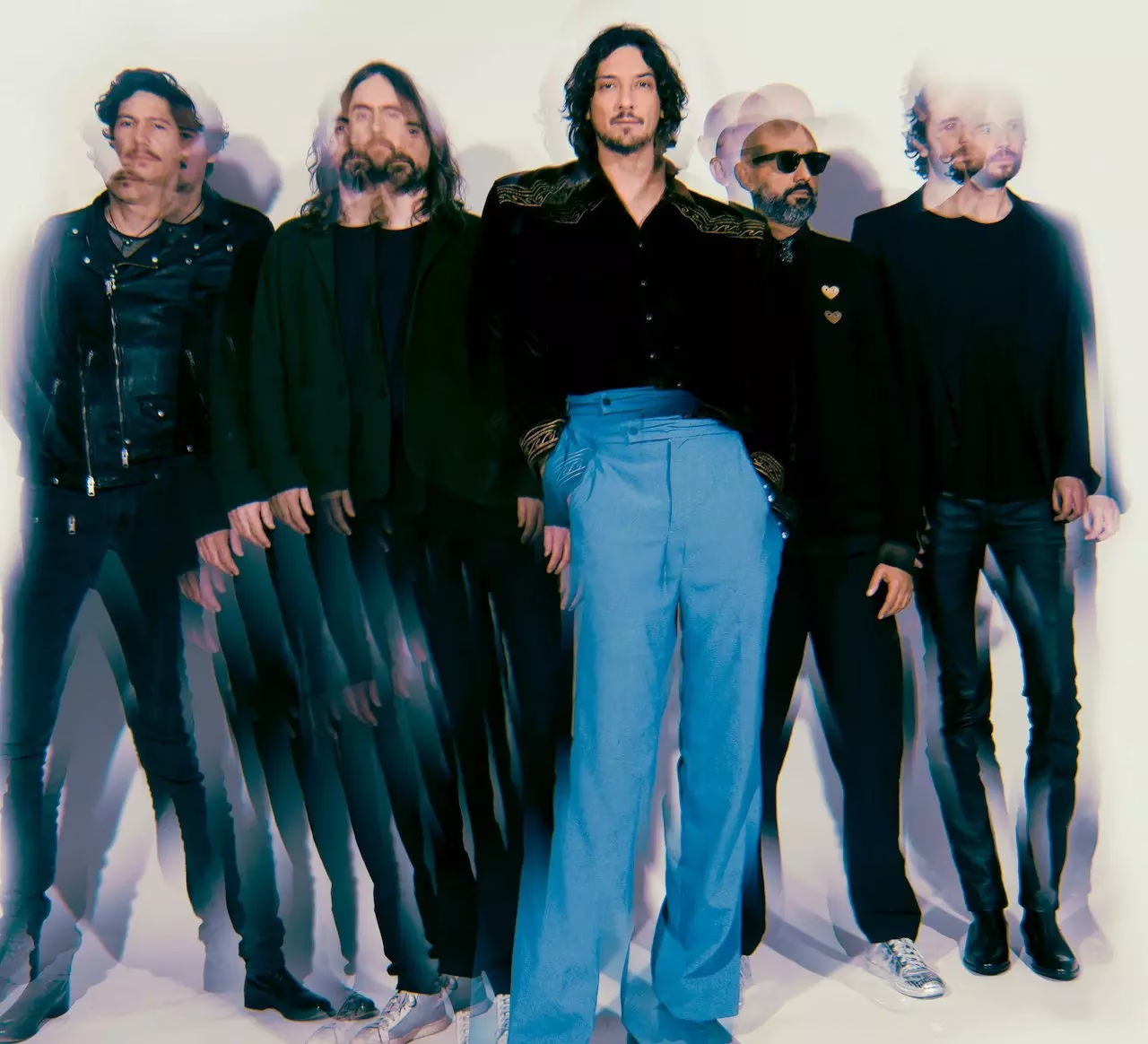
Though it may not seem like it—given that sounds like reggaeton pop are currently dominating the so-called Latin music field in the streaming age—Mexicans can be huge rock snobs. So the fact that Zoé, with their signature indie rock and synthpop sonic identity, are one of today’s most emblematic Mexican rock en Español bands in and out of Latin America—a place where rock still has an invested audience—more than solidifies their position in the rock history books.
The 24-year-old band continues to build on their legacy with Sonidos de Kármatica Resonancia, their latest album since 2018’s Aztlán, released on April 16. Though their seventh album as a band, creating Sonidos de Kármatica Resonancia gave vocalist León Larregui, bassist Ángel Mosqueda, guitarist Sergio Acosta, keyboardist Jesús Báez, and drummer Rodrigo Guardiola a few firsts. "It was the first time we used different techniques to record an album, and I think there was a lot of enthusiasm on the band’s part of doing something like that," Mosqueda shared through WhatsApp call as he lounged in his Mexico City bed. "To play and record together [in the same booth] was something the band wanted to do for a long time, and we finally got to do it."
Last year brought them another unexpected first, one that changed the way they promote their music: releasing half of the album’s tracklist as singles. The band began working on Sonidos de Kármatica Resonancia in 2019 and had it locked and loaded for a 2020 release. The pandemic, of course, ended up throwing a wrench into those plans. Instead, Zoé released five singles throughout the year: "SKR," "Fiebre," "Karmadame," and "El Duelo." Their track "Velur" followed up earlier this year and now, with the album release, "Popular" is their latest single.
<style>.embed-container { position: relative; padding-bottom: 56.25%; height: 0; overflow: hidden; max-width: 100%; } .embed-container iframe, .embed-container object, .embed-container embed { position: absolute; top: 0; left: 0; width: 100%; height: 100%; }</style><div class='embed-container'><iframe src='https://www.youtube.com/embed/v7lmrZWu5Ws' frameborder='0' allowfullscreen></iframe></div>
Most notably, however, is the fact that the band worked with Craig Silvey, known for his work with Arcade Fire and Florence & the Machine, to produce the full album. Zoé teamed up with Silvey for some of the songs on the 2019 GRAMMY-winning album Aztlán and wanted to pursue a new direction with Sonidos de Kármatica Resonancia. Up until this album, the band had worked with Phil Vinall for their entire careers. "We’re eternally grateful [to Phil]," Mosqueda explained. "He taught us a lot. Our albums [with him] turned out incredibly. It was an amazing phase." Thanks to the nostalgic 70’s rock n’ roll flair Silvey brought into the mix, Zoé fully dove into a trippier, lucid dream-like experience with SKR.
Zoé’s sound remains a galactic voyage, complemented with poetically introspective lyrics that simultaneously look out into the world. And though the band, who just announced their lengthy album- supporting U.S. tour, went for a heavily psychedelic sound and explored new production techniques on their new album, there’s a comforting familiarity in these songs that let you know: Yup, this is a Zoé album.
Mosqueda spoke to GRAMMY.com last week about all the magic that went into creating Sonidos de Kármatica Resonancia, the band’s progression over the years and having Latin American legends record their versions of Zoé’s songs.
This interview was conducted in Spanish and translated to English; it has been edited and condensed for clarity.
I was recently rewatching the music video for "Azul" off of your previous album Aztlán and the plot deals with the outbreak of a virus epidemic. Two years later, do you think that’s a bit trippy given the current state of the world?
Yeah, those are things that happen. León really likes science fiction, and in this case, the story coincided in a certain way with this issue, with what happened later. And it’s something that can keep on happening. There’s always new viruses, there’s always new beings that affect us. So yes, it’s particularly interesting.
<style>.embed-container { position: relative; padding-bottom: 56.25%; height: 0; overflow: hidden; max-width: 100%; } .embed-container iframe, .embed-container object, .embed-container embed { position: absolute; top: 0; left: 0; width: 100%; height: 100%; }</style><div class='embed-container'><iframe src='https://www.youtube.com/embed/Ry2sJ1qT4Dk' frameborder='0' allowfullscreen></iframe></div>
This new album, Sonidos de Kármatica Resonancia, is the follow up to 2018’s GRAMMY-winning Aztlán. How do you feel about releasing this new record coming back from this big win?
We’re very happy. We think Aztlán was a great album that had many achievements. Among them, winning a GRAMMY, which we obviously feel very flattered, happy, and satisfied about. With this new album, we’re also very happy with the entire production process [of] recording the album. We think this will be a great release, viene con todo (we put everything into it). We’ve had a lot of support, and we’re very confident about SKR too.
Can you talk about the story behind the album’s name?
The title makes a reference to our own music, what we’ve been doing during our now long career of a bit over 20 years. We wanted this album to have songs that are very Zoé. We believed this was a good moment to look back at our own careers and our career as a band and look at what we’ve been doing, look at the number of songs that have passed first before us and then have become part of the people’s liking. [The album] deals with that. An introspection, of looking into our own influences, both individually and as a group, and also how the influence that the group is already exerting over us when we’re composing. So on these songs [on the album] like "SKR," we can see ourselves not only in the present but also throughout our entire careers. And that what Sonidos de Kármatica Resonancia means — the music that resonates with you, that’s already part of you.
"Popular" is the newest single. How did this song come to be?
This song is the most pop-sounding on the album, and to me personally, I love it. This song comes from two different songs. We fused one song that Chuco and I [had worked on] a demo. León also had another demo and what we did was combine part of his song and part of ours and the result is "Popular." It’s a song we’ve always had our eye on because we knew it had those pop characteristics that are very Zoé. I think it’s a nice song.
The album opens up with "Popular," which as you mentioned is a more upbeat track, and then it takes you on a trip that ends a little bit darker than how it started.
On one hand we have songs that have worked really well, on the popular side, precisely, or on a mainstream level. And we also have other songs that are a bit crazier, more experimental, and even darker. The [second half] of the album is like that. I think that when fans listen to [the album cuts], they’ll have both worlds of Zoé synthesized in 10 songs. Well, that’s the intention. It would be practically impossible to do so, but that’s the intention.
In reference to the singles that are already out, I read that you said "Velur" was the song that reflects how the band makes music. Can you expand on that?
"Velur" has a structure that’s very, very Zoé. I feel like it’s in the family of songs like "No Me Destruyas" and "Vía Láctea," without them necessarily being alike. I’d categorize that song in that same universe because, [on "Velur"] the composition is very simple, with a very simple harmony, a lush melody; [it’s] very easy to understand, and very catchy. The chorus comes in where our other choruses come in on these types of songs. [And then] there are songs on the album that are something else completely. Like you said, [on] the last three songs, the structure is very different, the chorus comes in who knows where, [but "Velur"] got a very compact treatment. It has a guitar riff, I believe, between verse 1 and 2 that’s typical Zoé. It was something that was done consciously. I wouldn’t say this is the usual way that Zoé composes music, but one of the ways Zoé composes music. Because fortunately, we have a certain brand, and our songs have a certain familiarity when it comes to our composition and structures. This album establishes that there are songs with a structure like "Velur," but there are also others like "Ese Cuadro No Me Pinta," which breaks with everything that I just mentioned, and breaks with structure, and has a very long introduction, a chorus that comes in in a very weird place. So there’s no way of pigeonholing the way that Zoé composes music.
<style>.embed-container { position: relative; padding-bottom: 56.25%; height: 0; overflow: hidden; max-width: 100%; } .embed-container iframe, .embed-container object, .embed-container embed { position: absolute; top: 0; left: 0; width: 100%; height: 100%; }</style><div class='embed-container'><iframe src='https://www.youtube.com/embed/8t4008DSi5s' frameborder='0' allowfullscreen></iframe></div>
Now that you mention "Ese Cuadro No Me Pinta," like you said, it breaks with songs and sounds that we tend to associate with Zoé, which the first part of the album covers. Was that done intentionally? The album flows from sounds more aligned with pop and then it progressively gets darker, ending in "Bestiario," which is kind of a wtf moment.
What happened, right? [laughs] More than it being intentional, when we compose music and when we’re arranging the songs [and] playing them in the studio, there’s a lot of intuition. The element of intuition plays a role in the creative process. On a song like "Ese Cuadro No Me Pinta," we let ourselves flow with the music, we knew it wasn’t going to be a single. We knew it was an album track in which we could extend certain things that we couldn’t do on other songs that are for radio. So, our intuition alone would tell us "give it more turns to the intro, don’t let the voice come in." Even our producer Craig Silvey would tell us, “vibe out even more.” This is a song to trip out on. And when you’re doing this, then there’s a bit of intentionality, and that’s where we start dictating which road the song is taking, and it can be a lot more free. We wouldn’t have done this exercise on "Velur." So, yes, there is a bit of intuition and a bit of intentionality. Both are present in the music.
Speaking of Craig Silvey, how did the band come to the decision of having him produce the entire album?
With Craig, we also worked on four songs from the last album. We had an unrest about working with someone else on some songs. And things kind of worked out in a way that we had Craig on the last album. We really liked his work. We became friends, we understood each other musically really well, and for this album, the group still had that unrest about working on a full, unified album with him. We’re very, very happy that this happened. For this album, we wanted to work with the type of techniques that Craig could offer, the band thought it was the moment to try it out. And I think the result was very rewarding.
Sonidos de Karmática Resonancia is the band’s seventh album and you’ve been together for 24 years. How would you say the way you create music has changed or evolved throughout the years?
It’s changed in the sense that we have more experience. You evolve with each album, and our evolution consists of being more mature when it comes to composing, making arrangements, recording techniques. On the other hand, on each album we look to incorporate new things, new synthesizers that give you new sounds, new basses, new guitars. On this album, one of the main "development differences" was recording many songs together, playing at the same time together while we recorded. And that gave the album a special touch. It’s nothing new in music, but we hadn’t experimented with that before, and it was very fun. Some songs sound as if we were playing a show together.
<style>.embed-container { position: relative; padding-bottom: 56.25%; height: 0; overflow: hidden; max-width: 100%; } .embed-container iframe, .embed-container object, .embed-container embed { position: absolute; top: 0; left: 0; width: 100%; height: 100%; }</style><div class='embed-container'><iframe src='https://www.youtube.com/embed/5clnKnkGTwA' frameborder='0' allowfullscreen></iframe></div>
Well, now that we don’t have live shows, that vibe is more than welcomed.
I think people will like it. The most important thing is the songs, really. The songs speak for themselves. And fortunately, the songs have come at a really good moment and we’re very happy about it. With the songs and the entire production process.
As a bit of a side note, can we talk about Reversiones? What is it like having Latin American staples, like Alejandro Fernandez, Juanes, and Mon Laferte, record their own renditions of Zoé’s songs for a compilation album?
Well, really cool. There has been a great selection of artists who have reinterpreted our songs, people of great caliber. And other than caliber, people with a long trajectory and an enormous level of popularity. It’s an honor for us that people of that stature in this industry accepted and worked on our songs, and created great versions. It’s something really cool, to have other artists play your music.
Just to close off, is there anything you’d like to add?
I think SKR is a dignified release, a dignified representative of yet another Zoé album. It’s yet another album that has all of our affection. And we hope that if things get better globally in terms of health and economy, we can play shows because that’s primarily what we do. After making records, you gotta play them.