
A new recording of a well-known piece is rarely a cause for celebration, other than for those who participated in it. But once in awhile, the muses bring us such an event, when the recording and performance can reignite our passion, impelling us to hear an old work with entirely new ears and a new heart. Rarer still is an album that is so perfectly suited to the time and circumstances in which we are living.
Spem In Alium, the new Harmonia Mundi release by ORA Singers, conducted by Suzi Digby, is one of these rare works, and it comes at a time when many of us find ourselves questioning the future of our families and familiar institutions. The title composition speaks of sublime hope, an unwavering faith that things will improve, and that in working together we just might be able to make the world better a better, more harmonious place. That sense of community is written into every semibreve, crotchet, and thread of Spem by Thomas Tallis (c. 1570), the most iconic of works for singers. It is motet, a composition for forty singers in eight groups of five singers, conveying complex, ever-in-motion eight-part harmony.
<iframe src="https://open.spotify.com/embed/album/4PO7rSMhc13N9OgHhTchQS" width="300" height="380" frameborder="0" allowtransparency="true"></iframe>
The title piece, which celebrates its 450th birthday this year, has been recorded many many times before, and yet, as with Mahler's Second, it has been insidiously difficult to capture on tape or in 0s and 1s. The care and exquisite attention to detail on ORA's recording strip away the false veneer of technology, and allow the music to shine, stunningly through, and (even to this jaded listener), the result is a masterpiece of musical vision, production, and engineering.
Although Spem (literally, "hope" or "expectation" in Latin) is the album's title and opening gambit, it is bookended here by the debut performance of a piece that ORA Singers commissioned by composer Sir James MacMillan, Vidi Aquam, as a contemporary reflection on the Spem in Alium. Vidi shares many of the harmonic and structural features of the original, with a decidedly modern set of spatial and harmonic twists. Says MacMillan, "The style hearkens back to the sound of sixteenth century polyphony, but gradually shifts into different, more modern textures. The strict counterpoint eventually subsides into a more impressionistic, hazy world where we hear closed mouth sounds and a ‘smudging’ of harmonies and textures. It feels delightful to hear the ORA singers sing this work [on] the beautiful recording of it."
In between these bookends are an artfully curated tasting menu of smaller Renaissance vocal pieces by Byrd, Tallis, Wilder, Gerare, and Ferrabosco, the great Italian madrigalist, no less stunning in their presentation. The album has been released in stereo, surround, and binaural versions, and a Dolby Atmos mix is forthcoming.
"Well balanced recording in a beautiful space. While it can be sometimes difficult to provide adequate diction and clarity in an album of this type, this issue has been overcome here - there is good precision along with the appropriate measure of perspective and depth." -GRAMMY-winning engineer Richard King on 'Spem In Alium'
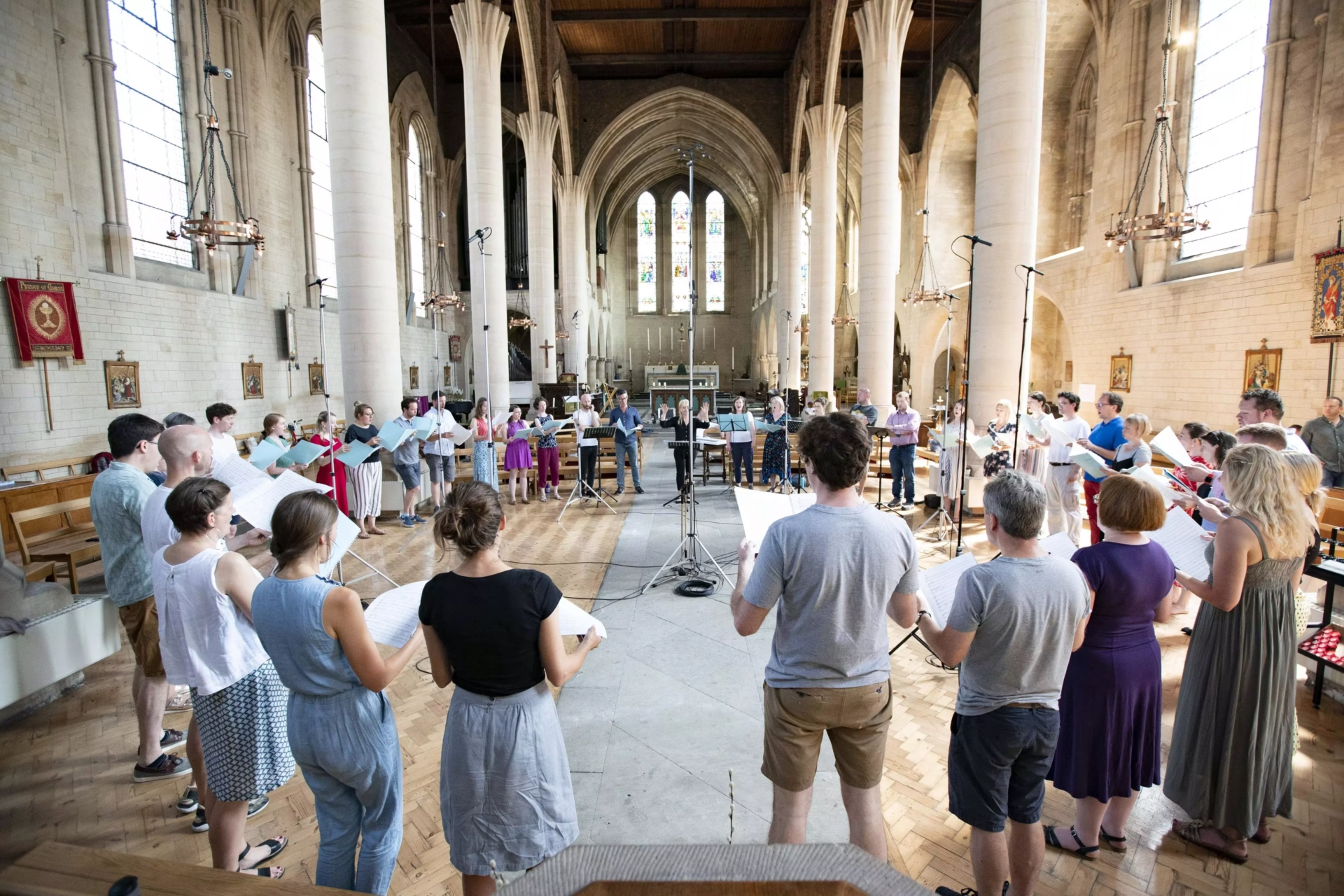
The entire album was recorded in two days at All Hallows Church, Gospel Oak in London, at 192K/24 bit, using 32 microphones, an RME Micstasy preamp and A/D, with fiberoptic cable to the Pyramix recorder. Engineer Mike Hatch described his approach to Grammy.com:
"With SPEM, and the McMillan, the issue is always to try and represent the sense of scale that you get in life, to somehow present it through the artificial medium of two speakers, to contain it but still make it involving. The trick is to make sure there's enough clarity, but avoid the feeling of congestion—so that the listener who's not actually in the room can get a sense of it. Obviously, if you have the singers too far away from each other they can't sing in tune, and if they're too close together you don't get the binaural."
To accomplish this, the singers were arranged in a circle, which could only work for a recording and not in a live performance. Hatch treated each of the eight voices as a group, plus put some central microphones in the circle to capture blend and ambience. To capture the spaciousness, he jury-rigged a quadruple XY, eight mic matrix of his own design. "For the binaural we used Ambisonic microphones, a low and a high and did an ambisonic to binaural mix to create the effect in headphones. I used some padding around the mics to favor as it was a human head."
Proof of Hatch's engineering prowess is that the ORA singers performed live-to-streaming at the Tate Modern this month, which sounded astonishingly like the recording.
Producer Nicholas Parker adds, "this music particularly benefits from the panoply of modern engineering options. The innately complex intermodulation of the image and directionality of multiple sound-sources produces such exciting and moving effects. For the mixes, we were aiming for a truly 'democratic' balance, in an attempt to allow the composers' own writing to determine what lines might be more or less prominent within the complex counterpoint."
<style>.embed-container { position: relative; padding-bottom: 56.25%; height: 0; overflow: hidden; max-width: 100%; } .embed-container iframe, .embed-container object, .embed-container embed { position: absolute; top: 0; left: 0; width: 100%; height: 100%; }</style><div class='embed-container'><iframe src='https://www.youtube.com/embed//EZBcGIeKN_o' frameborder='0' allowfullscreen></iframe></div>
Suzi Digby, (Lady Eatwell) OBE, the founder, conductor and artistic director of ORA, formed ORA by handpicking its members from the best of British choral singers. And while she clearly has an affinity for Renaissance music, she has a foot firmly planted in rock music as well as the official choir director for the Rolling Stones. Parker recalls, "Suzi had a very clear idea of the global shape and pace of the pieces, and I think she knows that with this sort of music, often 'less is more'." On the message of hope, offered by Spem In Alium, Verdi Aquam, and the other pieces during this time of a global pandemic, Digby observes "It seems to have brought intense solace, joy and hope to many, at a perilous time for the Arts. It is a game-changing milestone for today." Surely the literal meaning of these religious pieces was different for listeners in the sixteenth century than it is for us today, but the emotional meaning and messages still resonate: embrace hope, and hold on to music, for it shows us a more orderly and beautiful world.
—Daniel J. Levitin
Read More: Violinist Concetta Abbate Talks Trauma, Empathy & The Healing Process Of 'Mirror Touch'
