
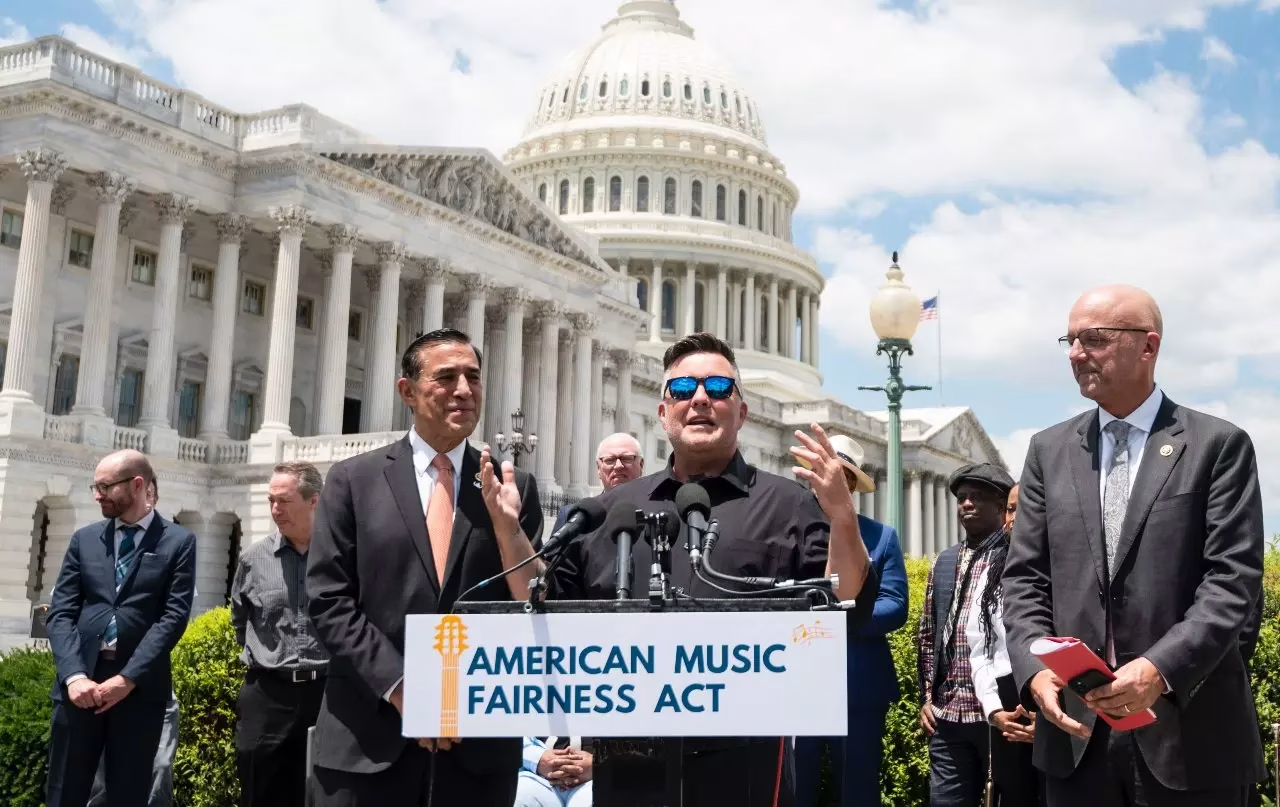
It's been only a matter of weeks since Representatives Ted Deutch (D-FL) and Darrell Issa (R-CA) introduced the American Music Fairness Act (AMFA), a new bill to ensure that artists, performers, producers, and music creators are fairly compensated when their songs are played on terrestrial radio stations.
Deutch and Issa are far from alone in this undertaking, though—and the growing list of supporters in the political and broadcasting centers is constantly growing.
In addition to Deutch and Issa, Reps. Jerry Nadler (D-N.Y.), Tom McClintock (R-Calif.), Karen Bass (D-Calif.), Diana Harshbarger (R-Tenn.), and Judy Chu (D-Calif.) have co-sponsored the bill. Notably, Congressman Nadler is the Chairman of the House Judiciary Committee—where the bill was referred—and has long been a vocal champion to establish a performance right.
The bill has garnered strong support across the music industry, including from organizations like the American Federation of Musicians, the Future of Music Coalition, the musicFIRST Coalition, RIAA, SAG-AFTRA and SoundExchange. And even the AFL-CIO—the largest federation of unions in America—has endorsed it.
As the AFL-CIO's President Department for Professional Employees, Jennifer Dorning, put it in a statement, "Now is the time for Congress to close a loophole that has prevented union creative professionals from earning fair compensation when their songs are played on terrestrial radio."
Despite the expected and misleading opposition from the National Association of Broadcasters (NAB)—who represent conglomerates like iHeart Radio and Audacy— groups representing truly community-owned broadcasters have also come out to support the AMFA, including the Alliance for Community Media, Common Frequency, the National Federation of Community Broadcasters, Media Alliance, Prometheus Radio Project and REC Networks. The support of community radio undermines one of NAB’s misleading arguments that paying artists would bankrupt local stations.
But, that couldn’t be further from the truth. As the small broadcast organizations noted in their support for the American Music Fairness Act, the bill contains important protections for small and non-profit broadcasters to ensure that local and community-supported radio stations can continue to be diverse and thrive. Because small radio stations deserve to be treated differently than Big Radio groups like iHeart, the AMFA protects radio stations that fall under a $1.5 million in annual revenue and whose parent companies make less than $10 million in annual revenue overall. Under the bill, some stations would pay as little as $10 a year for unlimited music!
And naturally, many artists remain on board in support of securing a performance right. From legacy acts like Dionne Warwick and Sam Moore—who travelled to Washington to advocate for the bill at its introduction—to the vocal Academy members who have reached out to Congress in support, it is clear that artists are fed up with the status quo and are ready to fight for real change.
On top of that, according to the musicFIRST Coalition, a majority of Americans support the proposed changes in the American Music Fairness Act as they believe it's unfair that artists are not paid when their music is played on traditional radio; with Americans believing that Congress should side with artists not radio by a 20 point margin.
Despite the growing support for the American Music Fairness Act, Big Radio and the NAB are not backing down and they remain a formidable roadblock in Washington. If you wish to join this fight in support of artists, you can contact Congress here.
Why The American Music Fairness Act Will Give Music Creators What They Deserve
