
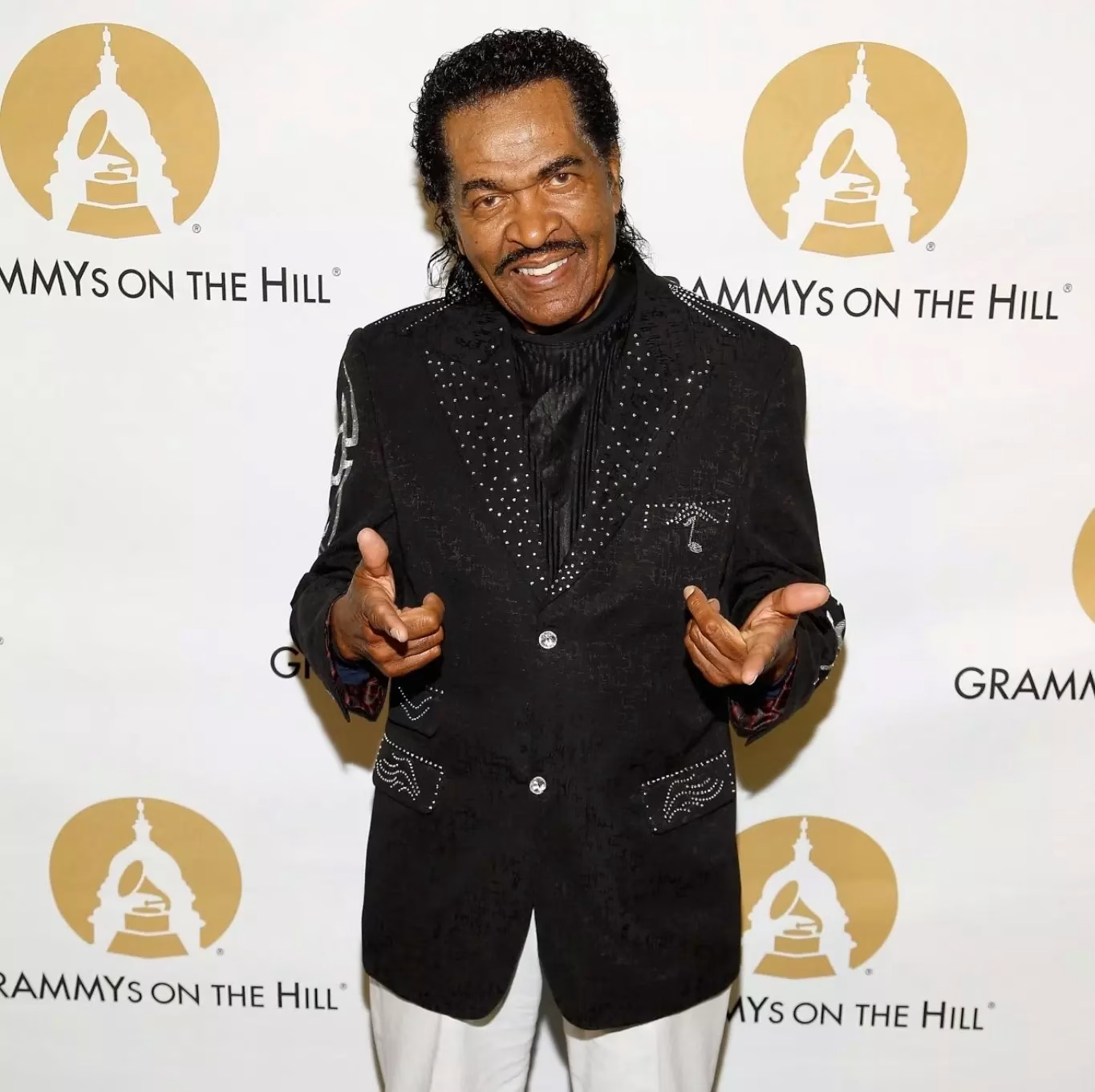
The Recording Academy has asked our members to reflect on their path of becoming an advocate for music and discuss the importance of using your voice to create change. This "Profile in Advocacy" is from Bobby Rush, who recently took home the 2021 GRAMMY for Best Traditional Blues Album.
I'm so grateful and honored by the opportunity to write this article about my experiences as an advocate. I'm thankful to be able to speak my opinion about where we have gone and are going, and what is happening now regarding the progress it will bring to the future of music. Let me start out by saying that I'm very appreciative to the Recording Academy for bestowing upon me the six GRAMMY nominations and two GRAMMY Awards for my records throughout my career. It’s an incredibly high honor. I'm mainly involved in this advocacy because I saw Black men not represented or included in the music industry throughout my career, and that I have a presence that can make a difference by being myself so that other Black people can see me and feel encouraged to get involved themselves. I believe that my involvement in various organizations and aspects of the music industry have encouraged Black artists to do the same over the years. I hope that I am able to continue to have that impact on not only Black artists, but all artists.
I recognize that I am able to have a voice in the process of advocacy because of the success that I've had with the GRAMMYs and through my long career. Now that I have achieved this success, I have been able to be a part of real change on a national level by meeting with members of Congress and highlighting laws that need to be updated to better compensate, and protect, songwriters, artists, and musicians. I have also been able to work with leaders in local and state government, such as mayors and governors, to effect change in my communities.
In 2017, I was asked to participate in GRAMMYs On The Hill in Washington D.C. Of the many policy priorities addressed during the Advocacy Day, our main focus was to stress the importance of passing reforms, like what would become the Music Modernization Act, with members of Congress. Signed in 2018, the legislation immediately impacted my colleagues and I by closing the “pre-1972” loophole that allowed digital services to forgo compensating legacy artists, and securing a system for accounting and issuing payments of mechanical royalties from streaming services which is now set up through the MLC, the Mechanical Licensing Collective. I was blown away by the experience of going to Capitol Hill to meet with our few scheduled meetings, but also by personally being brought outside the House floor and seeing dozens of my friends and fans that are members of Congress. This ranged from Congressman Bobby Rush out of Chicago, to Congressman Stephen Cohen from Memphis, to Senator Roger Wicker of Mississippi, to the great late Congressman John Lewis. Throughout my career, I have become friends with many politicians and performed for those such as Rep. Bennie Thompson, President Bill Clinton and Senator Hillary Clinton, as well as the African American Mayors Association, and the Congressional Black Caucus. However, the experience at GRAMMYs On The Hill gave me a bird's eye view of exactly how legislation is supported and potentially turned into law.
For those of you who don't know me, I was born in the 1930s, in a little town called Carquit just outside of Homer, Louisiana. Throughout my life, I have lived in Louisiana, Arkansas, Chicago, and Mississippi. Even though I didn't live in Memphis or St. Louis, I have been very involved in those communities too. I started performing for the first time in the 1940s, and I eventually made my way to Chicago in the early 1950s. My first record was recorded in 1964, and, arguably, my biggest hit “Chicken Heads” was recorded in 1971. I’ve had the opportunity to release over 400 recordings in my career for a variety of labels, most of which I was the main songwriter for. The reason I mention this is because I’ve had many experiences, both good and bad, that have taken money out of my pocket at that time and for the rest of my career.
I have learned a lot of lessons, and I have gotten to a point of obtaining a good lawyer and manager to help protect me. I'm grateful to have my manager, Jeff DeLia, by my side who has also been very involved with the Academy's advocacy work, including District Advocate Day. Jeff has been able to speak to members of Congress in his area both in-person and on Zoom, including Congressman Adam Schiff, and recently wrote a letter directly to Senator Dianne Feinstein in support of the HITS Act, which was recently reintroduced.
It's true that we have come a long way since the 1960s and1970s, but we still have a ways to go. As much as the world is changing and has changed throughout my career, it's vital that the laws continue to be updated to better protect and serve the artists, songwriters, producers, and musicians, not just line the pockets of the big corporations. As a man, and as a Black man, I not only didn't have the protection that I was deserved but also I was slighted in many ways. To have an organization and my peers in the industry join together to fight for these rights and generate new legislation by lobbying for it, is something I not only never dreamt of having for myself as a Black man but never dreamt of being a part of personally.
To people with my level of experience in this career as well as newcomers such as young artists rising in the industry, I encourage you all to get involved with your local Recording Academy chapter. Get involved in your local community, and especially, if called upon, get involved in the local, regional, or national advocacy efforts of the Recording Academy to continue to speak for yourself and your colleagues. And, most importantly, get involved for those who have less of a voice in these laws. You won't regret it. – Bobby Rush, the bluesman
Read More: Profiles In Advocacy: Ledisi On The Importance Of Using Your Voice To Make Change
