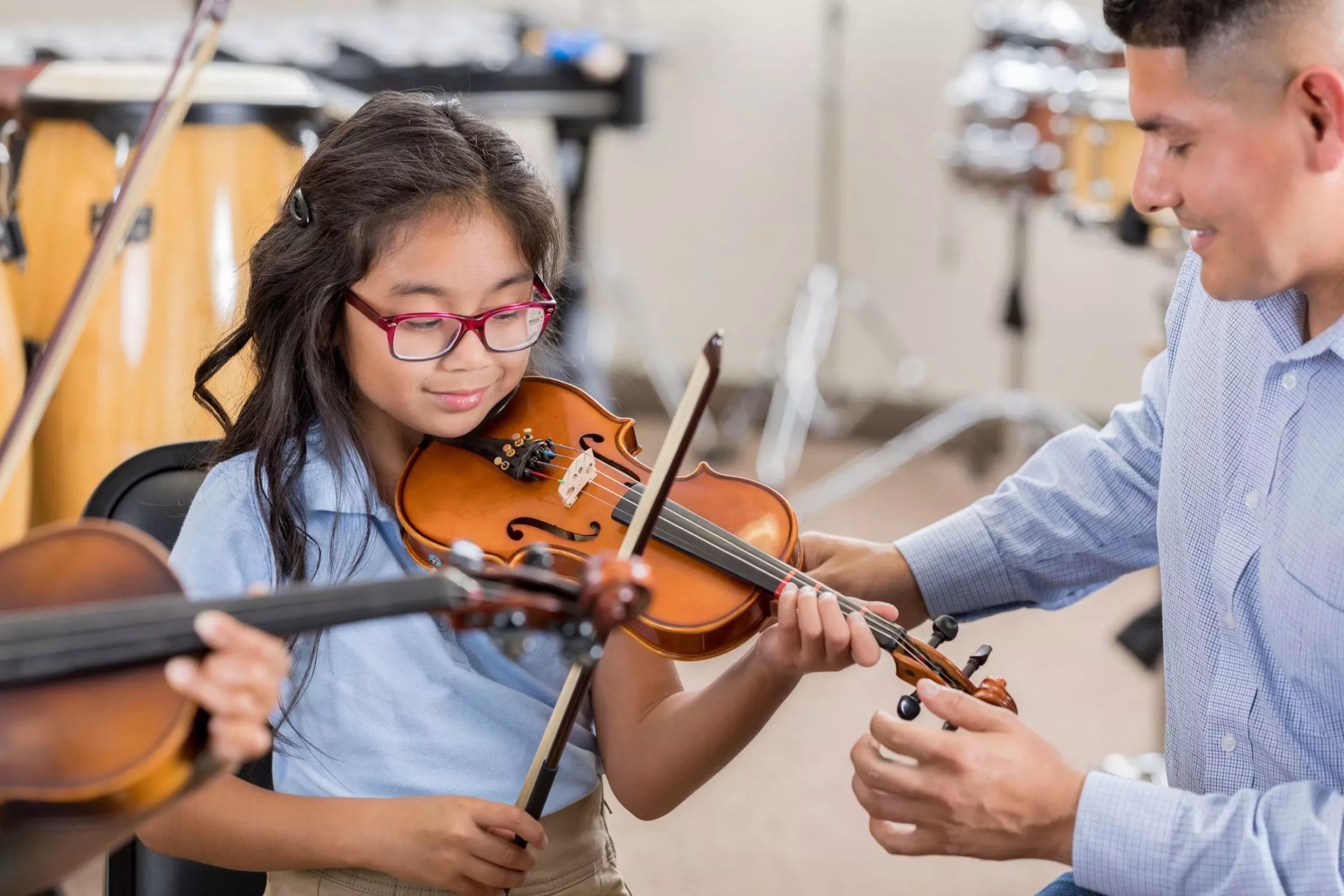
Since its founding 172 years ago, California has been a global epicenter for incalculable contributions to arts and music. So it may come as a shock to know that barely one in five students attend a public school with an arts and music program — while New York state has almost four in five.
Just think of the implications, when four out of five schoolchildren have no access to dance, theater, music, animation, or anything else under the umbrella of the arts. Because as former Los Angeles Unified School District superintendent Austin Beutner says, arts and music are far from playtime or a distraction — they're crucial to instilling unbounded thinking in kids of all ages.
Furthermore, the lessons therein don't just apply to careers in arts and music, but to every sort.
"It prepares students to become not only professional [artists or] musicians someday, but designers, architects, engineers, writers, poets. All kinds of jobs of today and tomorrow," Beutner tells RecordingAcademy.com. "Lots of research shows us that the impact is there… Music is in the soul. And we want to make sure the whole child — body, mind and soul — all are nourished when they're in school."
That's why Beutner is a public and vocal advocate of the California Arts and Music in Schools Initiative, which is officially on the state's ballot for this year's November election. If passed, Proposition 28 would put about $1 billion of state funding each year to arts and music education in California schools — without raising taxes one iota.
This includes music, dancing, computer graphics, coding, film, and an abundance of other mind- and soul-nourishing art forms — all which enrich children's sense of self-worth, collaboration and agency.
And Beutner's past initiatives with philanthropic music giants like Dr. Dre and Jimmy Iovine led him to work with Recording Academy Advocacy — also a proponent of Prop. 28 — in order to get the word out and encourage voters to understand the weight of the matter. "Given so much evidence, unfortunately, music is the first to be cut — and it shouldn't be," he says. "So, this is our chance to make sure there's arts and music in every public school."
Read on for an in-depth interview with Beutner about how his early life instilled the importance of arts and music, why there's virtually no resistance to Prop. 28, and what its passage could mean for school communities across America — not just in California.
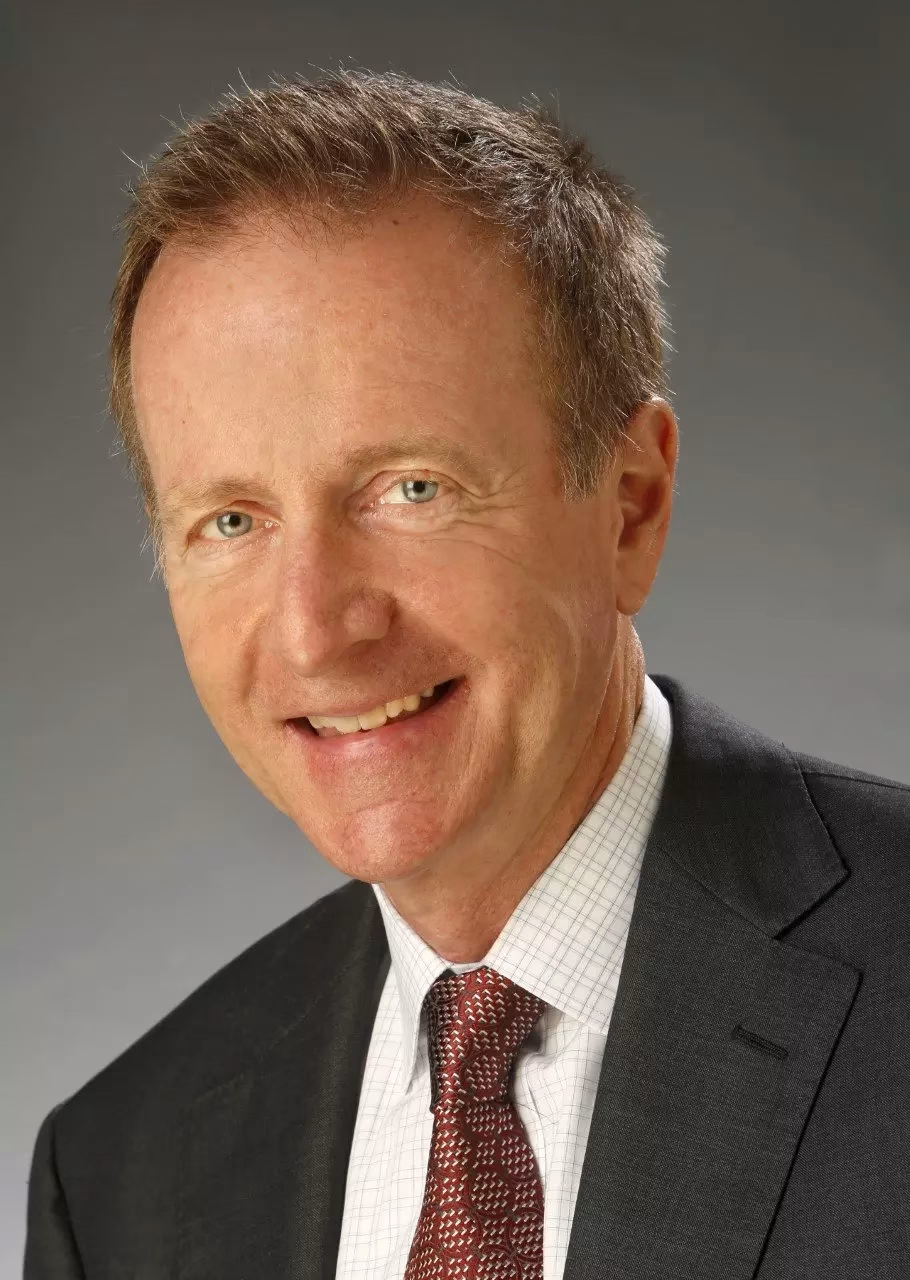
*Austin Beutner. Photo courtesy of the office of Austin Beutner.*
This interview has been edited for clarity.
Tell me about which problem — or gap in the social fabric — Prop. 28 aims to ameliorate.
In simplest terms, it's providing access for children to participate in arts and music while at school. In California public schools, barely one in five students attend school with an arts and music program — barely one in five. Compare that to, let's say, New York; New York has almost four in five.
I can take you through all the benefits of participating in arts and music education, like giving a child a reason to come to school — so, increased attendance, and a sense of belonging to a group, and social and emotional well-being. It's one of the most unbounded forms of creative expression, and gives students a sense of agency; it gives them their voice.
What they learn in critical thinking can be applied not only to the world of music, but across the board to so many jobs today and tomorrow. So, it's an essential piece of a well-rounded education.
I think, sometimes, people have a mistaken impression that somehow arts and music are just this "other." You've got math, you've got reading, and you're all good in school. And if you have a little art on top, that's fine, but that's not what it's all about. Arts and music are an essential part of a good education.
In California, barely one in five children have access at school, compounded with the challenge that so many of the children from families that are struggling to get by have little access outside of school.
We're not doing all we can for children, so here's this opportunity to provide adequacy of funding to help schools provide arts and music — and with that, a more creative and brighter future for the six million kids in public school across the state of California.
I feel like matters of the soul, like arts and music, get lost in the sauce when it comes to policy. It's seen as recreation or a distraction or something.
Yeah, sometimes policy-makers don't understand, or haven't had that lived experience themselves. It's an essential piece of learning.
Unfortunately, in schools [during] the last decade or two, there's been an increased trend in trying to measure everything. No Child Left Behind, and a bunch of federal mandates about what you're supposed to measure in terms of literacy and math.
It may be harder to measure arts and music, but it can be done. There are lots and lots of studies that show increased attendance at schools which have a fulsome arts and music program. Kids want to be there. They come to school.
There are a lot of studies that show that children are better — are whole socially and emotionally — when they can participate in arts and music. They gain a sense of agency.
And study after study shows the power of unbounded critical thinking in the arts — how it prepares students to become not only professional [artists or] musicians someday, but designers, architects, engineers, writers, poets. All kinds of jobs of today and tomorrow.
This one may be a little harder to measure, but lots of research shows us that the impact is there. As you said, most fundamentally, music is in the soul. And we want to make sure the whole child — body, mind and soul — all are nourished when they're in school.
Not to draw too much of a connection between these two spheres of society, but I remember reporting a story on how providing arts and music access to incarcerated people was a boon in every conceivable way. Recidivism went down, violence went down, morale went up…
It's in prisons; it's been studied for just about every demographic that exists, from the youngest children to adults who are currently incarcerated — and hopefully not to be reincarcerated.
It's fascinating to me that given so much evidence, unfortunately, music is the first to be cut — and it shouldn't be. So, this is our chance to restore it. It won't raise taxes on anybody. We've put the power in the hands of each school community, so they can figure out which form of expression best suits the needs of children in that school — music, art, dance, theater, animation, anything in between.
And, I'm particularly excited about this — we're asking schools, when they receive the money each year, to share with their school community publicly what they do with the funds, how it aligns with state standards, and the impact it has on children.
I think this approach to radical transparency across the board will elevate some amazing new programs, and programs that already exist but people don't know about. Because, right now, were this to pass, there are some schools that don't have a music program. And the ability to share with them quickly — and for them to access publicly — what other schools are doing [means] we're going to see great ideas flourish.
California has always been a hotbed for forms of creative expression, and I think we'll look back in five or eight years [and see that this sum] and amazing things will be happening in schools.
I hope it can encourage other states to adopt an effort like this. But also, for schools around the country to see the benefits of arts and music and share good practices so that so many of the voices who are with us and supporting this initiative and stay with us after it passes. To lend their voice and share great ideas.
What I love about this proposition is that it gives kids who might not have type-A personalities an alternative that can help them engender meaning and purpose in their lives. They're not derailed if math or science aren't their thing right off the bat.
There's no question that it will better prepare a generation of students in California for the future. But let's roll back the clock to preschoolers; this will benefit children all the way from preschool to 12th grade.
When preschoolers get together and learn to socialize and be with each other, it's most often through some form of expression like art or music. They'll sing. And, by the way, 99 out of 100 kids enjoy that! So, let's keep it going!
And for the child who might be distracted or have trouble keeping concentrated, let him or her find their own agency and voice in music. I know for myself, my family moved around a bunch when I was in elementary school. My mom taught in public schools and my father worked in factories. By fifth grade, I had attended five different schools.
When I arrived in Michigan from Missouri, I was a bit concerned about the cold weather, but not so much. The snow didn't bother me. My biggest fear on the first day of school was what I was going to do for lunch. Who was I going to eat lunch with? I did not know anybody which is a scary thing for a shy kid.
A music teacher invited me to a class, which happened to be at lunchtime. I didn't ask what a cello was; I found that out later. I asked whether they had lunch, so I got lunch, and immediately had a group of friends. Cello became bass, bass became guitar, and I developed a sense of belonging; a sense of agency.
I could play in front of thousands of people before I could speak in front of tens of people. That's my story. Everybody's got their own story of how art or music impacted their lives. It's universal. Everybody does it. We need to make this opportunity exist for all kids in public schools.
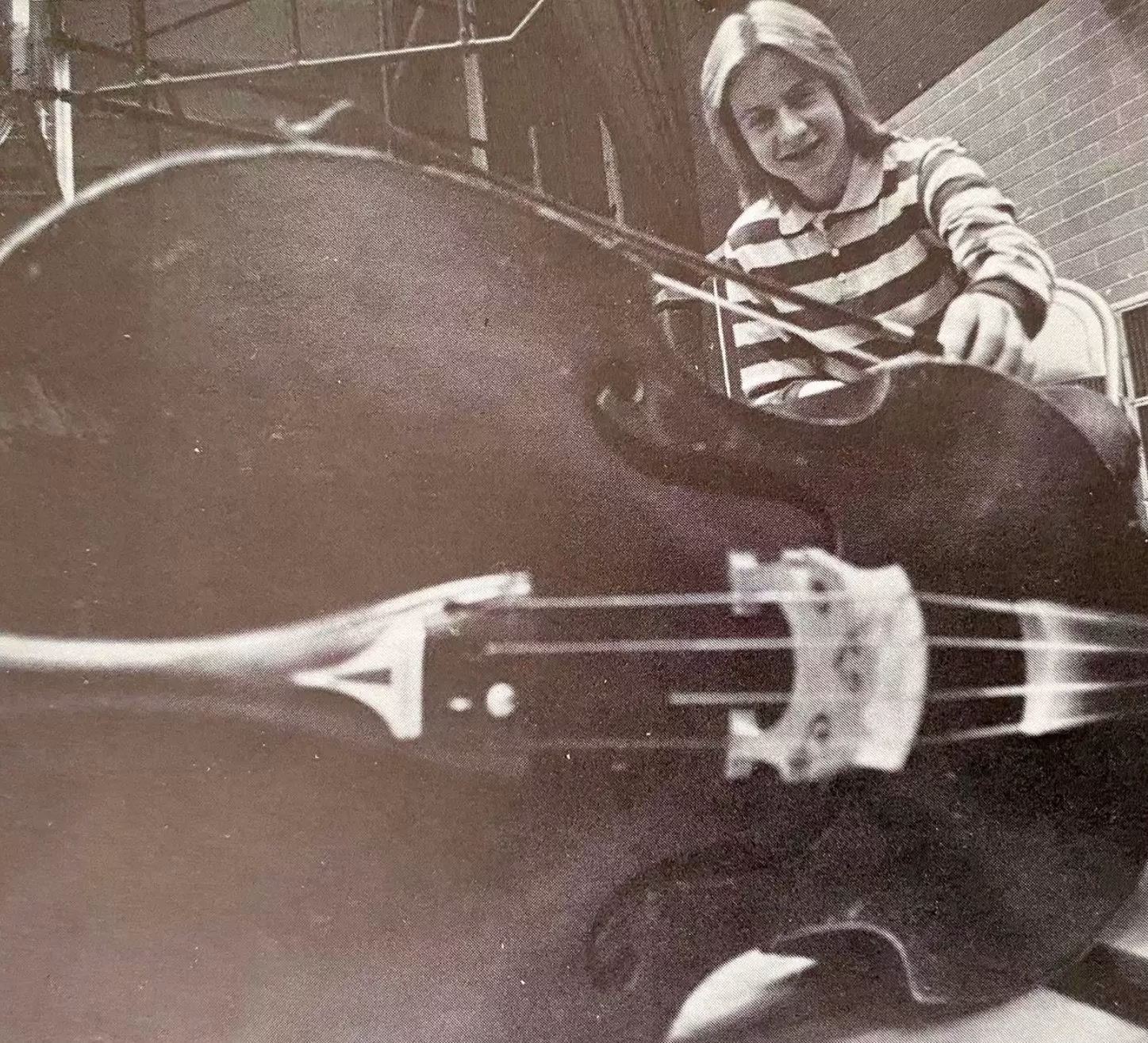
*Austin Beutner. Photo: East Grand Rapids High School, Class of 1978*
You and I understand the squishy, ineffable, spiritual part of life on Earth that isn't rigid and binary and formatted. How you're going to express your longings and insecurities and fears.
And it doesn't exist in isolation! It stitches together. Some of the most lettered people are songwriters. Ultimately, music at its highest level is math. So, it weaves in literacy and math and critical thinking, and it's kind of the glue that holds it all together.
No doubt. Even the simplest pop song is a mathematical marvel. And making music teaches you about collaboration and cooperation. Playing in a band can teach you to work in a boardroom.
Yeah, I remember being in a different elementary-school classroom where we were asked to write a song in musical notation. I couldn't read music, so it was more of a picture for me than a series of sounds.
It was amazing what kids came up with because it was a mathematical expression. It was a pattern, or lack of patterns. It was symmetric or asymmetric. And when you can connect that with a sound, you're activating all parts of your brain with the amount of thinking that goes into that.
At the time, I think they were just trying to teach us half notes and full notes and all the different notes on the scale. But it was unbounded.
How did you come to champion Proposition 28, and how did that, in turn, lead you to join together with the Recording Academy in pursuance of its passage?
In my individual journey, I wouldn't be in this conversation with you without the opportunity I had to participate in arts and music. And many, many moons later, I wound up as the superintendent of schools in Los Angeles. More than half a million kids, their families, the school employees — so, a school community of a few million people.
I visited hundreds of schools and asked what I could do to help. My job was not head teacher; I was not the head principal. My job was to make sure each of the more than 1,000 schools had what they needed. And I would ask, "Give me your top three; what do you need?" Invariably, that would include more arts and music.
Now, if there's adequacy of funding, you can add it. If the funding isn't there, you're presented with this awful choice. You can add music, but how about less P.E. or less lunch? Or, you can add music, but what about less math or less English? None of those are wise choices.
It became clear to me this was an issue of adequacy. Compare New York to California. Almost four in five New York schools have a full-time arts and music program. Pre-pandemic — the last time there were clean numbers on school funding — schools in New York received about $30,000 a year per pupil in funding.
At that same time — in the 2018 and 2019 school years — schools in Los Angeles received about $17,000. The costs are about the same in New York and Los Angeles in terms of a place to live and the biggest component of costs at schools is the people who work at schools, and it costs about the same.
You can't get for 17 what you can get for 30. Those two numbers don't exist in equilibrium. So, $17,000 gets you one in five schools and $30,000 gets you four in five schools. As I heard again and again and again from the students and their families and teachers, "We need arts and music in our school."
Once you grasped the problem, how did you execute a plan to help them out?
So, when I stepped down as superintendent in June of 2021 and started thinking about what we could do about this. Here in California, we have this initiative process where you can convince a certain number of people — you have to get a million people in California — and you can put any law or idea on the ballot.
We got together with a coalition of fantastic supporters — the folks at Fender had worked together with us at Los Angeles Unified and provided more than 10,000 students with free guitars in middle school during the pandemic.
[Dr.] Dre and Jimmy [Iovine], I'd worked with them to open a new high school which is built on the intersection of entrepreneurship, music and marketing — as they've done with the Iovine and Young [Hall] at USC, but mapping that back to K-12.
Others had been with us as part of a coalition to build a film and TV academy in Los Angeles public schools — George Clooney, Eva Longoria, Mindy Kaling, Brian Lourd and the folks at CAA [Creative Artists Agency] and others. [They aimed] to prepare students for jobs not only in front of the camera, but behind the camera.
A cinematographer has to know physics to understand the refraction of light in the lens. A set designer has to know algebra, because that's how you make the pieces fit… We found ways to bring the talents to schools, but we needed to make sure schools had the money to bring teachers in to help teach the classes.
And how did the Academy get on board?
We went out, built a coalition and collected a million signatures throughout the state of California in less than 90 days. And as we built the coalition, so many of the artists we were working with said, "We need our partners at the Academy, where we all come together to express our appreciation for music and help share our music with the world."
I was introduced to Harvey Mason jr. and the team, and it was a "You've got me at hello" kind of conversation. Because, he said, "This is what we're all about, ultimately." The GRAMMYs may be the presentation of the highest order of music, but they fully recognize that the point of the GRAMMY mission is to bring everybody into the conversation about music, which includes schoolchildren.
So, they came on board and helped us get the word out, and they continue to do that today. They helped spread the word among their members, and so many of their members are our most fierce advocates, from the Will.i.ams to the Dr. Dres to the Katy Perrys to the Jackson Brownes, and on and on and on.
I'm speaking now for the Academy, but I think it's consistent with their mission and it is authentic. Today, artists can and do express their views on a whole variety of issues, and it's important.
There's nothing more authentic than an artist sharing their view as to what music means to them — the life-path it helped create for them. And there's nothing more authentic for those who work in the industry — as sound engineers, as set designers, as recording engineers, as stagehands.
Across the industry, they've come out in support of this, because they understand the importance of music and are 100 percent behind the goal of making sure every kid in a public school in California has an opportunity to participate.
WIth all of this in mind, what can we do right now in support of Proposition 28?
Help spread the word and make sure people vote Yes on Proposition 28: November 8, this initiative is on the ballot. California will have a chance to vote on Proposition 28. It takes 50 percent plus one voter in the state of California to prove it.
And when voters approve it, this will provide funding to the tune of about $1 billion a year, each and every year, for public schools in California. It will make sure every student in every school — preschool through 12th grade — can benefit. Twice as much money will go to schools serving students in high-needs communities.
So, job one: let's get this passed in California on November 8 and spread the word. There is literally no opposition; it's interesting. There's a voter guide the State of California publishes and shares with every registered voter.
There are seven ballot propositions on this ballot. There have been literally dozens in the past decade, and this is the first one where there's no opposition. What a voter will see on the left-hand side of the page is why we believe you should vote yes — the arguments for the ballot proposition.
On the right side of the page, it's blank. All it says is, "No argument was submitted in opposition to this proposition." Nobody's opposed to this.
So, our first task is to spread the word. We want everybody to understand the benefit of this. Hopefully, voters will vote yes. Then, the next chapter's going to be: we're going to share this with the rest of the nation. This will be, in and of itself, the largest investment in arts and music in our nation's history.
There's a lot of conversation every year about the national endowment for the arts, how much is in the budget, and whether different administrations have increased or decreased that. For context, that's about $200 million a year.
Proposition 28 will provide five times that amount, just in one state. So, if we can get this done in California, let's bring it to Tennessee; let's make it happen in Nashville. Let's do this in New York. Let's do this in New Jersey. This ought to be happening to help kids in every school across the country.
Public schools across the country have a class in literacy — teaching kids to read. They all have something in numeracy; they have science. They should have it in music, and we want to make sure it's happening across the country. This movement starts in California.