If any part of your elementary, middle or high school years were spent practicing scales on an actual musical instrument in a classroom or warbling in a chorus or stage musical with fellow students, consider yourself lucky.
According to a number of research studies, your music education gave you a leg up on students without arts education by helping you develop better overall cognitive skills, stronger language development and powers of recall, and improved deduction and mathematical skills, while boosting overall creativity and aptitude across all subjects.
Increasingly, today's K–12 students are not so fortunate. Required to place more emphasis on measurable math and language skills, school districts have focused fewer resources on supporting subjects for which proficiency is not subject to national testing, including music and the arts. While there are individual schools with the time and money to make arts education a vital part of their curricula, research shows that students in wealthier school districts are more likely to be exposed to arts programs than children in high poverty areas.
The benefits of arts education should not be reserved for a privileged few because of shortsighted educational policies, but a standard part of all K–12 curriculums. This is why Congress first established Arts In Education Week in 2010, designating the second week in September to promote and showcase the powerful role arts education has in producing "engaged, successful and college- and career-ready students."
On that front there's a glimmer of good news: The House and Senate have each recently acted to reauthorize the Elementary And Secondary Education Act, the first time since 2001 that federal K–12 education policy reform has advanced in Congress. The House version of the bill contains more than a dozen provisions — supported by The Recording Academy — that affirm and support music and arts education. A conference committee must now work to reconcile the differences between the two bills to forge a final package that can be signed into law by the president.
To preserve our cultural legacy, music advocates need to focus not only on advancing the rights of our current creative artists, but on fostering an educational system that values the arts and inspires new artists. This is why arts education is one of the pillars of The Recording Academy's mission. Thanks to the GRAMMY Foundation's GRAMMY in the Schools programs and the establishment of the annual Music Educator Award, The Academy continues to provide financial incentives and workshop and performance opportunities to dedicated music educators and talented high school musicians nationwide.
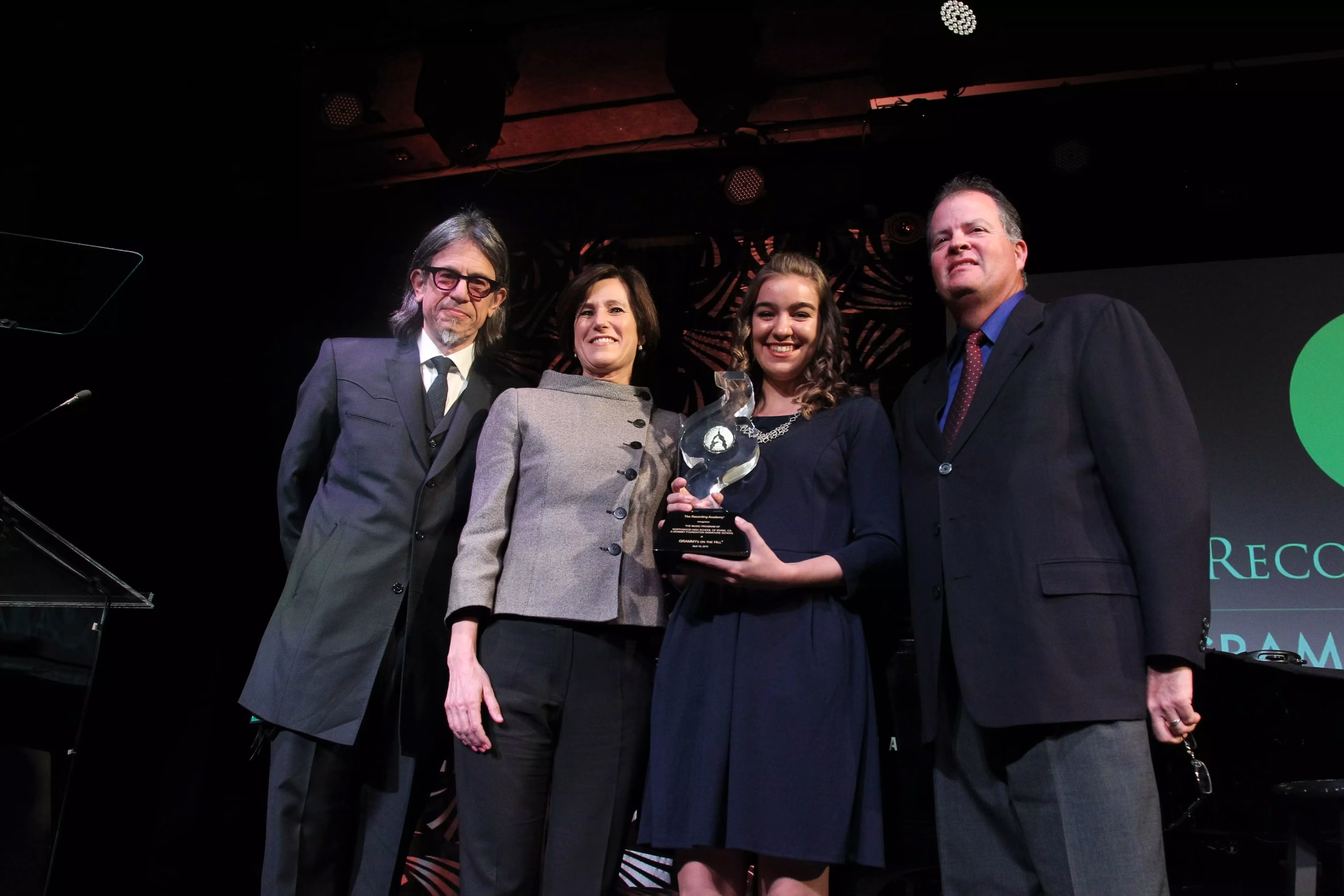
At this year's GRAMMYs on the Hill in April in Washington, D.C., music creators and policymakers came together to salute those who had done outstanding work in the previous year to advance and protect music creators. Among the honorees was 2015 GRAMMY Signature Schools recipient Northwood High School of Irvine, Calif. In saluting the school's choral director, Zach Halop, and chorus member Claire Paladichuk, GRAMMY-nominated artist Hunter Hayes noted that music education is "not only life-changing for many young people, it can be life-saving," as a means of creative expression or coping with stress.
In recognition of 2015 Arts In Education Week, The Recording Academy will continue to fight for the well-rounded education all children deserve, and for the opportunity to inspire future generations of music creators. You can show your support by signing this online petition from our friends at Americans for the Arts