
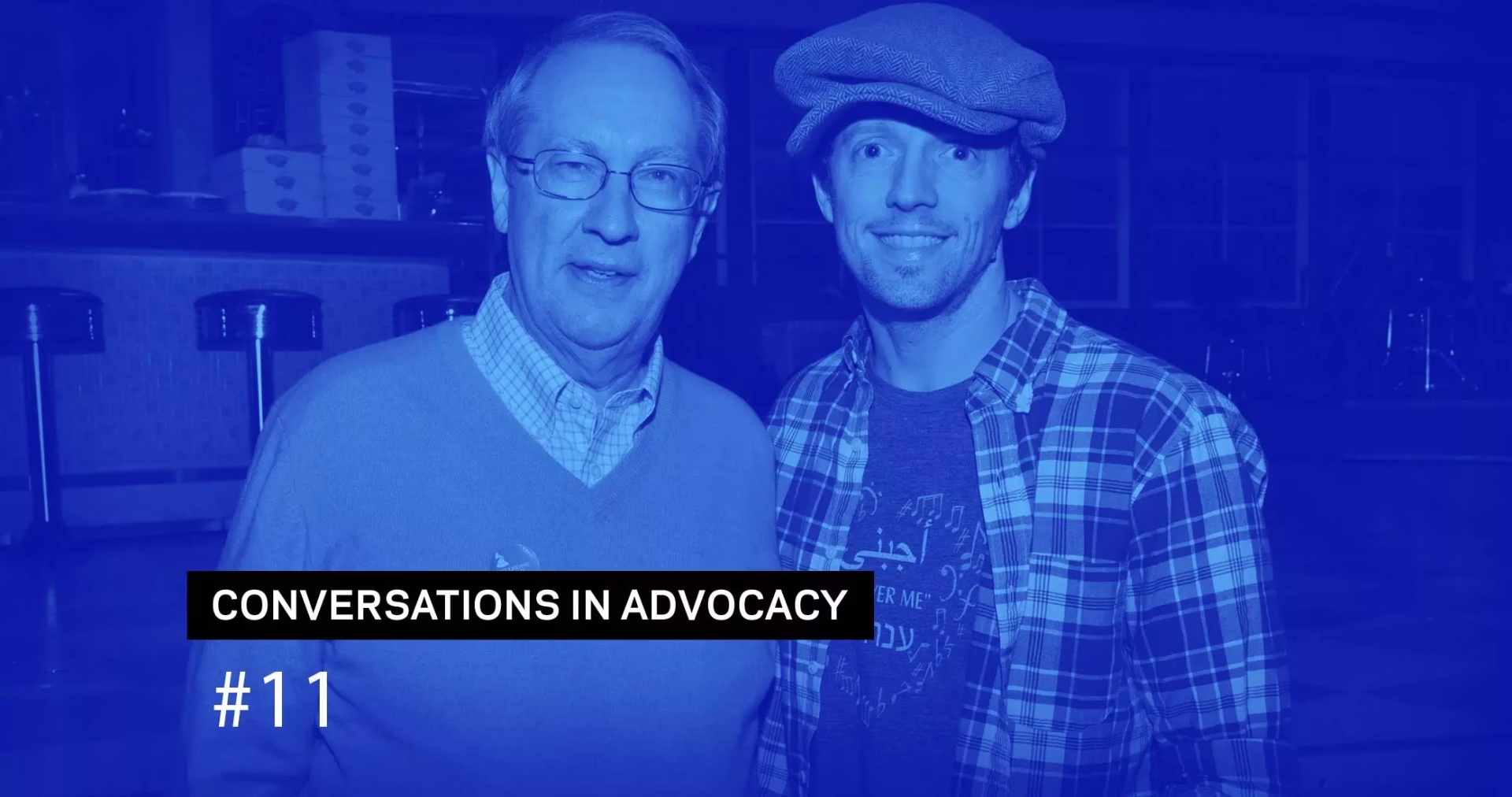
"Hearing rumors that House Judiciary Chairman Bob Goodlatte and Ranking Democrat Jerry Nadler are going to introduce a new comprehensive music bill soon! That's a big signal that Congress could actually pass music licensing reform this year." — Conversations In Advocacy #11
Suspense is building that the music community hopes will soon be fulfilled. Tips indicate that Rep. Bob Goodlatte (R-Va.), chairman of the House Judiciary Committee, and Jerry Nadler, the committee's top Democrat, are putting together copyright reform legislation that would consolidate several separate music reform bills, which have gained unprecedented unified support, into one bill.
The rumored bill is expected to have the support of not just the music community, but also many digital platforms, broadcasters and stakeholder organizations.
The bill also comes on the heels of a Jan. 26 field hearing by the Committee during GRAMMY Week, where Recording Academy President/CEO Neil Portnow proposed the idea of comprehensive legislation, outlining to lawmakers how current laws — including complicated regulations dating back before the internet — do not protect the interest of modern-day music creators.
Portnow closed his testimony by imploring, "Just as creators can't be compartmentalized, neither should music legislation. There are issues of consensus that would help all creators, and they're ready to be marked up by this committee. … I urge this committee to mark up one comprehensive music licensing package of the consensus issues."
<blockquote class="twitter-tweet" data-lang="en"><p lang="en" dir="ltr">Fulfilling on a vision of copyright reform first proposed by <a href="https://twitter.com/RecordingAcad?ref_src=twsrc%5Etfw">@RecordingAcad</a>, the music industry has banded together to support key music legislation.<br><br>Join our efforts and tell Congress to support comprehensive music reform: <a href="https://t.co/9tK7wAVF5L">https://t.co/9tK7wAVF5L</a> <a href="https://twitter.com/hashtag/SupportMusic?src=hash&ref_src=twsrc%5Etfw">#SupportMusic</a> <a href="https://t.co/OEVxnUJ474">pic.twitter.com/OEVxnUJ474</a></p>— GRAMMY Advocacy (@GRAMMYAdvocacy) <a href="https://twitter.com/GRAMMYAdvocacy/status/965322285677797382?ref_src=twsrc%5Etfw">February 18, 2018</a></blockquote>
<script async src="https://platform.twitter.com/widgets.js" charset="utf-8"></script>
Other witnesses on the panel spoke specifically to those consensus issues that are rumored to be included in the Goodlatte package. GRAMMY-nominated songwriters Aloe Blacc and Tom Douglas spoke up at the hearing on behalf of the Music Modernization Act of 2017, a complex bill that would improve songwriters' rate standard, create a blanket licensing resource to comprehensively track song ownership and grant writers a fair share of digital mechanical royalties.
"This is a defining time for music licensing reform," Blacc testified. "I can tell you we are in desperate need of change if we're going to protect what is arguably America's greatest export: music."
The 1962 hit "Green Onions" by Booker T. and The M.G.'s was made 10 years before 1972 federal copyright legislation, leaving witness Booker T. Jones out in the cold with regard to getting paid when services use his GRAMMY Hall Of Fame recording. The CLASSICS Act would close this loophole for pre-1972 recordings, improving life for senior musicians while simplifying licensing administration for services.
"This uncertainty is bad for artists, and it's bad for the digital music services," Jones said.
The Allocation for Music Producers Act (AMP) would bring music producers into formal copyright law for the first time. Decorated producer Mike Clink spoke at the hearing about how it feels to lack copyright protection. "In fact, they are the only individuals directly involved in the creation of music to lack copyright protections," he said about producers.
While these three independent bills form the essential framework for an umbrella bill, they are not the only reforms rumored to be considered. For example, language from the Fair Play Fair Pay Act establishing willing buyer/willing seller compensation standards across all digital platforms is expected to be included as well.
At the GRAMMY Week field hearing, Rep. Darrell Issa (R-Calif.) spoke for many of his colleagues — and all the witnesses on the panel — when he beseeched Chairman Goodlatte to undertake the big step of combining years of the committee's work into a single, consolidated bill.
The MMA and CLASSICS Acts have also recently been introduced in the Senate. The feeling among music creators that there is momentum for change, at last, is strong.
Testifying on Jan. 26 alongside Portnow, multiple GRAMMY winner Dionne Warwick concluded with a wish shared by many.
"As I once sang [notably in 1967], I say a little prayer for you," she said referring to her GRAMMY-nominated hit "I Say A Little Prayer." "And [I] hope that this is the year when all those who write, sing, record, and produce the songs we love are recognized and appropriately compensated for their work."
"Conversations in Advocacy" is your weekend digital tip sheet on music advocacy and the policies that affect music makers and their craft. New installments post every Friday.
