Working as a music journalist, the most immediately thrilling part is watching your record collection come to life over the phone and Zoom. Coming in close second and third would be the rapport with behind-the-scenes music people from all over the planet, and being able to behold live music not as a ticket-holder, but as a reporter — as a participant, however minor.
Hanging out on Zoom with elected representatives, while Recording Academy members encourage them to vote on bills that support music makers, may not be a normal part of the job description. But as far as the impact it has? It may have more real-world consequences than all those other aspects combined.
That's why having a catbird seat to District Advocate Day 2022, which occurred on Thursday, Oct. 6, wasn't just business as usual — it was downright goosebump-inducing.
For those unaware, the Recording Academy's District Advocate program is the largest grassroots advocacy movement for music and its makers. Held annually in the fall, Recording Academy members visit their local district offices and virtually their elected representatives to discuss issues affecting their livelihoods and careers, including fairer compensation for songwriters, performers and studio professionals.
Specifically, Recording Academy members and lawmakers homed in on four bills during District Advocate Day.
Good morning to every @RecordingAcad #DistrictAdvocate out there making a difference today to #SupportMusic!
Let’s Gooo!!! pic.twitter.com/27cSpqtNZC— Todd Dupler (@ToddDupler) October 6, 2022
The first was the bipartisan Help Independent Tracks Succeed (HITS) Act, which amends the tax code so independent artists can fully deduct the cost of new recordings on their taxes immediately, up to $150,000. The HITS Act gives music production the same tax treatment as film, television and theatrical production and will provide a stimulus to put indie artists, musicians and studio professionals back in the studio to create new music.
The second was the PEACE Through Music Diplomacy Act, which will put a spotlight on music as a tool for promoting peace and cooperation around the world. The bill directs the State Department to leverage partnerships with the private sector when designing and implementing its music-related exchange programs and specifically authorizes music-related exchange programs that advance peace.
For #DistrictAdvocate Day, @RecordingAcad members nationwide championed our music community by advocating for key legislation that seeks to create a more sustainable #musicindustry for all music creators.
➡️ Learn more and #SupportMusic: https://t.co/JynHlfmvob https://t.co/zJkEQM6l6M
— GRAMMY Advocacy (@GRAMMYAdvocacy) October 7, 2022
The third was the American Music Fairness Act, which would fix a loophole in copyright law that allows broadcast radio to use music without paying anything to the artists who created it. As Congress considers the Journalism Competition and Preservation Act (JCPA) — a bill to help broadcasters negotiate compensation when big tech platforms use their news content — it must pass the American Music Fairness Act so artists will finally be paid when AM/FM radio broadcasters use their music.
And the fourth was the Restoring Artistic Protection (RAP) Act. Every artist, no matter the musical genre, should be able to express themselves without fear of reprisal from the justice system based on the content of their art or bias against their chosen art form. The RAP Act will protect every creator's right to free expression by limiting the use of lyrics and other creative works as evidence in federal court.
Being an advocate means staying active in the weeks leading up to the meetings to help advance key priorities through social media and calls-to-action on specific legislative issues. And this paid off in a legion of virtual and in-person meetings across the country with an aisle-transcending array of representatives — and from this journalist's perspective on the East Coast, the home base was the Recording Academy's new Manhattan home.
On the morning of Oct. 6, Congressman Jerry Nadler (D-NY) swung by said office to meet up with the New York Chapter — including Lachi, an EDM singer-songwriter, New York Chapter Governor and DEI Ambassador, and Noshir Mody, an Indian-born composer, guitarist and producer who resides in the Midtown West neighborhood. Both were on the mic alongside Congressman Nadler.
Music creators deserve to be fairly compensated for their music when it’s played on AM/FM radio. #AMFA would ensure artists receive their performance royalties from AM/FM radio broadcasters. #SupportMusic and learn more: https://t.co/uOokFJftqC #DistrictAdvocate pic.twitter.com/Bd5d1LLCQB
— GRAMMY Advocacy (@GRAMMYAdvocacy) October 6, 2022
Mody kicked off the proceedings by asking Nadler why he took it upon himself to fight for music people — and Nadler, a lovably phlegmatic personality and brilliant legal mind, answered simply.
"I've always considered it obvious. Creators create," Nadler stated. "We wouldn't have music; we wouldn't have the entire music industry without them. There are all kinds of jobs dependent on them. A lot of people make their living in the music industry, and the performance of it is the base of that.
"In addition to which, of course, people want music," he added. "It's an essential."
Lachi then took the floor, turning the conversation toward the HITS Act with commentary from members in the room. These included Ellyn Harris, a singer-songwriter who owns a music and PR consulting company. Speaking to Congressman Nadler, Harris highlighted how music is crucial not only for entertainment, but for the betterment of those with mental illnesses, such as dementia.
"[Music is] medically proven to help people with issues [like] dementia," Harris said. "There are people who haven't spoken forever, and they suddenly come out and talk. That doesn't happen with TV, film or theater, specifically, because it's the sound that makes them feel something."
Jackson is proud to join @GRAMMYAdvocacy and thousands of @RecordingAcad members across the country today to fight for creators’ rights and tell Congress to support laws that build up and sustain the music community. #DistrictAdvocate #SupportMusic pic.twitter.com/AYmQnNj2nm
— Jackson Browne (@JacksonBrowne) October 6, 2022
She went on to note how artists often need to spend thousands in order to write off their work — and it was crucial, and only fair, to give artists relief in that regard. Her point was bolstered by commentary from musician Tyrone Smith, who laid out how those who might pay lip service to the music community must walk the walk.
"If we're going to sell the story that entertainment and music support everything else within this country, you can't make me believe that you don't have the same tactics available to us to help relieve the stress of doing business," Smith stated. "It's just that simple for me, and I hope it's just that simple for everybody else."
Another member in the hard rock and metal community, Militia, expressed to Nadler the financial barriers to even recording an album on a tight budget. "Most of the time, we don't speak up at things like this because we feel like no one cares about rock and metal anymore," she said. "But, actually, rock and metal are the fastest-growing genres in the world. I'm a proud, independent alternative metal artist.
But despite the global expansion of the alternative, rock and metal genres, simply making her art has put Vox in financial peril.
"My last full length album cost me around $2,000 a track, which is not a lot. It was on a super tight budget," she said. "But you multiply that by nine or 10 tracks, and it adds up. Then I'm still trying to recoup that because it was all out of pocket. I'm a pro artist. I don't have a day job or side hustle, so everything I make goes back into my music."
Nadler was listening carefully, and replied thoughtfully. "If the capital cost is $100 to $120,000," he said, "how does a new company get into it?"\
\
Mody then moved on to the American Music Fairness Act, which is intended to close a decades-long loophole that prevents music creators and music makers from being compensated when their material is played on AM/FM radio. "This is a descendant of my Fair Play, Fair Pay Act," Nadler noted. "I obviously support it."
Thank you @RepYoungKim for supporting music creators! #DistrictAdvocate #SupportMusic pic.twitter.com/XtadmSxr9X
— GRAMMY Advocacy (@GRAMMYAdvocacy) October 6, 2022
Ditto for the RAP Act: "Some lawyers and courts are using rap music as evidence in a crime," Nadler said. "That should not be." Eileen Sherman, a lyricist, producer and young adult novelist, noted the significance of this act in light of increased scrutiny (some might call it overreach) regarding what reading material children are or aren't exposed to in schools.
"This is a very slippery slope, as we all know," Sherman said. "I don't even think I need to enumerate really where this could lead in all… I thought we were really beyond this. So I think this is a critical, critical bill."
Nadler also expressed support for the PEACE Through Music Diplomacy Act: "I thought that part of our policy, going way back to the Cold War, was to do that through the Voice of America and other ways." And as the meeting wound down, Nadler cited his preferred styles of music: American folk, like Phil Ochs and Judy Collins, as well as Hebrew liturgical music.
The meeting with Nadler proved to be a constructive and upbuilding one — but of course, District Advocate Day 2022 wasn't limited to an hour and change in New York City. From there, almost 200 meetings with nearly 200 lawmakers occurred around the country — over Zoom and in person, with Democrats and Republicans, and always with utmost class, respect, and focus on the well-being of music people.
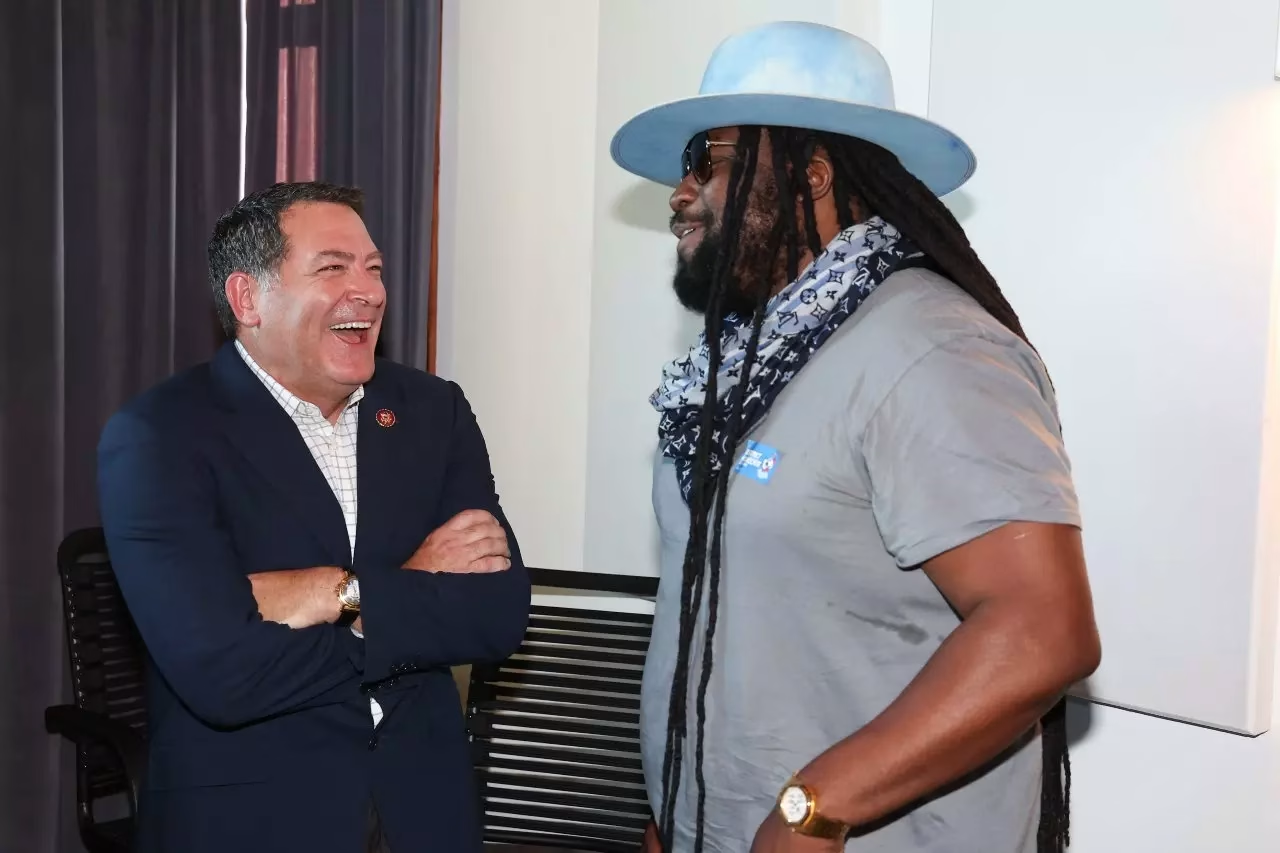
Said lawmakers included Sen. Marsha Blackburn (R-Tenn.), Sen. Brian Schatz (D-Hawaii), Reps. Hank Johnson (D-Ga.), Chip Roy (R-Texas), Pramila Jayapal (D-Wash.), Jimmy Gomez (D-Calif.), Mark Green (R-Tenn.), and Michael McCaul (R-Texas), among many others.
And when lawmakers responded positively to the Academy-sponsored bills, it was with a minimum of big talk or fanfare — but a staggering amount of forward momentum as a result.
All in all, District Advocate Day was a rousing success, despite distances and an ocean of coordination — and pointed to a bright 2022 and an even brighter 2023 in the fight for music people's rights on Capitol Hill.