They say change is the only constant in life. That's a mantra by which the music industry lives. And when it comes to entertainment law, change is what drives the business forward.
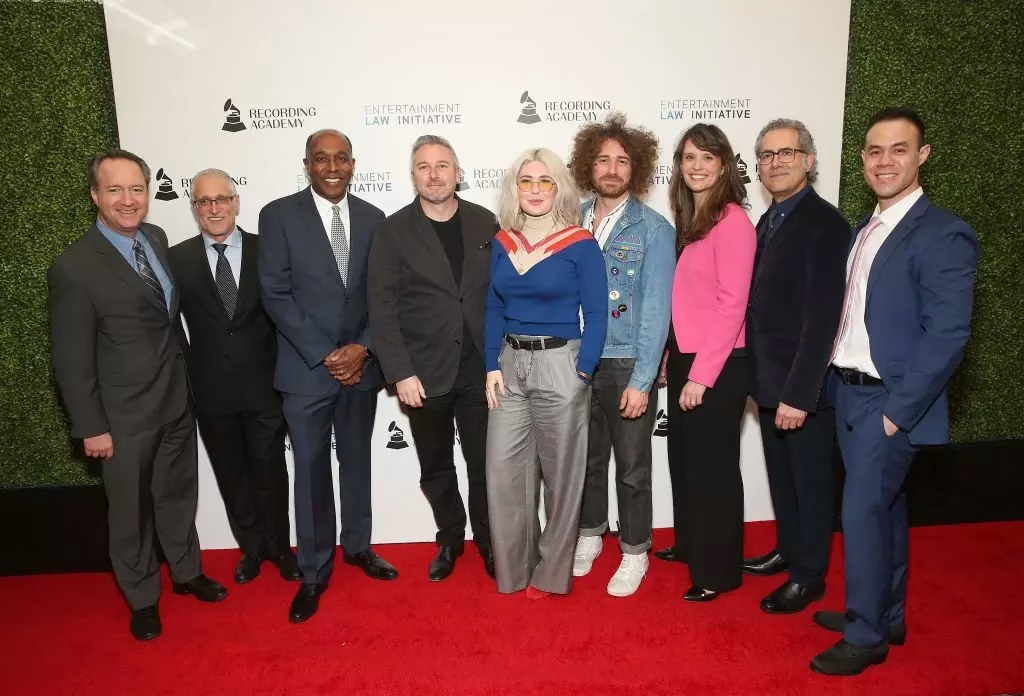
Change is the theme that defined the 22nd Annual Entertainment Law Initiative (ELI) Event & Scholarship Presentation, the most prominent gathering for entertainment attorneys and other music business professionals during GRAMMY Week. Every year, the ELI event unites the music business community and addresses some of the most compelling issues facing the music industry today. The 2020 ELI event—held last week (Friday, Jan. 24) as an official GRAMMY Week event at the Fairmont Miramar Hotel in Santa Monica, Calif.—honored an industry luminary initiating change today while also recognizing some future leaders in law.
For over two decades, ELI has addressed the shifting landscape of entertainment law head on, providing a forum for legal thought leaders and honoring its own practitioners who are ensuring the industry adapts to the ever-changing music and entertainment industry.
It's no wonder, then, that this year's ELI Service Award honored Jeff Harleston, a music industry veteran who has faced virtually every sea change to directly challenge the entertainment law field.
"Over the last 25 years or so, no industry has experienced more change than the music industry," Sir Lucian Grainge, chairman and CEO of Universal Music Group, said in his opening remarks at the gathering. "But throughout this period of turmoil and transformation, there've been two constants. First, amazing artists making great music. And secondly, as if you didn't know by now, Jeff Harleston's extraordinary sound judgment."
Harleston, who currently serves as the general counsel and executive vice president of business and legal affairs at Universal Music Group, has been a champion for artists and creators throughout his decades-long career. Across his days as the head of the business and legal affairs department at MCA Records in the late '90s to his time as general manager of Geffen Records, Harleston has worked with iconic artists like Mary J. Blige, Nelly Furtado and Snoop Dogg, among many others.
"There's no bigger friend to artists than Jeff," three-time GRAMMY winner Common said of Harleston in a personalized tribute video. "So you can call Jeff a general counsel or a board member or a role model. They all fit. But I'll continue to call him a friend. He's a true advocate for artists. And I couldn't be prouder of the recognition he's receiving today."
Making his way to the stage, the crowd offering a well-deserved standing ovation, Harleston addressed the room with pride and jubilation in his voice and optimism in his sight.
"This is to the lawyers in the room," he said. "At times, we know being a lawyer in the music business can be an entirely thankless task, but we love it because we love music… But most importantly, we have learned to work together. And what we've been able to do when we work together is move it forward really well. We move things forward legislatively, we've empowered new services that are finding ways to bring our music and the artists' music to places they've never been before. And it's all because we've allowed ourselves to respect each other and trust each other. I really am happy to see that happen and I really hope that we can continue that spirit."
As he remembered his extensive career and all that he and his colleagues have together accomplished for the industry and the wider artist community, he took a moment to acknowledge the road ahead for entertainment law and the challenges to come.
"As I reflect on my almost-27 years in this business," he said, "there's one thing that's clear about the music business: the constant is change. Change happens all the time... But what we have to do and what we've learned to do... we've learned to deal with the change. And change is hard. It can be abrupt. It can be unexpected. It can be painful. But it's important, and it has to happen.
"We are in the midst of a change as we speak. But I know that we are strong and resilient, and we will get through it. And when we come out the other side, we will be better, we'll be stronger and the world will be great. In the words of Bob Dylan, 'The times, they are a-changin’."
Fittingly, Dylan's eternal lyrics and Harleston's remarks nod to the ever-evolving music industry and the modern issues it faces, many of which were addressed by the entrants of the 2020 ELI Writing Competition.
As one of its core elements, ELI has supported promising law students and has fostered future careers in entertainment law, having provided more than 800 students with scholarships to date. The event's popular yearly student writing competition and scholarship presentation acknowledge the outstanding law students who are seeking to push entertainment law into the future.
This year's writing competition entrants, who each addressed a compelling legal issue confronting the music industry and proposed a solution in their essays, tackled some of today's most timely and pressing matters in the field.
Christopher Chiang, a student at University of California, Los Angeles (UCLA) School of Law, won the writing competition with an essay proposing a sliding scale framework for copyright protection in music. Chiang was presented his award, which came along with a $10,000 scholarship and tickets to various GRAMMY Week events, onstage by Ken Abdo, a partner at Fox Rothschild who has been involved with the ELI Writing Competition since its beginnings. Runner-ups included John Gilbertson, a student at Drake University School of Law in Des Moines, Iowa, and Graham Fenton from UCLA Law.
Perhaps the most urgent issue and forthcoming change to affect the music industry today comes via California Assembly Bill 5, more commonly known as AB5. The newly passed state statute aims to protect workers in the "gig economy," namely Uber drivers. However, its impact on the music industry could prove detrimental. (Music creators, particularly those who work as independent contracts, such as studio musicians or session/backing players, would potentially need to be recognized as employees and/or employers in order to secure work, which in turn entails a more complicated hiring process and higher fees for one-time gigs and short-term projects and performances.) Having gone into effect at the beginning of 2020, AB5 today stands as one of the most timely and important issues for music creators' rights in 2020.
In a panel that followed remarks by ELI Executive Committee Chair Michael Kushner, who is executive vice president, business & legal affairs and general counsel at Atlantic Records, some of the brightest and most active voices in the battle over AB5 spoke of the well-intended law and its potentially damaging effect on the music industry.
"AB5 is the definition of the 'law of unintended consequences,'" said Jordan Bromley, a partner at Manatt Entertainment Transactions & Finance. "It was meant to hit a certain sector of California industry, and it [was] painted with such a wide brush that everyone is affected, unless there's a specific exemption in the bill. I would say the one way to look at it is if somebody is providing you or your company or your artists or your producer or your songwriter a service that is 'core to the business,' they are now your employee."
Since its passing, the music biz and artist community have largely banded together to address AB5, with many from both sides of the industry launching online petitions and meeting with California lawmakers directly in an attempt to secure exemption from the law on behalf of the wider music industry.
Ari Herstand, an independent musician, author and music industry blogger, has been at the forefront of the AB5 debate since it went into law. He's since gathered 50,000 petitions from California music professionals who are against the law.
"We're 20-something days into this thing right now, and I'm literally gathering stories every single day from musicians who are losing work," he said. "I've hundreds of documented cases of musicians in California that are losing work."
But much like any other major change to impact the business, the music industry is already making headway into addressing and alleviating the issues of AB5.
Both Bromley and Herstand agree education is a key component in pushing things forward.
"The unions ran the bill," Bromley said. "The unions will run the next bill, most likely. So we need the unions on board. They're all conceptually there... It's frankly a lot of education on our business because it's weird and wacky and nuanced. And even some of the unions that exist in our business don't really understand how it's evolved in the last 10 years. So it's just a lot of patience and education, but everyone's at the table and everyone is focused on a solution."
"There needs to be education," Herstand added. "Right now, because of all of the hysteria around this—that's why so many musicians are literally losing work every day. So as soon as this—hopefully it's an urgency bill—passes, everybody needs to write about it. Every lawyer needs to know this to be able to educate. So I encourage everybody here to follow this process along and, once this thing gets passed, to educate your clients on what is actually happening and that we have found a fix, hopefully."
Panel moderator Daryl Friedman, Chief Industry, Government and Member Relations Officer for the Recording Academy, concluded the chat on a high note of optimism regarding the road ahead with AB5.
"It's going to be a lot of hard work by a lot of people," he said. "Hopefully a year from now, we will realize that this has been fixed. But I think there's also another lesson that is more enduring: the lesson of when creators get involved [and] when creators speak. They make the difference here. When creators speak, policymakers listen."
It's the exact kind of dialogue that has come to define the ethos and vision of ELI throughout the decades: When change comes a-knockin', we will be there to adapt, listen, learn and educate.
The Entertainment Law Initiative maintains its support for the music industry as a whole, from its creators to its executives to its attorneys, and will continue to foster the next generation of change-makers within the music business and legal community for decades to come.