Washington, D.C., is a rare breed of city where culture, commerce and politics merge on a daily basis. In addition to its role as the political and governmental epicenter of this nation, Washington, D.C., boasts a rich musical history that has established the city as a cultural capital in the U.S. It's exactly why D.C. is the perfect backdrop for GRAMMYs on the Hill, the Recording Academy's annual premier advocacy event uniting music creators and policymakers.
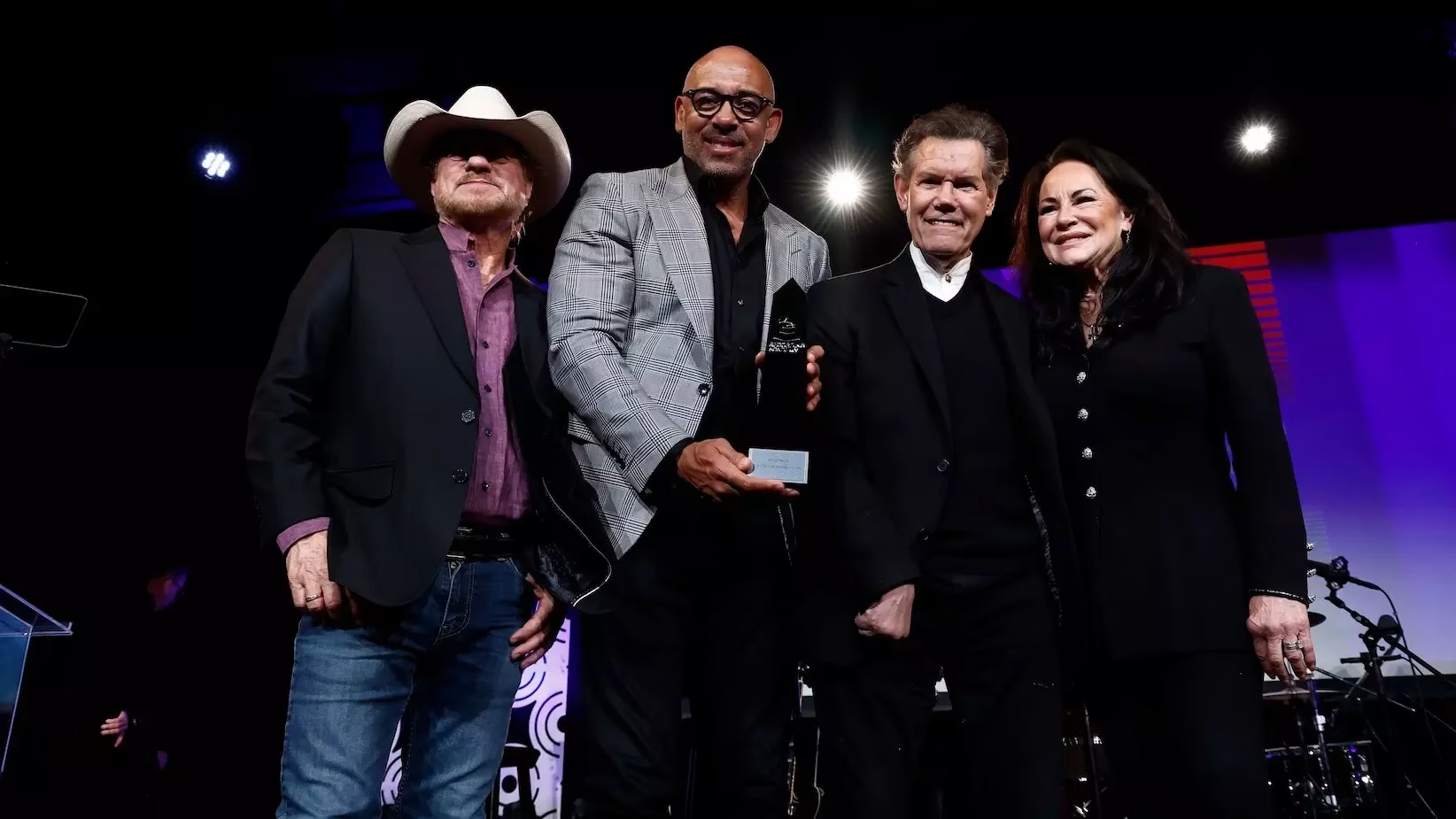
This jubilant celebration of music and policy came to life at the 2025 GRAMMYs on the Hill Awards, where the Recording Academy honored seven-time GRAMMY winner and dedicated music advocate Randy Travis alongside United States Representatives Linda Sánchez (D-CA) and Ron Estes (R-KS). The impactful event, the first of three days of powerful programming this year, honored those who have helped shape a better future for music and amplified the theme of GRAMMYs on the Hill 2025: building music's future by promoting, protecting and preserving the art and industry.
Each of this year's GRAMMYs on the Hill Awards honorees exemplify this mission. Travis, who received the Creators Leadership Award this year, is a music advocate who's used his platform throughout the years to protect artists' rights, champion fair compensation, and progress the ethical use of AI in music.
"Mr. Travis has been an example of service, and you continue to be a trailblazer and an innovator by showing us how we can embrace new technologies and new ways of thinking," Recording Academy CEO Harvey Mason jr. said in a speech from the GRAMMYs on the Hill Awards stage. "You've used AI in a really creative way, and it's proven that humanity is still at the heart of creativity."
Likewise, both U.S. Representatives Sánchez and Estes, the 2025 congressional honorees, have each strengthened the music ecosystem through their work on Capitol Hill. Both lawmakers played key roles in introducing the bipartisan and bicameral Help Independent Tracks Succeed (HITS) Act, which fights for essential tax relief for independent artists and songwriters by enabling them to deduct 100% of production costs — up to $150,000 — upfront rather than over multiple years and ultimately fueling new music creation in a more financially viable fashion.
"I want to thank all the incredible artists who are here tonight," Sánchez said in her acceptance speech from the stage. "Your willingness to lend your time and energy to this cause speaks volumes … Unfortunately, too many independent musicians struggle to make ends meet, earning less than $25,000 a year, making it harder to share their gifts.
"Our bill helps ease that burden by allowing them to deduct music production costs in the year they incur them, aligning with other industries. Let's give these independent musicians the tools they need to continue sharing their talents."
Estes, who accepted his honor remotely via a pre-recorded video message, echoed the sentiment.
"The HITS Act is more than a bill about music. It is also a jobs bill, and it's common sense that should be supported by those who create music and those who appreciate music," he said in his message.
🏛️ It was a powerful night in Washington as the Recording Academy honored champions of creators' rights at our annual #GRAMMYsOnTheHill Awards! pic.twitter.com/t8kLQwAFgm
— GRAMMY Advocacy (@GRAMMYAdvocacy) April 9, 2025
In the same vein, Michael Sticka, President and CEO of the GRAMMY Museum, which was the beneficiary of the proceeds from this year's GRAMMYs on the Hill Awards, spoke of the importance of institutions and systems that work to advance and protect music education. He spoke of the turmoil happening at the Institute of Museum and Library Services (IMLS).
"Uncertainty about the future of the IMLS raises questions about its ability to fulfill its legal obligation to distribute congressionally appropriated funds. This puts museums, libraries, and communities nationwide at risk of losing crucial resources," Sticka said in his speech.
"Museums are not only cultural cornerstones, they enrich our communities," he continued. "They offer invaluable educational opportunities and act as powerful economic engines. Providing resources to accomplish those goals is the critical mission of the IMLS, and it is one that we must protect."
Learn More: How The GRAMMY Museum Is Expanding Its Mission In 2025
During the GRAMMYs on the Hill Awards celebration, music took centerstage. MŌRIAH, a rising Latin country singer/songwriter, opened the night with an enthralling, Latin-inflected rendition of the national anthem, while GRAMMY-winning Contemporary Christian Music and gospel artist DOE brought the house down with a powerful, personal performance of "So Glad We Met."
The night also featured a touching performance from fellow country star Meghan Linsey, who honored Travis, one of her musical heroes, with a rendition of his GRAMMY-winning classic "I Told You So."
"I remember riding in the minivan on the way to school and listening to Randy Travis' songs," Linsey reflected ahead of her performance. "And just the way that his voice came through the speakers, it was so sincere, and he told a story. And I just wanted to be able to sing like that one day. So, thank you to Randy, for who you are. You're a legend."
Read More:2025 GRAMMYs: 10 Winners & Nominees Who Champion Music Advocacy Across Genres

Paul Overstreet performs onstage during the 2025 GRAMMYs on the Hill Awards at the Hamilton Live on Tuesday, April 8, 2025 in Washington, D.C. | Photo: Paul Morigi/Getty Images for The Recording Academy
In one of the most moving moments of the night, two-time GRAMMY-winning singer/songwriter Paul Overstreet reflected on his decades-long friendship and creative partnership with Travis. (Overstreet wrote several of Travis' most iconic songs, including "On the Other Hand," "Diggin' Up Bones" and "Deeper Than the Holler.") Ahead of his performance of Travis' "Forever and Ever, Amen," Overstreet told the story of how he and Don Schlitz came to write the song together.
"[Don's] little boy was learning to say the Lord's Prayer, and at the end, he'd say, 'Forever and ever, amen.' And he was saying, 'Mommy, I love you forever and ever, amen.' And Don goes, 'I think there's something to that.' So he had this idea and so we sat on the front porch and wrote it."
GRAMMY-winning singer/songwriter and Pentatonix member Scott Hoying, who doubled as the night's host, closed the GRAMMYs on the Hill Awards with a rousing, time-traveling medley performance of multiple songs that have won the GRAMMY for Record of the Year, including the Eagles' "Hotel California," Roberta Flack's "Killing Me Softly With His Song," Tina Turner's "What's Love Got To Do With It," Bruno Mars' "24K Magic," and many more.
While the 2025 GRAMMYs on the Hill Awards celebrated music and culture, the event also tackled critical, timely issues impacting the music community today.
"GRAMMYs on the Hill is music's biggest week in Washington, D.C.," the Recording Academy's Chief Advocacy & Public Policy Officer Todd Dupler said in an interview on the GRAMMYs on the Hill Awards red carpet. "It's our chance to connect artists and creators with lawmakers and policymakers here in our nation's capital to have conversations and discussions about the things that really matter to music makers right now and chart a path forward. We're excited to see how much GRAMMYs on the Hill has grown over the past 20-plus years, and we're thrilled about the future."
In his acceptance speech as the 2025 GRAMMYs on the Hill artist honoree, Randy Travis, via his wife, Mary, addressed these issues head-on.
"As we go back and we filter through our souls about the music that Randy left the world, we think it's really important in this point in time in our lives to make sure that the younger artists of tomorrow have a healthy and fair platform in which to perform," Mary Travis said on behalf of her husband. (Mary Travis has represented Randy in his interviews and speaking engagements after he suffered a near-fatal stroke in 2013.)
"AI and intellectual property, those are things at the forefront, and it's an ever-changing landscape, and it's fast," they continued. "Last year when we were here in Washington, we thought we needed to get ahead of it. Now we're a year later and we're almost behind it. It was on the horizon last year. This year, it's on our front porch, so we need to get things in place so that these artists of the future … that come along behind us have that path and that platform in which to do what Randy did."
The rise of AI and its impact on creative industries remained a critical topic throughout the GRAMMYs on the Hill Awards. The NO FAKES Act, which would protect artists from having their voices, images, and likenesses used in AI-generated digital replicas without consent, remained a top priority at GRAMMYs on the Hill for the Recording Academy, creators and lawmakers alike.
"I think that we're at a very interesting historic crossroads where AI is penetrating our industry and currently doesn't have any controls on it. So, it can be extremely dangerous when unique artistry like mine, for example, can be ripped off without consent or compensation," Fran Drescher, award-winning actress and SAG-AFTRA president, said in an interview on the GRAMMYs on the Hill Awards red carpet. "I think it's a dangerous time when the public doesn't know what's real and what's fake.
"So, I'm here to not only try and bring focus to the NO FAKES Act, but to also connect it to how dangerous it is once Americans begin to not trust each other and not know what's real or fake."
Read More: Key Music Bills To Watch In The 119th Congress: The Recording Academy’s Legislative Priorities
Passing the NO FAKES Act would leave an immeasurable impact on creative industries. If passed, the NO FAKES Act would establish the first-ever federal right of publicity, protecting creators from unauthorized AI-generated creation and use of digital replicas. Building essential protections for artists, this legislation would ensure creators maintain control over their identities in the digital age and, ultimately, keep ownership of their creative legacies.
The day following the GRAMMYs on the Hill Awards, at a press conference on Capitol Hill during the annual GRAMMYs on the Hill Advocacy Day, the Recording Academy spearheaded the reintroduction of the NO FAKES Act, alongside Senators Chris Coons (D-DE), Marsha Blackburn (R-TN), and Amy Klobuchar (D-MN), Reps. Madeleine Dean (D-PA) and Maria Salazar (R-FL), and leaders from the Motion Picture Association (MPA), Recording Industry Association of America (RIAA), SAG-AFTRA, Warner Music Group, and YouTube. As the second day of GRAMMYs on the Hill, Advocacy Day unites GRAMMY-nominated and GRAMMY-winning artists, songwriters and producers with members of Congress to advocate for the key legislative priorities impacting music creators.
This grassroots day of advocacy progresses the mission of GRAMMYs on the Hill and the year-round advocacy efforts of the Recording Academy. Over the years, GRAMMYs on the Hill has played a pivotal role in passing landmark legislation that protects and uplifts music creators — championing rights, fair compensation, and the future of the industry. The annual initiative is the Academy's platform to fight for rights for all human music creators: Recording Academy members, non-member industry professionals, and the public at-large.
Protecting music creators is an ongoing fight, and GRAMMYs on the Hill is just one part of a bigger advocacy movement that the Recording Academy champions year-round. Our Washington, D.C.-based Advocacy team galvanizes Academy members and music professionals from across the country to present a powerful lobbying force that fights for music creators’ rights at the local, state and federal levels. In 2024 alone, the Recording Academy helped pass five new laws that protect artists, creators and fans alike and supported 20 bills at both the state and federal levels addressing creative expression, AI and fair ticketing. Read more about the Recording Academy's policymaking and advocacy milestones in our 2024 GRAMMY Impact Report, and learn more about how we will continue to push the progress forward into the future.
Read More: State-Level Advocacy In 2025: How The Recording Academy Is Championing Music Creators Nationwide
Continue the mission of GRAMMYs On The Hill by joining the Recording Academy in advocating for a future that prioritizes human artistry. Contact your representatives and urge them to support the HITS Act, the NO FAKES Act, and increased arts funding. Download our official GRAMMYs On The Hill social media toolkit, raise your voice, and share why promoting, protecting and preserving human music creation matters.