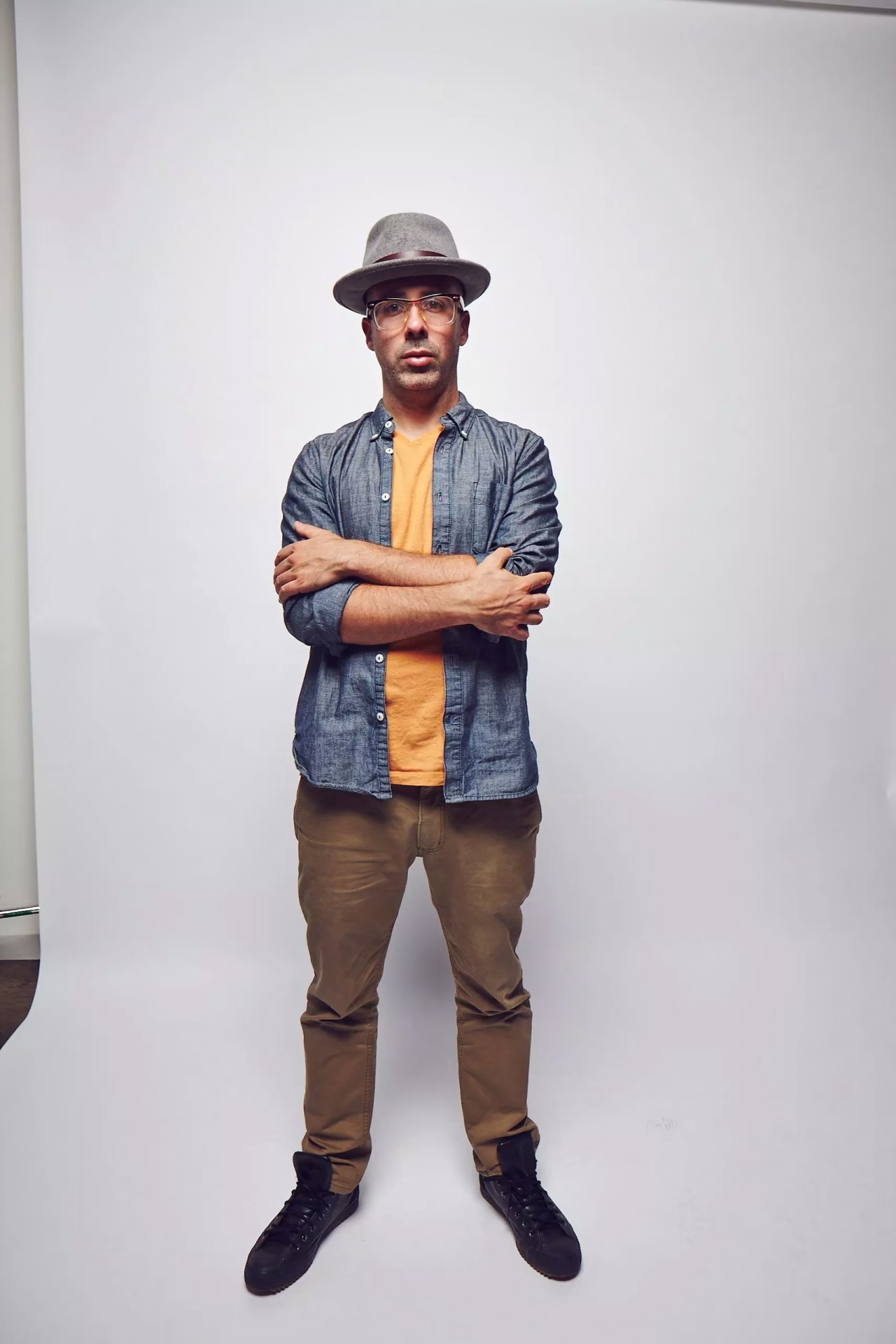
What does it take to make a living as a songwriter in today's music industry? The answer may surprise you. Multi-platinum songwriter, producer and keyboardist Sam Barsh would know. His smash-hit credits include co-writer on Aloe Blacc's "The Man," writer and keyboardist on Kendrick Lamar's To Pimp A Butterfly, contributions to albums by Anderson .Paak, BJ The Chicago Kid, Ledisi and many more.
We sat down with Barsh to hear his perspective from the front lines of music creating as a living, and his insights are powerful. Below, Barsh shines a light on the reality of making a living as a songwriter in the streaming age and provides valuable advice to aspiring songwriters and a glimpse at why all music creators can find optimism in the recently passed Music Modernization Act.
<iframe width="620" height="349" src="https://www.youtube.com/embed/AAuCMf14FzU" frameborder="0" allow="accelerometer; autoplay; encrypted-media; gyroscope; picture-in-picture" allowfullscreen></iframe>
As a major songwriter how has the streaming age affected your bottom line?
The biggest change that streaming has brought to the songwriting business is the replacement of physical or download sales with streaming, and the corresponding difference in revenue. Physical sales continue to disappear while streaming is the way of the present and the future.
The mechanical royalty payment for a physical or download sale of a song is $0.091 per sale, while the average streaming mechanical royalty payment is $0.00043 per stream. (The $0.00043 per stream figure is the average per stream payment from Spotify, which is the most used streaming platform in the US. Apple and Tidal pay more, Google pays less, so the Spotify number is a good median). And since songwriters have their rates set by the U.S Government, we can’t really go out and sell our songs to those services for what they should be worth.
The good news is the Music Modernization Act is set to change that [with the institution of a market-based "willing buyer, willing seller" standard], and that’s exciting and encouraging, but at the end of the day the new royalty rates will still be set by the government and as we’ve seen recently subject to appeals and court fights. So even though I have a catalog of over 100 songs, a large number of which are with major artists, including four songs featured on No. 1 albums on the Billboard 200 and multiple Gold and Platinum plaques, that doesn't translate into riches.
Could you go into more detail on the royalties you earn?
To paint a very clear picture of how most songwriters earn money from streaming, let's examine the “album cut,” or a song that wasn't a single, on a major platinum album.
Fifth Harmony's [second album] 7/27 is a perfect example to use, since it's an album by a huge act that has a lot of different songwriters on it… It's a quintessential professional pop songwriter album, if you will.
Like almost every platinum album, 7/27 was led by its singles. On Spotify, “Work from Home” has almost 900 million streams, “All in My Head (Flex)” has close to 300 million, and “That's My Girl” has 130 million plus.
By contrast, seven of the songs on the album have less than 22 million streams each on Spotify. Taking into account that Spotify has a little less than 40 percent market share for streaming, let’s just approximate that each of those seven album cuts streamed 50 million times total across all platforms.
With the average streaming rate mentioned before of $0.00043 per stream, that means a song with 50 million streams earns $21,500. With an average of 5 writers per song on 7/27, assuming in this case that they all got even splits, each writer on one of these cuts would earn around $4,300 from streaming.
Considering that album cuts are much less likely to get major sync licenses or radio play, in many cases that $4,300 is practically all the songwriter will make from landing a song with an A-list pop act. Of course, artists like Fifth Harmony still sell some physical copies, but that is a small number in the scheme of overall sales. And keep in mind that there are songs on major platinum albums with WAY less than 50 million streams. Also, most writers have either an admin deal or a publishing deal, which will take anywhere from 10 to 50 percent of their earnings.
Contrast this with if Fifth Harmony had released this album in 2003 with the same numbers. For the entire CD era, if people wanted to buy an artist's single, they would purchase the album that the song was on. Given that “Work From Home” went 5x Platinum in the USA alone, for this purpose we'll assume people would have purchased 5 million copies of the album. With a statutory mechanical rate at that time of around 9 cents per song, each song on the album would have generated $450,000 from U.S. sales, with the individual songwriter's 20 percent of one song earning them $90,000 in US mechanicals alone, as opposed to today's number of $4,300 from the entire world.
This analysis is not an exact science, but it paints the picture of how things have changed.
In light of the difficulties of earning a living in the streaming age, what would you say to an aspiring hit songwriter?
First of all, I would say don’t quit writing songs if that's what you love to do. It’s part of our DNA as writers to create songs, and it is a hell of a lot more fun than most other things people do for a living. However, if you’re in it just to chase hits and make money, you need to know what the stakes are.
Be forewarned that if your primary goal in becoming a songwriter is to get rich, your odds are infinitesimal. You’re not only competing with millions of writers for one of the top 30-50 songs (the songs that generally make real money), you also have to account for the fact that most hits today have between three and six writers on them, so the pie is divided accordingly.
Also, the concept of an “evergreen” copyright has changed, since streaming has put a major dent into catalog sales for older songs.
"I was told recently by a legacy artist who had big hits in the 70s that their catalog royalties went down about 70 percent since streaming took over." -Sam Barsh
Given that most hit songs generate the majority of their revenue during a two to three-year peak period, you would have to write multiple hit singles and/or have a substantial percentage of a global super-smash to make the “set for life” money that many people think comes from writing just one hit song. It's definitely not impossible, but you can have a lot of success as a songwriter and still just be living royalty check to royalty check.
On the positive side, streaming is a great tool for artists. So if you're a writer/artist, self-releasing music is a way to both gain exposure and make money. It's much easier to get somebody to check out your music via streaming than it was when you just had to hope someone who never heard of you would randomly decide to buy your CD at the record store. And payments for the master side of recordings are about 10 times higher than mechanical streaming royalties for songwriters.
Lastly, for my musician friends that are dabbling in songwriting and production, know that you’re competing with people who do nothing but write songs and produce, and have been honing their craft with as much dedication as we have with our instruments. I myself have put in my 10,000 hours at least threefold, as a musician, a songwriter and as a producer and engineer. And it still took me 10 years of seriously working at songwriting to write major records.
<iframe width="620" height="349" src="https://www.youtube.com/embed/HroxIimJYHU" frameborder="0" allow="accelerometer; autoplay; encrypted-media; gyroscope; picture-in-picture" allowfullscreen></iframe>
What’s one tip you’d give that a young songwriter might not be aware of?
Be mindful of splits ahead of time. I recommend having a conversation with your co-writers directly, before getting management involved, whenever possible. That doesn’t always prevent somebody from tripping or going back on their word, but if you can communicate directly with your collaborators and agree on splits before the song gets placed or recorded, it will alleviate headaches later on.
You mentioned your role as a producer earlier. Can you talk a bit about what it’s like to be a producer?
One of my favorite things about being a producer is that it requires me to utilize the entire range of my musical, emotional and intellectual skill sets. I'm a people person, and every situation is different, so I always get an intrinsic feel for the energies in the room and do my best to facilitate a day of great work. Making the artists, writers, musicians, engineers and anyone else who happens to be in the room feel comfortable and stay focused is essential, because most of the time they're looking to the producer to set, or at least guide, the tone of the session.
All that being said, nowadays producers spend a lot of time working alone. In modern pop, hip-hop and R&B music, producers are responsible for creating the instrumental tracks, hiring outside musicians if necessary, recording and editing the vocals (sometimes with help of engineers and vocal producers), editing audio, adding effects, making requested changes from artists and labels, and delivering a quality rough mix and individual audio files (aka stems). In my experience, the average pop track takes a producer 30-50 hours to complete, often more.
I produce jazz records as well, which tend to take less time because in most cases the artist has selected the material and gotten the arrangements done in advance of the session, and the recordings are usually done by a live band all at once in the span of 2-3 days. Jazz producing is largely about time management and setting a good vibe in the tracking sessions, helping the artist pick takes and solos, and shaping the sound of the instruments in conjunction with the tracking and mix engineers.
For all of this work, producers receive an upfront fee upon delivery of the final product and a backend royalty [The Music Modernization Act guarantees direct payment of this royalty if you register with SoundExchange]. Despite the fact that a lot of people may not understand all it is that we do, as you can see from the amount of skill and time it requires to create and take a record across the finish line, the work of a producer has big-time value and should be treated as such.
Lastly, what can songwriters do to ensure their rights are protected and demand better compensation?
There’s no union for songwriters, but there are organizations like the Recording Academy or Songwriters of North America that we can join that fight for our rights and compensation. These groups were instrumental in getting the Music Modernization Act passed.
However, even with these groups fighting for our rights, according to US law anybody can record any song without permission, and any terrestrial or streaming radio station can play any recording without permission, as long as they pay the statutory rate of compensation to the rights holders. Without the ability to withhold the product, and with compensation rates set by government, we don’t have much leverage in that fight.
The exceptions to this are for the first recording of a song, and for sync licensing in film, television and commercials.
If you write a song that you believe is a smash meant for a major artist, but a label wants to have an unknown artist record it, or an indie artist wants to record it, you have the right to say no, as long as the song has never been officially released on another recording. However, once the song has been recorded and released, anyone has the right to record it again.
And if someone wants to license your song for a show, film or commercial, you have the right to negotiate the fee or to say no.
The underlying theme of all of this is that knowledge is power. The more we all stay aware of the realities of our business and communicate with each other, the better off we all will be. Earning money as a songwriter or music producer is the definition of art intersecting commerce, but a lot of us ignore the commerce part of it. Nobody would accept a job in another field without knowing how much it paid first, and a contractor wouldn't build a custom home for a client without first negotiating a price. If we can approach our work the same way, it could go a long way to convincing our clients and consumers to acknowledge the value of our work.
The opinions expressed are those of the writer and do not necessarily reflect official positions of the Recording Academy.
GRAMMYs On The Hill 2019: Music & Politics Unite At Washington's Largest Advocacy Event For Music