The Recording Academy continues to work across the country to protect creators from being exploited or manipulated by artificial intelligence (AI).
Last week, attention was focused on the Illinois General Assembly, where hearings in both the House and Senate dove into HB 4875/SB 3325, critical legislation protecting the right of musicians and artists to control their image, likeness, and voice. The legislation, which has been championed by the Recording Academy since its inception, is sponsored by Rep. Gong-Gershowitz and Senator Edly-Allen and seeks to address the challenges posed by AI for creatives.
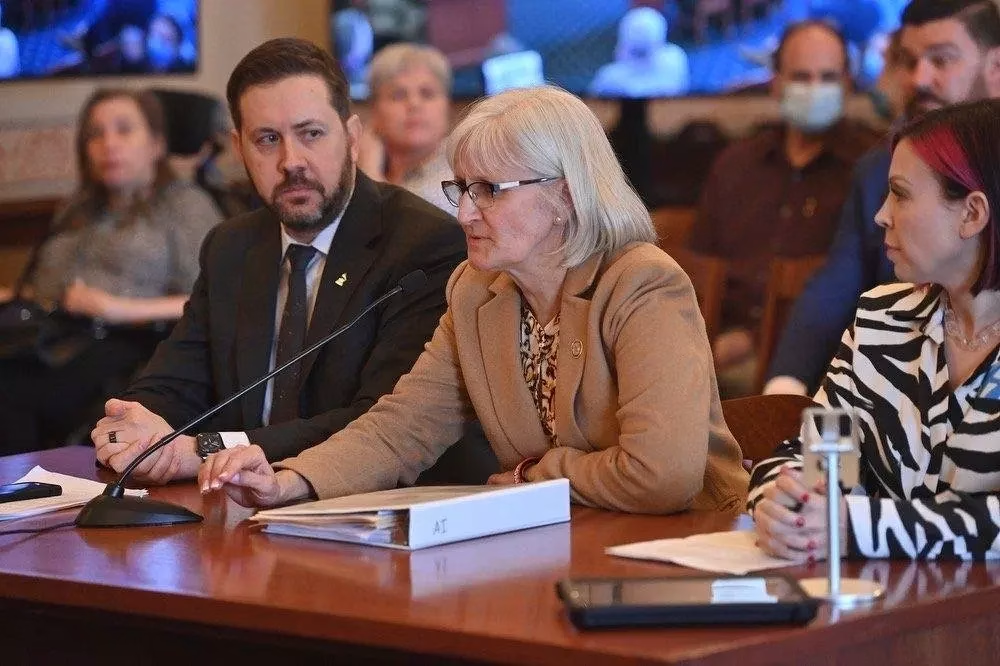
Among the witnesses who testified at the two hearings were Recording Academy Chicago Chapter Board Members Jeff Becker and Dani Deahl. Becker is an attorney and Chair of the Entertainment and Media Law Practice Group at Swanson, Martin & Bell and Deahl is a prominent artist, DJ, and producer based in Chicago.
HB 4875/SB 3325 represents a crucial step towards modernizing Illinois's Right of Publicity Act for the AI era. By granting additional enforcement rights and remedies, the bill aims to shield musicians from exploitation by generative AI systems. While existing copyright laws offer some protection, the amendments directly address gaps in safeguarding an artist's name, image, likeness, and voice.
During his testimony, Becker emphasized the urgency of updating existing laws to accommodate the rapid advancements in technology. He expressed, "As technology has evolved, our law must adapt to keep up. Specifically, artificial intelligence has provided new ways for people to have their image, likeness, and voice exploited in a manner that our current law didn't contemplate."
Deahl echoed these sentiments, emphasizing the importance of safeguards to prevent the abuse of AI technology. "As we embrace AI's potential, we must also be prepared for the risks it presents that are already here. The clearest example of these risks is the ability of AI to steal people's images and voices. I myself have had the unsettling experience of hearing my voice replicated by AI, delivering messages I never endorsed. This violation of identity is a profound invasion of personal autonomy."
The legislation addresses a pressing concern for musicians in Illinois – the rise of digital replicas that impersonate their unique voices and likenesses without consent. This phenomenon poses a significant threat to artistic integrity and individual rights.
"Nothing is more fundamental to each of us than our identities, and everyone should have the right to decide what words come out of their mouths and how their likeness is used," Deahl remarked.
During questioning in the House hearing for HB 4875, Becker clarified the legislation stating, "The violation is utilizing technology to imitate somebody else. If you're trying to sound like somebody else and make money selling music sounding like that other person, that's the violation."
The bills received overwhelming support in both committees and will next move to the House floor for a vote by the full Illinois House of Representatives.
Illinois boasts a rich and diverse music community, contributing significantly to the state's cultural and economic landscape. With nearly 65,000 jobs supported by the industry and a GDP contribution exceeding $4 billion annually, the stakes for protecting artists' rights are high. From iconic venues to world-renowned festivals like Lollapalooza, Illinois has nurtured legendary talents and continues to be a hub of musical innovation.
Join the Recording Academy in supporting the passage of HB 4875/SB 3325, a critical piece of legislation to safeguard the integrity and rights of Illinois musicians. Send a message to Illinois lawmakers through our action center. Your support has the opportunity to ensure artists remain in control over their identities and creative output in the age of AI.