
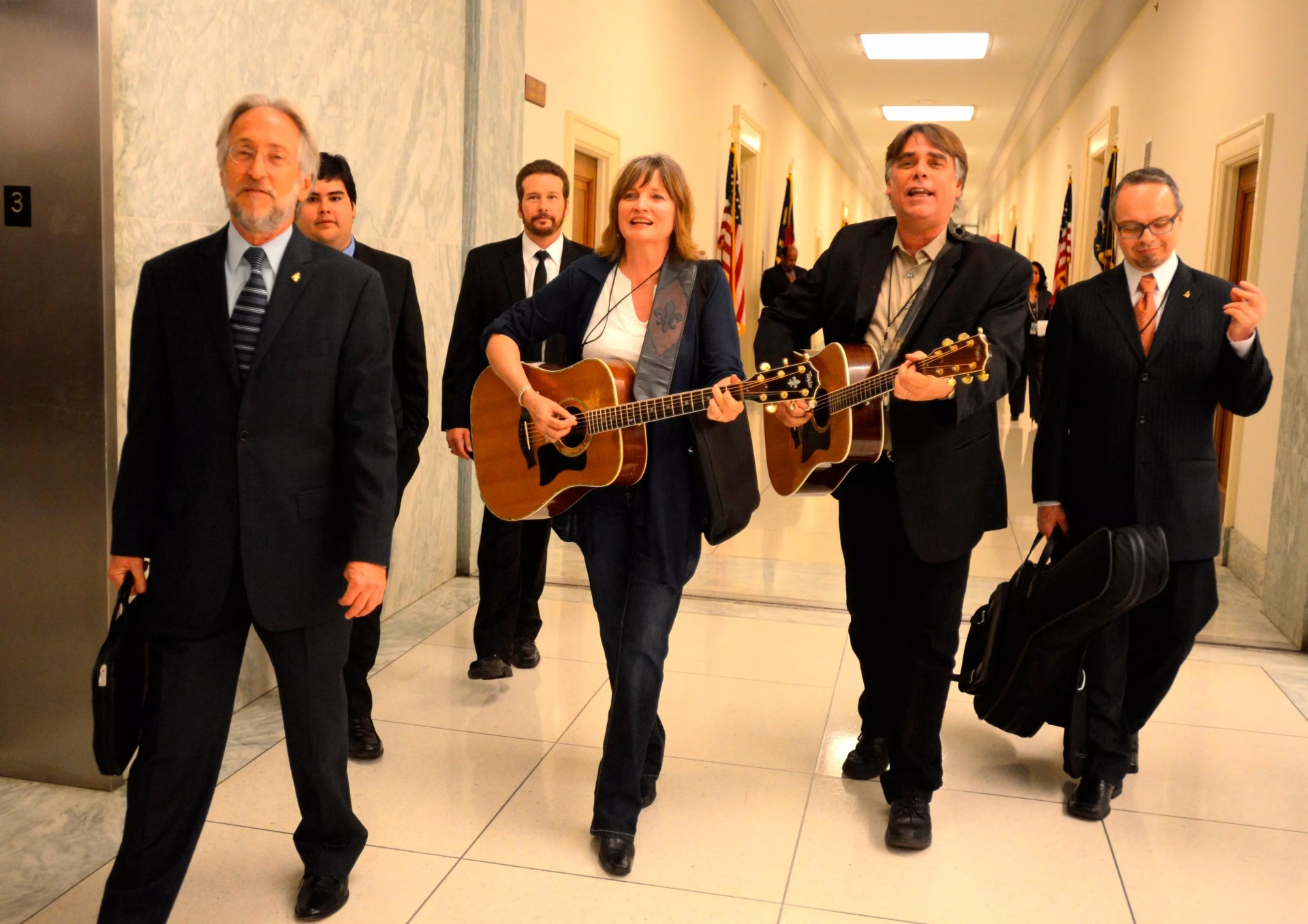
Last month, this blog recounted how hundreds of music creators and Recording Academy members descended on the nation’s capital for GRAMMYs on the Hill Advocacy Day. Hundreds more reached out to Members of Congress in their home districts last year for the inaugural GRAMMYs in My District. And so far this year, thousands of music creators and music fans have sent emails to Congress and flooded social media through the Academy’s online tools and through our partners at the musicFIRST Coalition.
Real people, real advocacy.
Whether it’s in Washington, D.C., in local congressional districts, or online, the message is both clear and simple: all music creators deserve fair compensation whenever and wherever their work is used. It’s not surprising that thousands of voices have risen up for basic fairness. It’s also not surprising that those who have an interest in keeping the status quo – big corporate broadcasters and Internet giants – are unable to muster the same kind of authentic, grassroots support for their cause. What is surprising is the lengths they’ve gone to convince us otherwise.
The newly formed Mic Coalition purports to be for a “rational, sustainable and transparent” music industry in service to the needs and wants of consumers. In reality, it’s a manufactured interest group led by a who’s who of corporate interests – including the National Association of Broadcasters, iHeartMedia, Google, Amazon, and Pandora – that are all committed to resisting the call for fair music royalties for creators. Under the guise of keeping music “affordable” and “accessible,” the coalition’s mission is fear-mongering, warning that modernizing music licensing laws to ensure fairness will somehow destroy their billion-dollar businesses. The Mic Coalition has already been rightly dismissed as the “McCoalition” for its corporate underpinnings.
The new Re:Create Coalition requires a little more effort to look behind the curtain. On its website, the coalition states principles that sound good. After paying lip service to creativity, the coalition espouses the principles of balance, freedom and clarity in copyright law. But for this coalition, “balance” really means to weaken copyright law; “freedom” is about securing the freedom to use someone else’s work; and “clarity” only seeks clear limits on the rights of creators. The Re:Create Coalition includes the Consumer Electronic Association, the Computer & Communications Industry Association, Public Knowledge, and the Electronic Frontier Foundation, each an organization that counts tech giant Google as either a member or a supporter.
During World War II, a secret unit of the U.S. Army was deployed in Europe to fool the enemy about troop strength and movements. The “Ghost Army” used inflatable tanks, special sound effects, fake radio communications, and more to convince the Germans that massive infantry and artillery units existed where there were none. The effort was a rousing success and a testament to American ingenuity and creativity. Perhaps inspired by history, Big Radio and Big Tech think they can fool us with their own fabricated ghost armies.
The efforts of The Recording Academy’s 24,000-strong membership and other like-minded allies have stirred up some mighty big guns, the best that money can buy. But like the rubber tanks that sat on the front lines in Europe 70 years ago, those guns aren’t real; they’re filled with hot air. These fake coalitions can’t match the real voices of music creators and music fans that are committed to basic fairness.
Make sure your voice is heard too. Take a moment right now to ask Congress to update our music laws to provide fairness for creators: grmypro.co/updatemusiclaw
