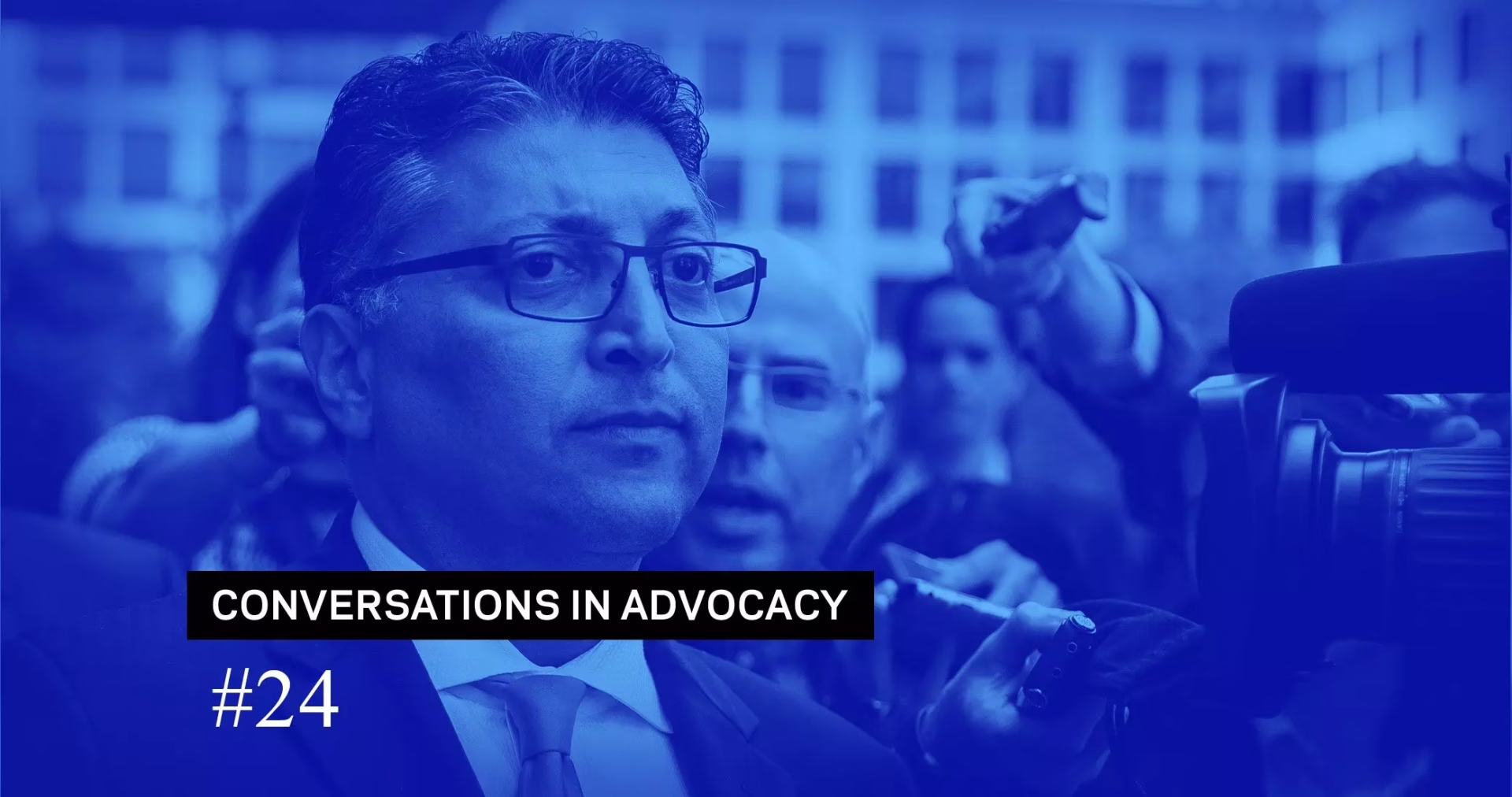
"Assistant Attorney General Makan Delrahim voiced support for the Music Moderization Act during the recent National Music Publishers Association meeting, another good sign this critical legislation will make its way through Congress soon." — Conversations In Advocacy #24
At the 2018 National Music Publishers Association annual meeting in New York City on June 13, Department of Justice Assistant Attorney General Makan Delrahim addressed attendees in a keynote speech. Prefacing his remarks with his love of music while framing its unique role in our culture, he proceeded to expand on regulatory ideas he expressed in March at Vanderbilt Law School. Overseeing his agency's Antitrust Division, Delrahim faces the complex job of ensuring consent decrees governing music licensing remain relevant, as regulations.
Returning to his previous topic of the 1,300 consent decrees presently in force and the need to review them for relevance, Delrahim promised nothing either way for stakeholders for and against the current system of regulation. "Some have commented that because the industry has grown up around these … decrees, they should never be changed, apparently ever," he quipped. In addition to his love of music, he committed to consistently approaching the questions of relevance by considering innovation, regulation and competition. "Protecting competitive markets in which innovation and consumers thrive" is how Delrahim summed these up.
Delrahim borrowed from the philosophy of author Nassim Nicholas Taleb to dub the music business, with respect to innovation, as "antifragile." "Things that are antifragile … actually thrive in change and they grow stronger with stress," he said. "The more things develop and change, the stronger the music business seems to grow, and we are all better off for that."
Although streaming presents different immediate challenges than those the blanket license solved decades ago, prediction is not the goal. "We aren't anywhere close to the end of the road," said Delrahim. "Markets and technology will continue to develop as music evolves with them. We can't imagine what that future holds, but we embrace it."
"In the 1930s, the Antitrust Division became concerned about the competitive effects of exclusive blanket licenses, and it sued ASCAP under the antitrust laws," he said summarizing the legacy state-of-affairs today. "In 1941, ASCAP settled that lawsuit, and BMI entered into a separate, but similar settlement. The resulting consent decrees, with some modifications over the years, still regulate most aspects of public performance licensing today, more than 75 years later."
Delrahim said the recent litigation over full versus fractional works licensing revealed that the Antitrust Division does not have a smooth path, simply choosing options that superficially seem pro-competitive. Saying, "The core mission of the Antitrust Division is to protect and preserve this kind of competition," Delrahim used the GRAMMY Awards as an example that musical competition is thriving.
Although some feared his equanimity meant swift and hasty action to upend the consent decrees in a potentially disruptive fashion, Delrahim sought to reassure stakeholders that DOJ would undertake a careful, measured consideration of the issues: "The Antitrust Division has not reached any conclusion about whether the ASCAP and BMI decrees strike the best balance among competition, innovation, and regulation." Billboard observed that as soon as the speech concluded, a group in favor of keeping the decrees released a statement. What Delrahim went on to say, however, is likely more significant.
"Congress … is also paying proper attention to the industry," Delrahim continued. "It is taking a hard look at the Music Modernization Act, and we look forward to seeing that legislation enacted and the results of those changes, which have involved several years of process and input from various interested parties."
In other words, the Department of Justice Antitrust Division knows what stakeholders across the creative and internet industries agree, the MMA provides overdue copyright law reform, providing an improved platform from which to consider other issues, including those old consent decrees.
Contact Your Senators: Tell Them To Support Comprehensive Music Reform
"Conversations in Advocacy" is your weekend digital tip sheet on music advocacy and the policies that affect music makers and their craft. New installments post every Friday.