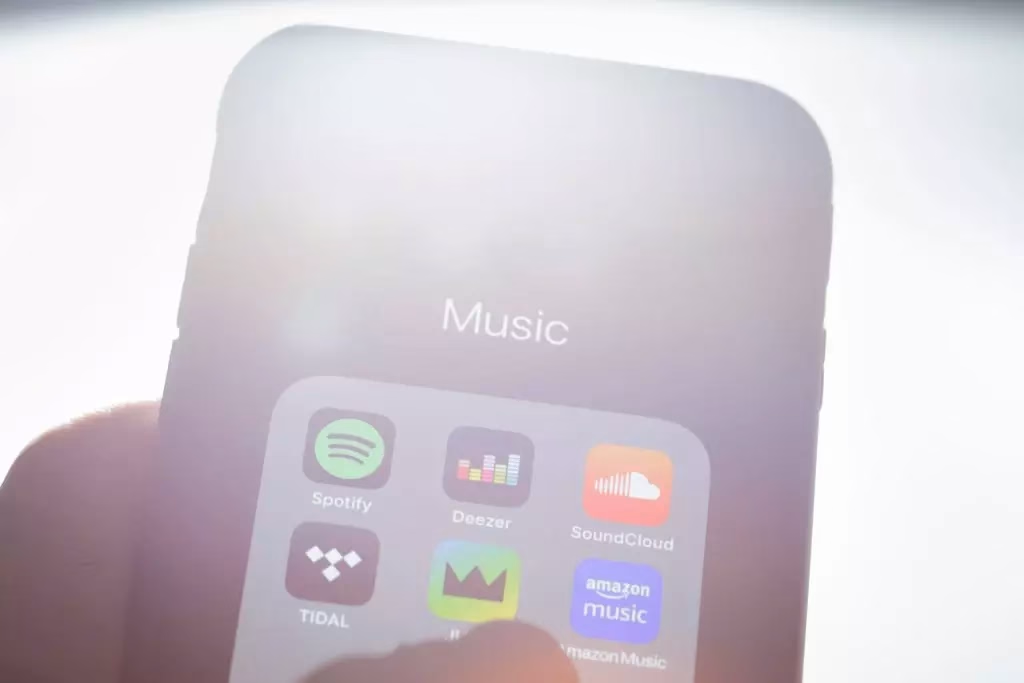
Music's big three labels had a landmark year in 2018. Reviewing data compiled by Music Business Worldwide, Rolling Stone reported $19 million per day of major label revenue from streaming in 2018, which can easily be considered as a massive triumph for major labels. Thanks to the Music Modernization Act, which was signed into law last year, this money will not only be shared with the artists but a fair market share will now go to the songwriters, too.
This is good news all around for monetizing the new industry. Looking at reported revenue from Sony, Universal and Warner, MBW tallied more than $6.9 billion in 2018 revenue from streaming. Compared to 2017's total of $5.3 billion, that is a $1.6 billion increase. These figures prove that, even in the music business economy where technical innovation can outpace due compensation legislation, there is real growth to be made.
But as streaming platforms find their footing, older formats struggle to evolve. In what has become a meaningful tradition for radio broadcasters, Congress has reintroduced the Local Radio Freedom Act (LRFA) once again, a resolution seeking to exempt broadcast stations from the burden of paying musical performers anything for playing their recordings. Meanwhile in the same world where streaming and innovation have made growing revenues real, it seems hard to believe that the past is a safe guide for terrestrial radio’s future, but still believers in LRFA seem to reject doing things differently.
On Feb. 14, the non-binding Local Radio Freedom Act was introduced into the Senate with its House companion introduced on Feb. 19. The National Association of Broadcasters expressed the gratitude of “America’s hometown broadcasters” on Feb. 20 in support of LRFA resolutions. However, this is a strange ritual that continues Congress after Congress in an attempt to deny paying artists, musicians and producers for the use of their sound recordings. The resolution seeks to entrench the U.S. as the only free market country in the world without a performance right for artists, joining North Korea, Iran, and China. As the industry, and the world, embrace innovative new platforms that benefit artists, platforms and fans, the radio industry doubles-down on outdated laws and technologies.
Music Business Worldwide's report also shows declining physical sales, which is nothing new, but its numbers surrounding streaming give cause for hope in fairly monetizing and compensating the platforms replacing physical. Radio, on the other hand, has seemed to resist this type of progress. Holding back an industry and then using its money troubles as a reason to fight change is what the LRFA stands for, not love of radio.