
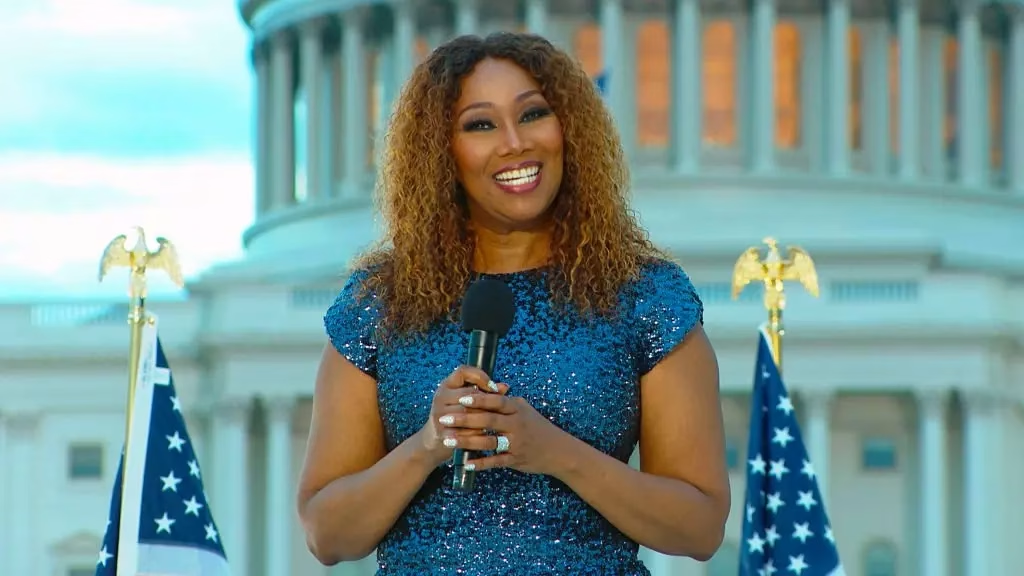
No one knows more about the importance of intellectual property rights than the creators who rely on their creative work to make a living. This morning, four-time GRAMMY winning singer/songwriter and Recording Academy Trustee Yolanda Adams shared her first-hand experience and perspective on the topic of fair use, as the Senate Committee on the Judiciary’s Subcommittee on Intellectual Property held another Digital millennium Copyright Act (DMCA) hearing.
Today's hearing was titled “How Does the DMCA Contemplate Limitations and Exceptions Like Fair Use?” and was broadcast live on the Judiciary Committee’s website. Adams would provide key insight into what matters to music makers and how fair use affects their income.
Adams opened her remarks with a nod of respect to late Congressman and civil rights icon John Lewis, who was lying in state in the U.S. Capitol Rotunda prior to his funeral on Thursday in Atlanta. Adams continued, laying out the reality of the pandemic's effect on the live music industry and what that means for performers like herself. She explained how she relies on multiple income streams, as many music makers do, and that dried up live performance opportunities put even more emphasis on income from recording.
"In the digital landscape, where streams only bring fractions of a penny to the creators, we hope to monetize every use. This is where fair use comes in.," Adams said.
"When you hear a debate about fair use, it’s typically about monetization," Adams said. "And that’s important to me and my fellow Recording Academy members. If someone’s claim of fair use reduces the artists’ ability to earn a living, it should be treated as infringement, plain and simple."
Furthermore, in her written testimony, Adams reminded the Committee on how "fair use" philosophies have been weaponized by Big Radio to generate free programming for their highly profitable stations without paying the performers. At a similar hearing back in May, Harvey Mason jr. testified on behalf of the Academy and creators about how the Ask Musicians for Music (AM-FM) Act would fix the issue. Adams did not shy away from making sure the topic is still top of mind for the Committee.
"If we are truly concerned with 'fair use,' we cannot allow large commercial businesses to use recordings 24 hours a day, every day, without a cent of compensation to the artist." Adams said in her submitted testimony. "I know the long-standing radio performance right issue is not today’s topic, but it is this Committee’s jurisdiction. There is no use more unfair than exploiting an artists’ music without permission or compensation."
For her efforts, Ranking Member Chris Coons (D-DE) acknowledged Adams' efforts. Asking for an artist’s consent “was the main point made by the Queen, Ms. Yolanda Adams, the reigning Queen of Gospel," he said.
"I regret that we aren’t in person for many reasons," Coons continued. "You have many fans in my office and in the Senate that were hopefully about getting a chance to speak with you today. Your songs, like ‘Victory’ and ‘I Believe’ and ‘Open My Heart,’ have touched the hearts of many and is a reminder that the work of singers and songwriters touches people of all backgrounds and political persuasions. I wanted to thank you for bringing the heart of an artist and the soul of a songwriter to the testimony today.”
Ranking Member Coons' comments prove the effectiveness of artists taking a stand, literally. The Recording Academy has launched its Summer Of Advocacy, activating members across the country to engage their lawmakers about issues and policy affecting creators' livelihoods, now during the pandemic and for the future artists of all types who deserve to inherit a fair system where they may flourish. The summer-long program will culminate on Aug. 12 with the Academy's seventh annual District Advocate, the year's largest grassroots movement for music.
Take Action To Help Music Creators In Need Of COVID-19 Relief
